Norwegian road signs — with English translations and explanations
218 signs, 28 road markings and 11 light signals — each with its official code and name from skiltforskriften (the Norwegian Traffic Signs Regulations), English translation and clear explanation. This is the exact data used in the Teorix theory test trainer.
Updated: 2026-11-01
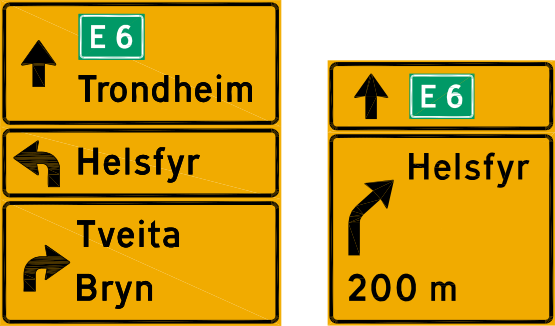
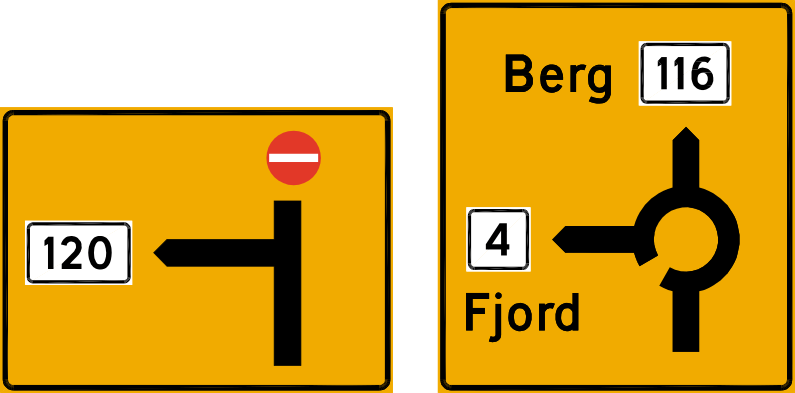
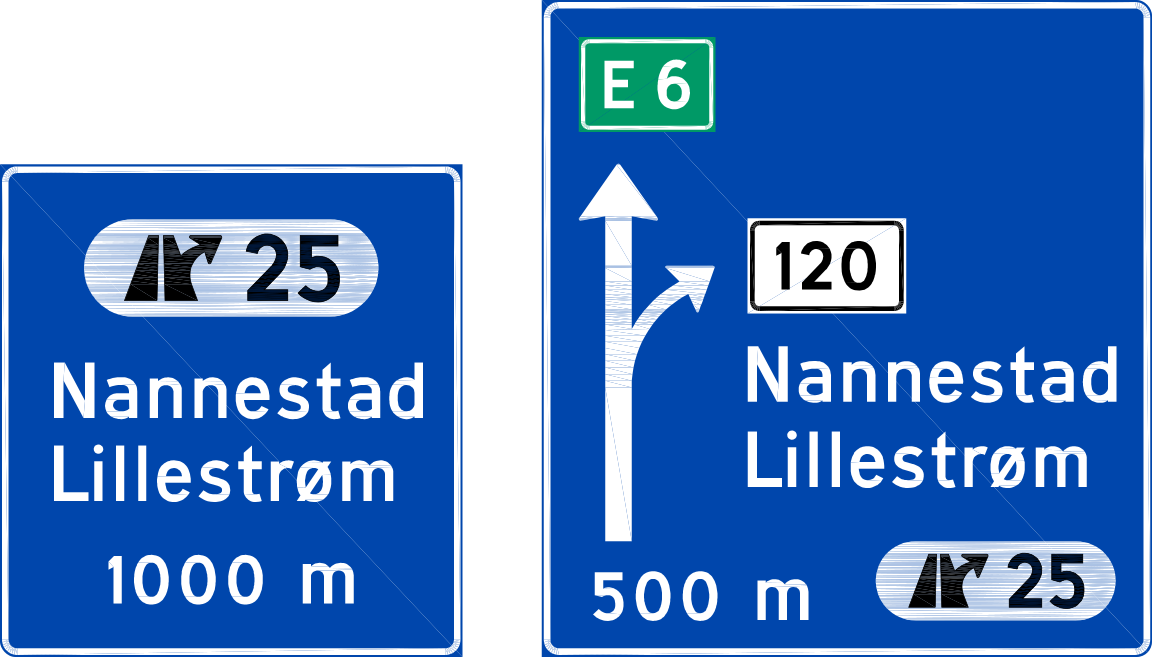
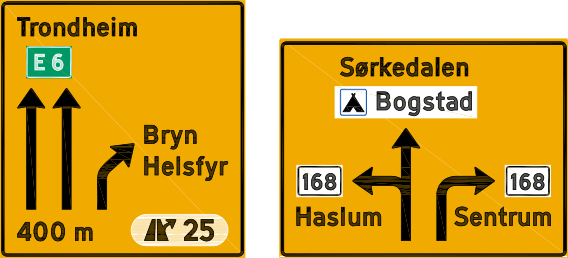
Signs are grouped by official statutory classes. Names are kept in Norwegian, as in skiltforskriften, with English translations and plain-language explanations alongside. This study catalogue contains the entries used by Teorix; the full statutory list, including direction signs (vegvisningsskilt) and supplementary plates (underskilt) can be referenced in skiltforskriften on Lovdata.
Warn of hazards ahead: sharp bends, steep gradients, animals on the road, junctions. When you see a fareskilt, reduce your speed and be prepared for what is shown on the sign. Class guide: warning signs — dedicated page
100
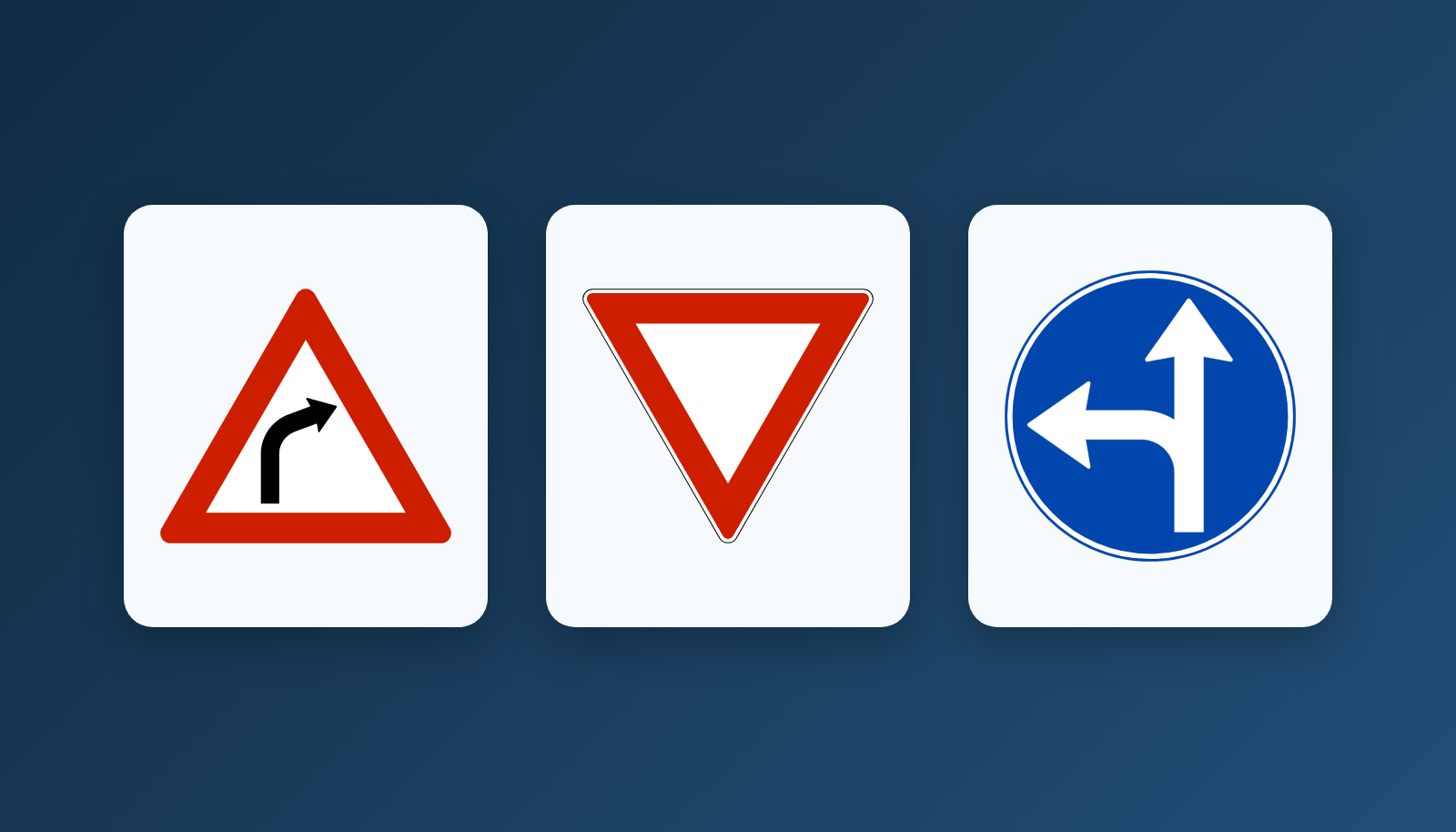
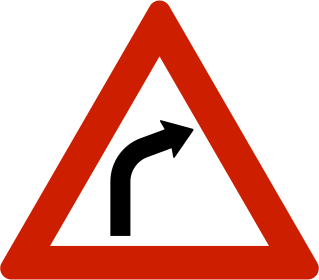
Farlig sving
Dangerous bend
Farlig sving (dangerous bend): a warning sign (fareskilt) alerting you to a dangerous bend ahead. Reduce speed and be prepared for the turn.
102
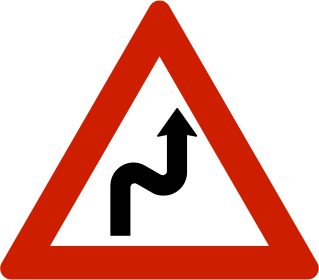
Farlige svinger
Dangerous bends
Farlige svinger (dangerous bends): a warning sign (fareskilt) alerting you to several dangerous bends in a row. Reduce speed and stay prepared.
104
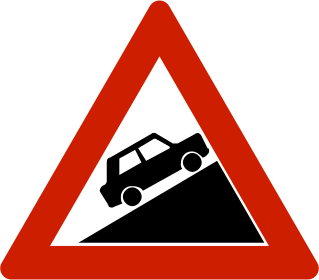
Bratt bakke
Steep hill
Bratt bakke (steep hill): a warning sign (fareskilt) alerting you to a steep hill (up or down). Adjust your speed and be prepared.
106
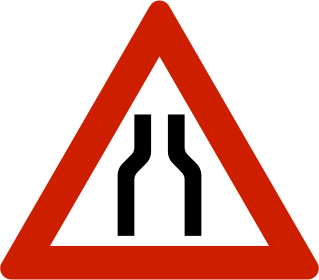
Smalere veg
Road narrows
Smalere veg (road narrows): a warning sign (fareskilt) alerting you that the road ahead becomes narrower. Adjust your speed and be prepared.
108
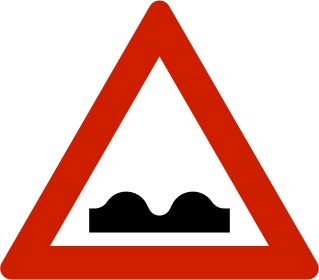
Ujevn veg
Uneven road
Ujevn veg (uneven road): a warning sign (fareskilt) alerting you to an uneven road surface ahead. Adjust your speed and be prepared.
109
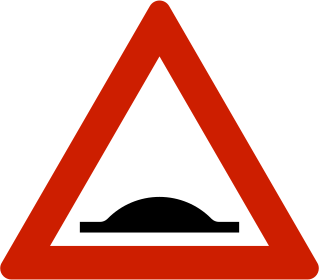
Fartshump
Speed bump
A warning sign (fareskilt) «Fartshump» warns of a speed hump in the road — slow down well before it.
110
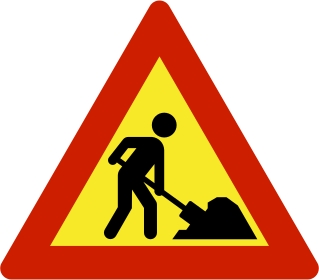
Vegarbeid
Road works
Vegarbeid (roadworks): a warning sign (fareskilt) alerting you to roadworks ahead. Reduce speed, be prepared, and watch out for workers and equipment.
112
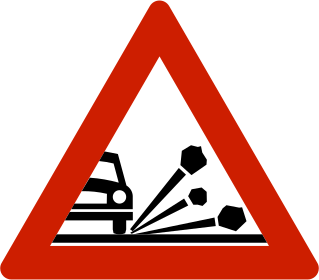
Steinsprut
Loose gravel
A warning sign (fareskilt), Steinsprut (loose chippings), warns that loose stones may be thrown up from the road — slow down and keep extra distance from the vehicle in front.
114
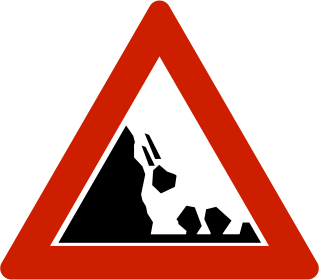
Rasfare
Danger of landslide
A warning sign (fareskilt) «Rasfare» warning of the danger of rockfall, landslide or snowslide, and that debris may lie on the roadway. Reduce speed, stay alert and be ready for obstacles on the road.
116
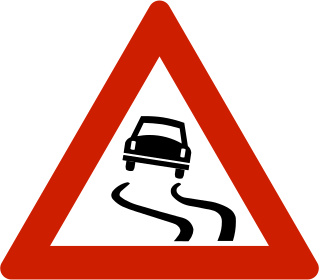
Glatt kjørebane
Slippery road
A warning sign (fareskilt) «Glatt kjørebane» warning of a slippery roadway due to special conditions. Adapt your speed and drive carefully.
117
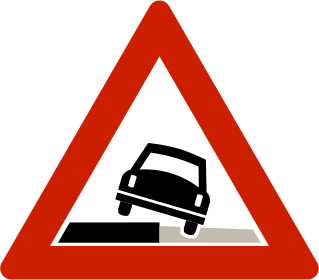
Farlig vegskulder
Dangerous road shoulder
A warning sign (fareskilt) «Farlig vegskulder» warns that the road shoulder is weak, soft or lower than the carriageway — keep well inside the carriageway.
118
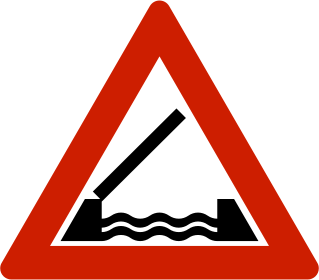
Bevegelig bru
Movable bridge
A warning sign (fareskilt) «Bevegelig bru» warns of a movable bridge that can open for boat traffic — be ready to stop and wait.
120
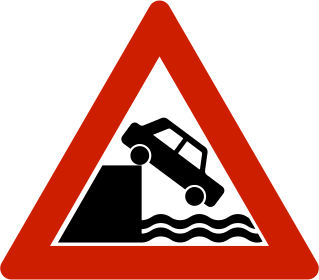
Kai, strand eller ferjeleie
Quay, beach or ferry landing
A warning sign (fareskilt) indicating a quay, shore or ferry landing. Pay particular attention to conditions at the location.
122
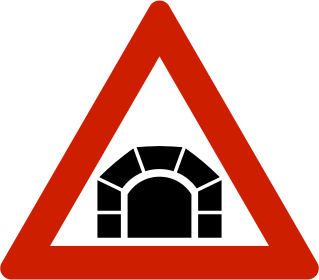
Tunnel
Tunnel
A warning sign (fareskilt) «Tunnel» warns of a tunnel ahead — put your lights on, take off sunglasses and keep a good distance.
124
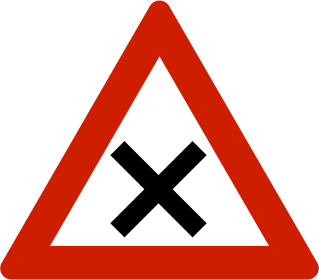
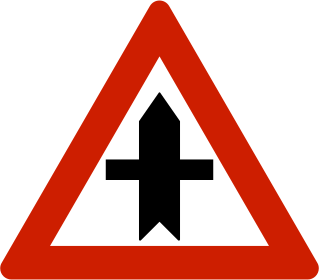
Farlig vegkryss
Dangerous intersection
A warning sign (fareskilt) «Farlig vegkryss» warning of a dangerous junction where the normal give-way rule (vikeplikt) applies to traffic coming from the right. Reduce speed and be ready to yield to traffic from the right.
126
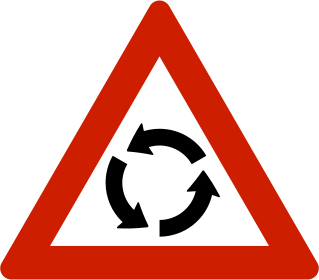
Rundkjøring
Roundabout
A warning sign (fareskilt) «Rundkjøring» warning that a roundabout is ahead. Reduce speed and be ready to adapt to the traffic in the roundabout (rundkjøring).
132
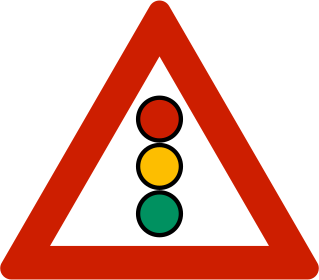
Trafikklyssignal
Traffic light signal
A warning sign (fareskilt) «Trafikklyssignal» warning that traffic lights are ahead. Reduce speed and be ready to stop for the signal.
134
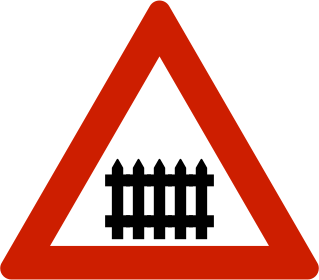
Planovergang med bom
Level crossing with barrier
A warning sign (fareskilt) «Planovergang med bom» warning of a railway level crossing with a barrier (bom). Reduce speed and be ready to stop when the barrier is down.
135
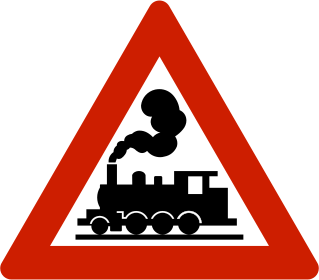
Planovergang uten bom
Level crossing without barrier
A warning sign (fareskilt) «Planovergang uten bom» warns of a railway level crossing without a barrier — slow down, look both ways for trains and be ready to stop.
136
Avstandsskilt
Distance sign
A warning sign (fareskilt) «Avstandsskilt» gives advance warning of a level crossing signed with 134 «Planovergang med bom» or 135 «Planovergang uten bom».
138
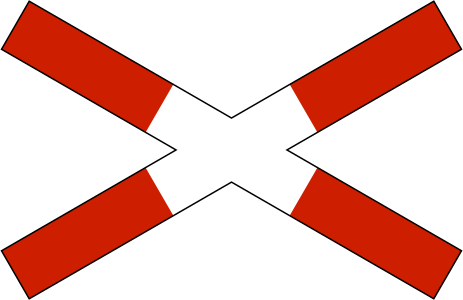
Jernbanespor
Railway track
A warning sign (fareskilt) «Jernbanespor» marks the point where a railway or suburban railway crosses the road at grade — 138.1 single track, 138.2 multiple tracks.
139
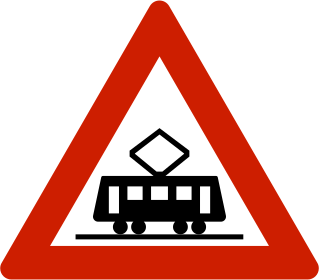
Sporvogn
Tram
A warning sign (fareskilt), Sporvogn (tram), warns of a tram (trikk) crossing or running in the road — remember that a tram has its own movement patterns and a long braking distance.
140
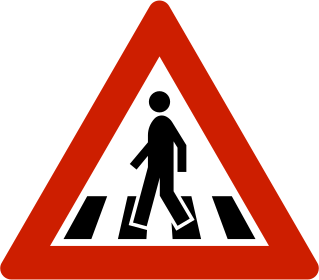
Avstand til gangfelt
Distance to pedestrian crossing
A warning sign (fareskilt) «Avstand til gangfelt» warns that a pedestrian crossing (gangfelt) is coming up — slow down and watch for pedestrians.
142
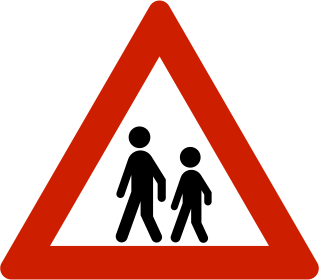
Barn
Children
A warning sign (fareskilt) «Barn» warning of a place on or along the road where children often move about or gather, e.g. near a school, kindergarten or playground. Reduce speed and be extra alert.
144
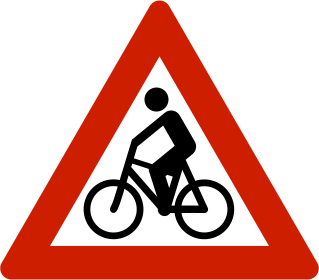
Syklende
Cyclists
A warning sign (fareskilt) «Syklende» warning of a place where cyclists often cross or enter the road, or of cyclists in a tunnel. Reduce speed and watch out for cyclists.
146
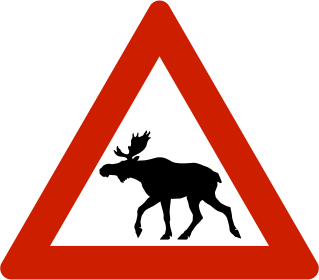
Dyr
Animals
A warning sign (fareskilt) «Dyr» warning that animals often cross or move along the road. Reduce speed and be ready for animals on the roadway.
148
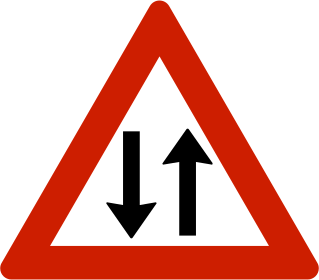
Møtende trafikk
Oncoming traffic
A warning sign (fareskilt) «Møtende trafikk» warning that the roadway carries traffic in both directions. Keep well to the right, reduce speed and be ready for oncoming vehicles.
149
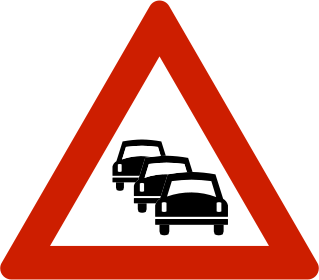
Kø
Queue
A warning sign (fareskilt) «Kø» warns of a stretch where queues often form — be ready for slow-moving or stationary traffic.
150
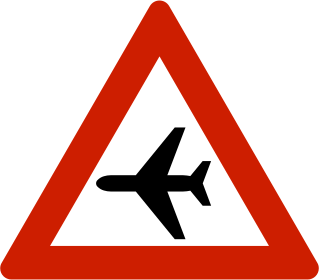
Fly
Aircraft
A warning sign (fareskilt) «Fly» warns that aircraft may fly low over or near the road — be ready for sudden noise and low-flying planes.
151
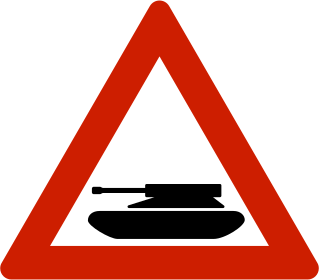
Militær aktivitet
Military activity
A warning sign (fareskilt) «Militær aktivitet» warns of military activity along the road — be ready for military vehicles and personnel.
152
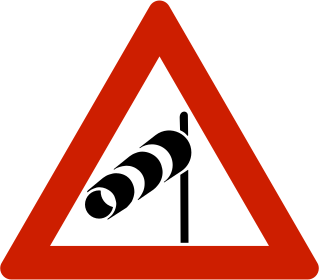
Sidevind
Side wind
A warning sign (fareskilt) «Sidevind» warns of a place with frequent strong crosswinds — hold the wheel firmly and slow down, especially with a trailer.
153
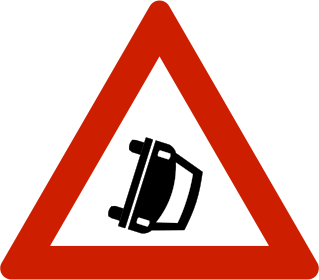
Trafikkulykke
Traffic accident
A warning sign (fareskilt) «Trafikkulykke» warns of a traffic accident ahead — slow down, follow instructions and be ready to stop.
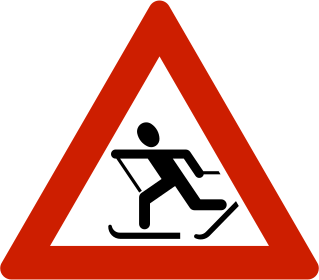
154
Skiløpere
Skiers
A warning sign (fareskilt) «Skiløpere» warns of a place where skiers often cross the road — slow down and be ready to stop.
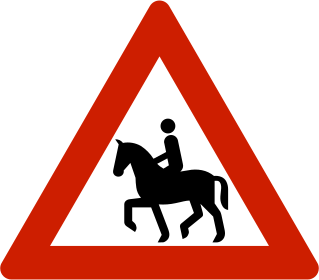
155
Ridende
Horse riders
A warning sign (fareskilt) «Ridende» warns of a place where riders often cross or ride onto the road — pass slowly and with plenty of room, as horses are easily startled.
156
Annen fare
Other danger
A warning sign (fareskilt) «Annen fare» warning of a hazard that has no sign of its own; the type of hazard is shown on the sub-sign (underskilt). Read the sub-sign, reduce speed and be prepared.
Vikeplikt- og forkjørsskilt — Priority and right-of-way signs
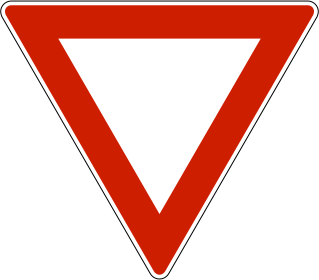
Vikeplikt means you must give way to traffic in both directions on the crossing road. You do not have to stop completely, but you must let traffic on the crossing road pass first.
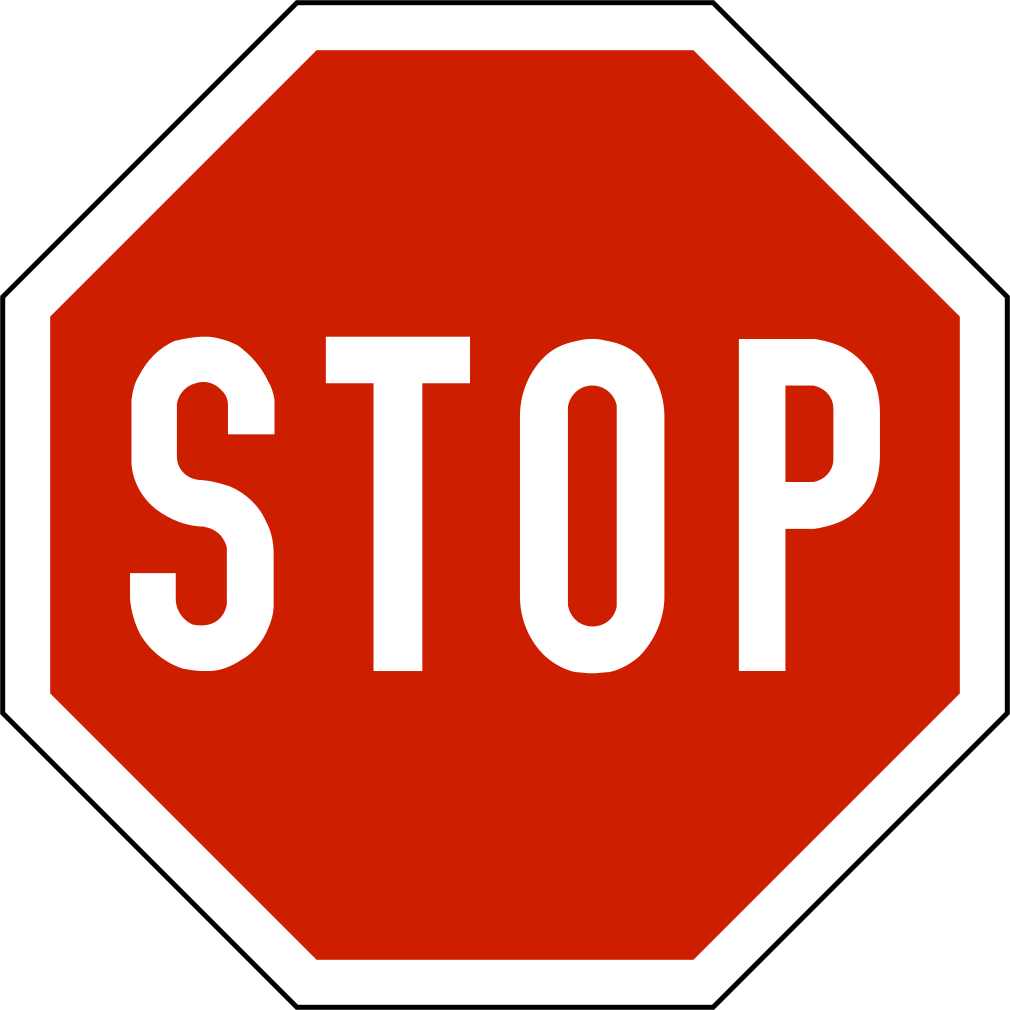
204
Stopp
Stop
Stopp means you must come to a full stop before entering the crossing road or crossing a level crossing, then give way to traffic in both directions or let a tram or train pass. Stop at the stop line, or as close to the crossing road as possible if there is no stop line.
206
Forkjørsveg
Priority road
A priority road (forkjørsveg) means drivers from side or crossing roads are required to give way by sign 202 “Vikeplikt” or 204 “Stopp”. It applies until cancelled by sign 208, 202 or 204. Nevertheless, in a lane with sign 531 “Felt for fartsøkning”, the traffic rules for acceleration lanes apply: the driver in the acceleration lane must adjust speed to traffic in the lane being entered, and drivers in that lane must facilitate leaving the acceleration lane.
208
Slutt på forkjørsveg
End of priority road
Slutt på forkjørsveg means your priority-road status ends. After this sign the normal give-way rules apply, and you can no longer count on having priority.
210
Forkjørskryss
Priority intersection
Forkjørskryss warns of a dangerous junction where traffic from side roads or crossing roads must give way to you (they have sign 202 «Vikeplikt» or 204 «Stopp»). Stay alert, but you have priority at the junction.
212
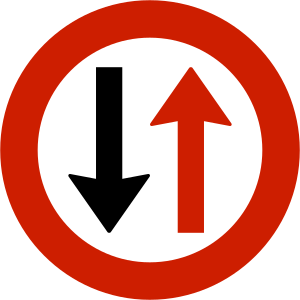
Vikeplikt overfor møtende kjørende
Give way to oncoming traffic
Vikeplikt overfor møtende kjørende means you may not enter a narrow stretch of road if doing so would obstruct oncoming traffic. You must wait and let oncoming vehicles pass first.
214
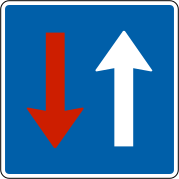
Møtende kjørende har vikeplikt
Oncoming traffic must give way
Møtende kjørende har vikeplikt means the oncoming traffic must give way to you (they have sign 212 «Vikeplikt overfor møtende kjørende»). You may drive through the narrow stretch first.
Forbudsskilt — Prohibitory signs
What is prohibited: entry, overtaking, stopping and parking, exceeding speed limits. As a general rule they apply up to the nearest junction, unless stated otherwise for a particular sign: read the description. Class guide: prohibitory signs — dedicated page
302
Innkjøring forbudt
No entry
Innkjøring forbudt means it is prohibited to drive past the sign. Cycling and using a small electric vehicle on the pavement may still take place in accordance with the traffic rules.
306.0
Forbudt for alle kjøretøy
No vehicles allowed
Forbudt for alle kjøretøy means it is prohibited to drive past the sign with any vehicle. The prohibition applies to all types of vehicle.
306.1
Forbudt for motorvogn med unntak av liten elektrisk motorvogn
No motor vehicles except small electric vehicles
Forbudt for motorvogn med unntak av liten elektrisk motorvogn means it is prohibited to drive past the sign with a motor vehicle, except a small electric vehicle, which is exempt from the prohibition.
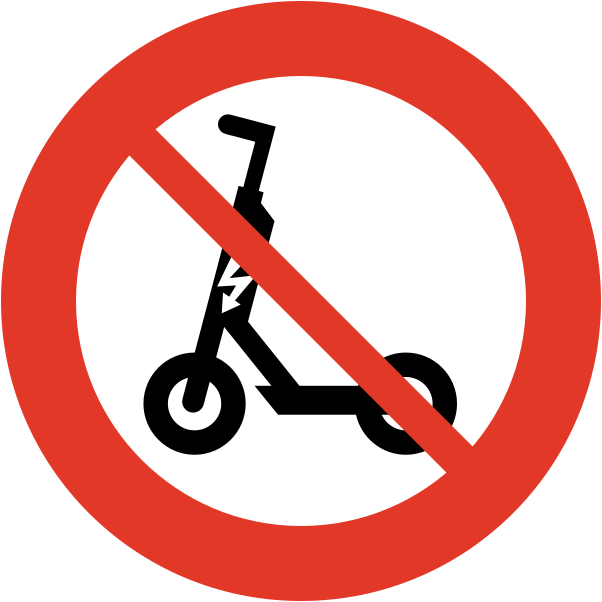
306.10
Forbudt for liten elektrisk motorvogn
No small electric vehicles
A prohibitory sign: no entry for a small electric vehicle (liten elektrisk motorvogn), on the road and on the pavement alike.
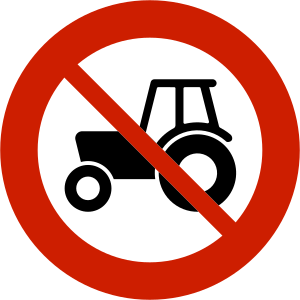
306.3
Forbudt for alle traktorer og for motorredskap konstruert for fart mindre enn 40 km/t.
No tractors or motorized equipment designed for speeds under 40 km/h
A prohibitory sign: no entry for any tractor or for motorised machinery built for speeds below 40 km/h.
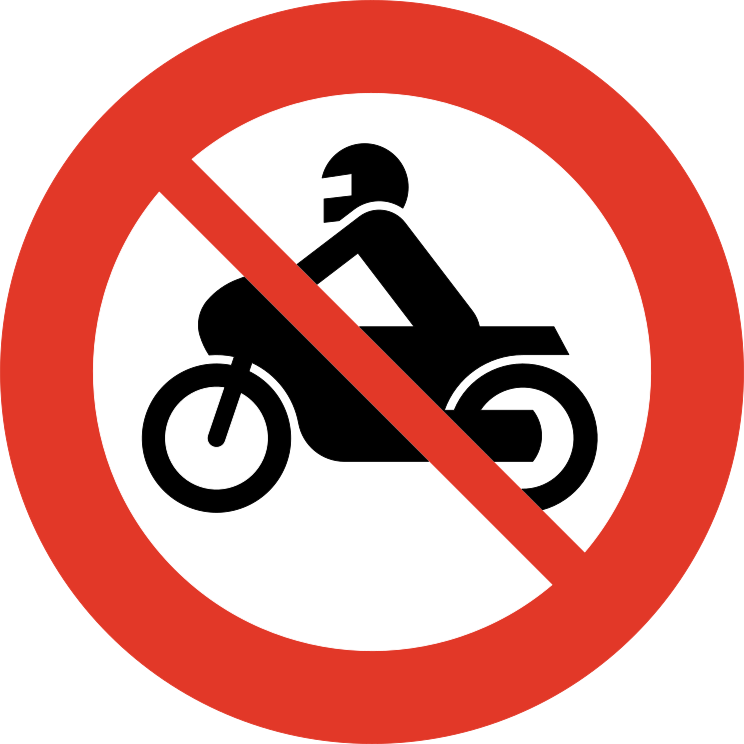
306.4
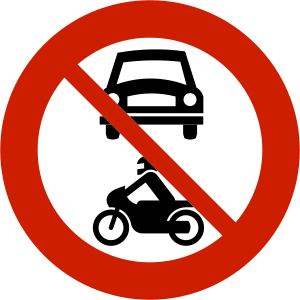
Forbudt for motorsykkel og moped
No motorcycles or mopeds
A prohibitory sign: no entry for motorcycles and mopeds — it does not apply to cars.
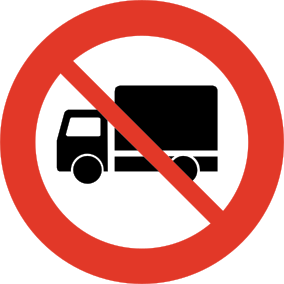
306.5
Forbudt for lastebil og trekkbil
No lorries or tractor units
A prohibitory sign: no entry for lorries and tractor units.
306.6
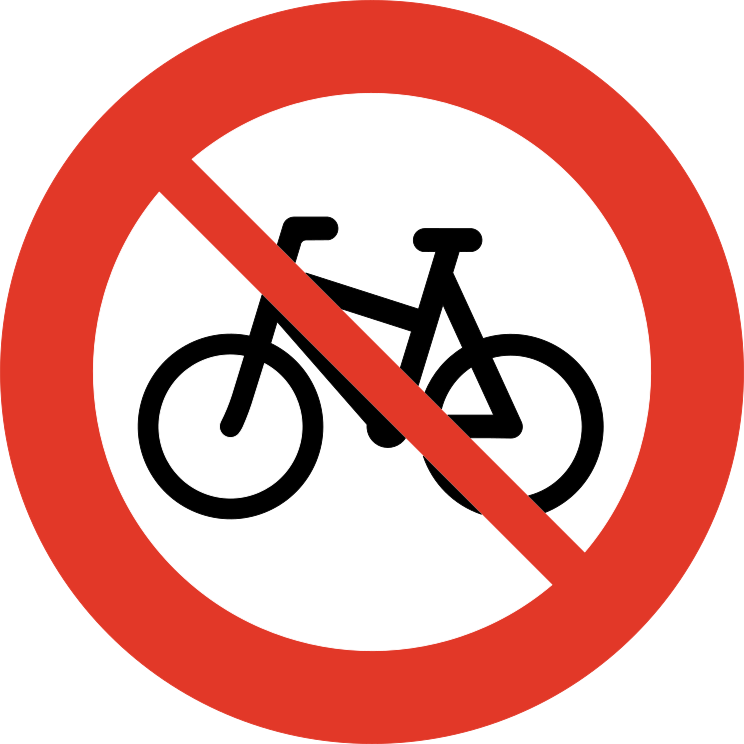
Forbudt for syklende og fører av liten elektrisk motorvogn
No cyclists or small electric vehicles
A prohibitory sign: no entry for cyclists or for riders of a small electric vehicle (liten elektrisk motorvogn, e.g. an e-scooter).
306.7
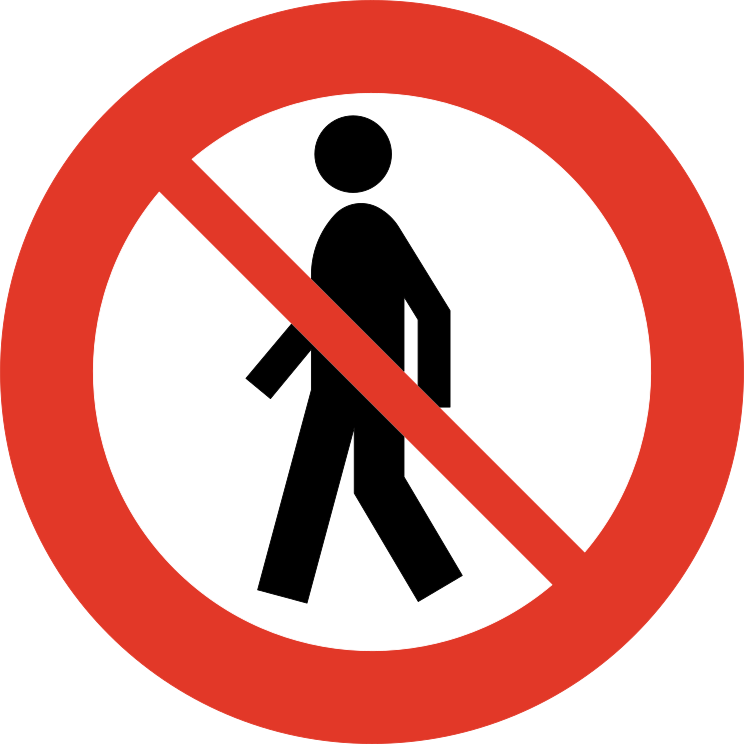
Forbudt for gående
No pedestrians
A prohibitory sign: no entry for pedestrians.
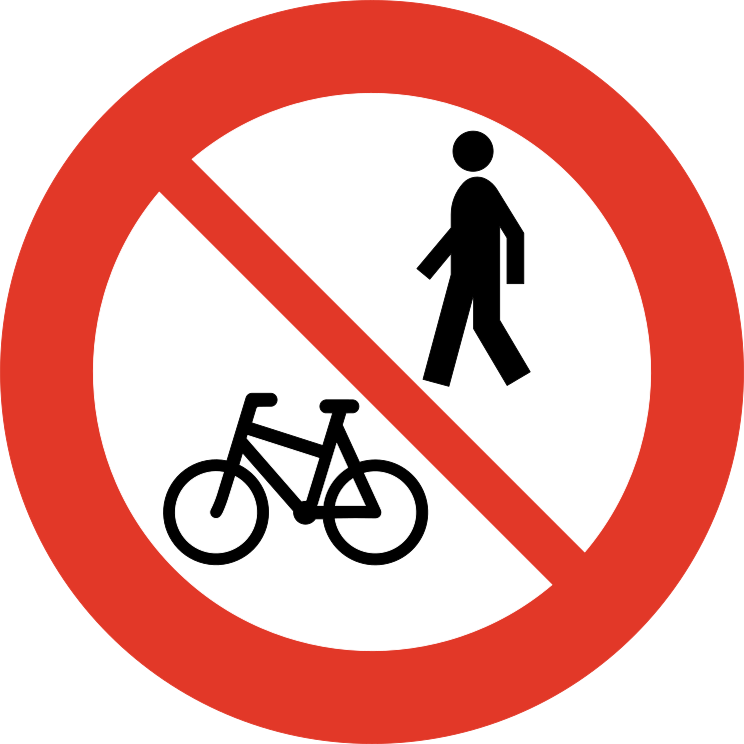
306.8
Forbudt for gående, syklende og fører av liten elektrisk motorvogn
No pedestrians, cyclists or drivers of small electric vehicles
A prohibitory sign: no entry for pedestrians, cyclists or riders of a small electric vehicle — typically at the entry to a motorveg or a tunnel.
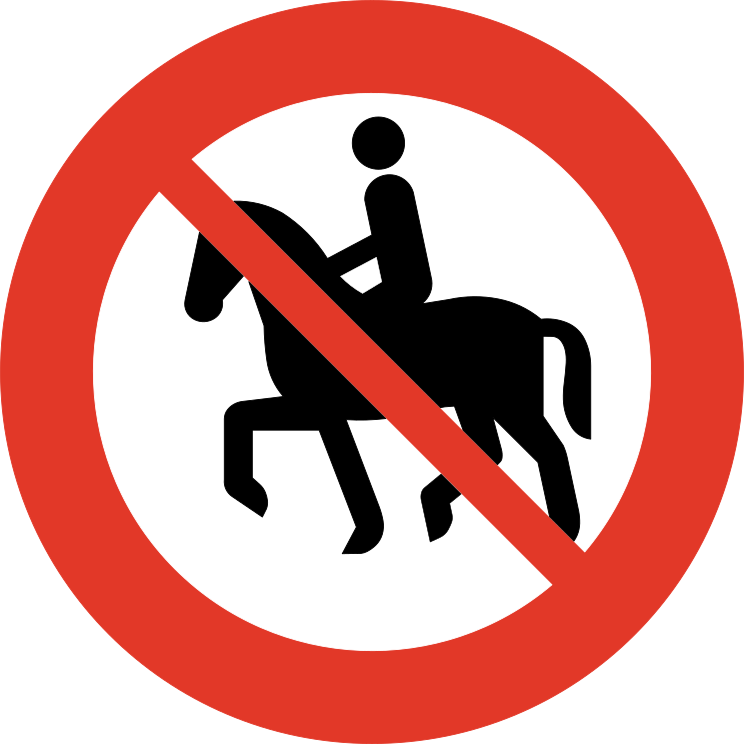
306.9
Forbudt for ridende
No horse riders
A prohibitory sign: no entry for horse riders.
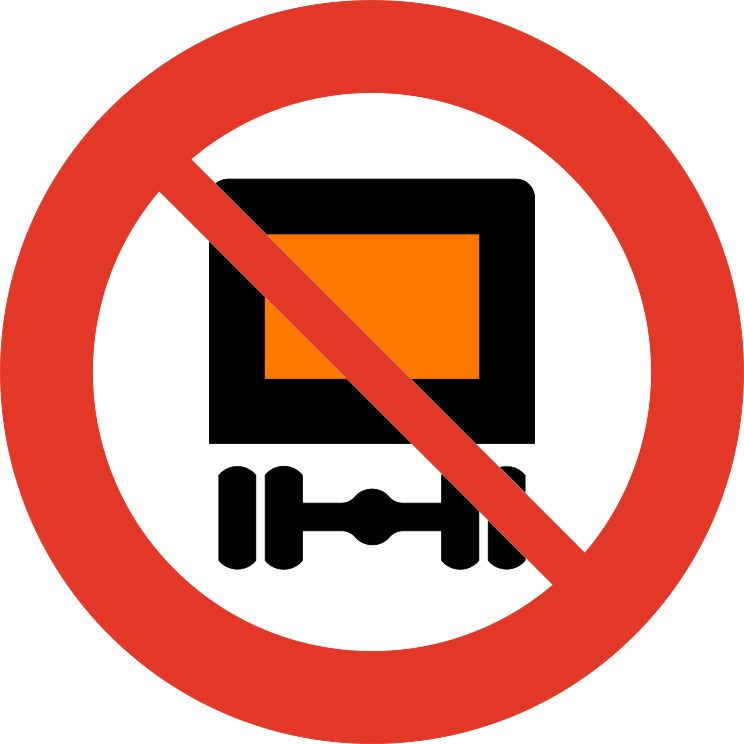
308
Forbudt for transport av farlig gods
No transport of dangerous goods
Forbudt for transport av farlig gods means the prohibition applies to vehicles carrying dangerous goods whose transport unit must display orange plates under ADR section 5.3.2. Where the prohibition applies to road tunnels, it covers the vehicles specified in ADR section 1.9.5.3.6.
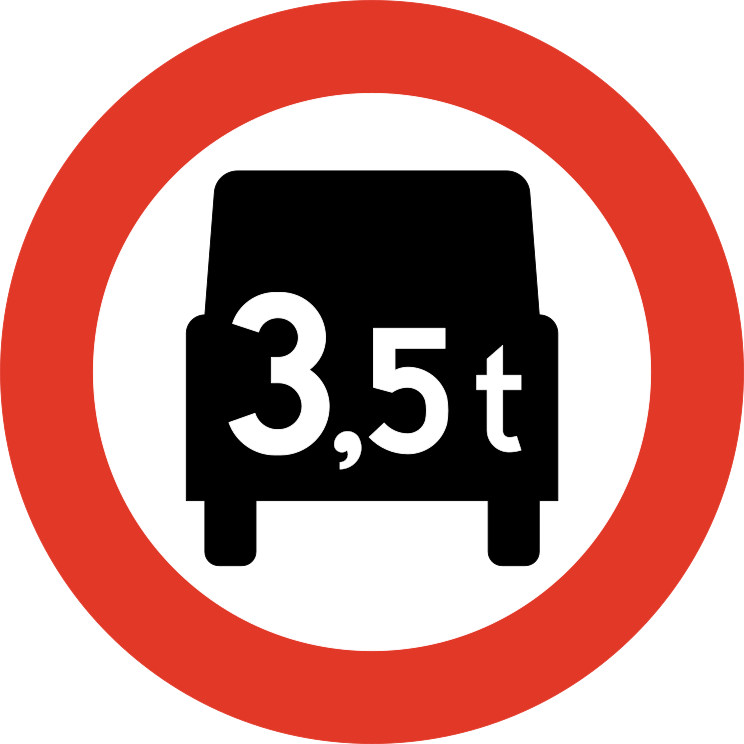
310
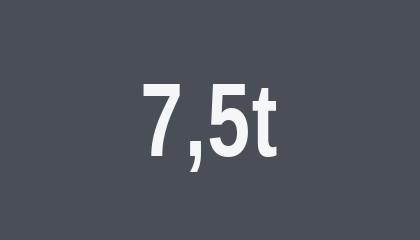
Forbudt for motorvogn med flere enn to hjul og med tillatt totalvekt høyere enn angitt
No motor vehicles with more than two wheels and permissible gross weight exceeding that indicated
A prohibitory sign: no entry for motor vehicles with more than two wheels whose permitted total weight exceeds the figure on the sign.
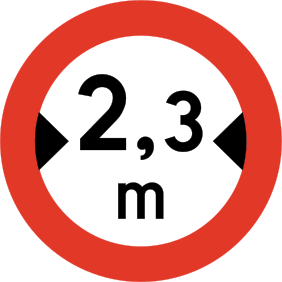
312
Breddegrense
Width limit
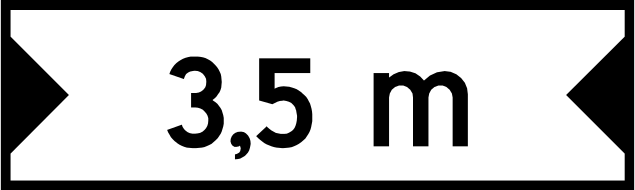
Breddegrense (width limit): vehicles wider than the number shown, including their load, are prohibited. If your vehicle with its cargo is wider than stated, you may not drive here.
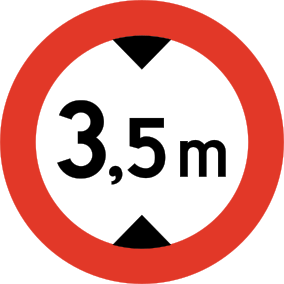
314
Høydegrense
Height limit
Høydegrense (height limit): vehicles taller than the number shown, including their load, are prohibited. If your vehicle with its cargo is taller than stated, you may not drive here.
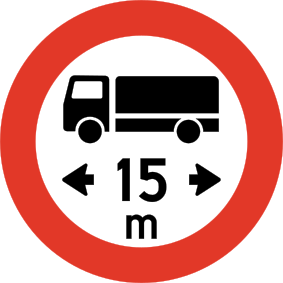
316
Lengdegrense
Length limit
Lengdegrense (length limit): vehicles or vehicle combinations longer than the number shown, including their load, are prohibited. If your vehicle or combination with its cargo is longer than stated, you may not drive here.
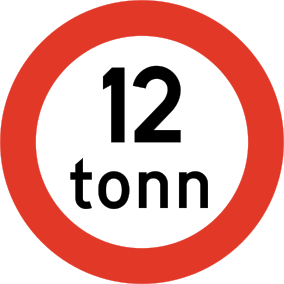
318
Totalvektgrense
Total weight limit
A prohibitory sign (Totalvektgrense, weight limit): 318.1 bans a single vehicle whose actual total weight exceeds the figure shown, while 318.2 applies to the combined weight of a vogntog — relevant when driving a car with a trailer.
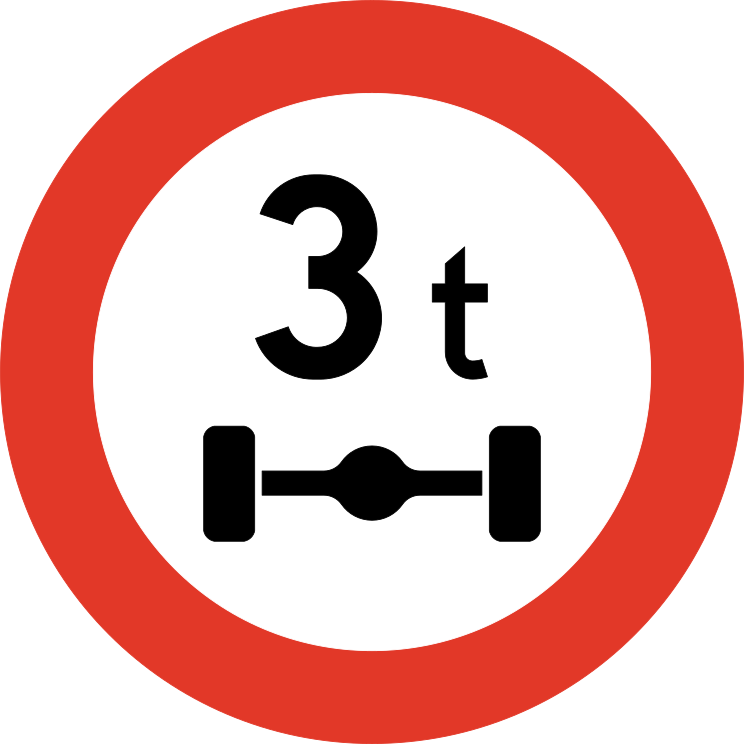
320
Aksellastgrense
Axle load limit
A prohibitory sign (Aksellastgrense, axle-load limit): no vehicles whose actual axle load exceeds the figure shown, with matching limits for bogie and triple-bogie loads.
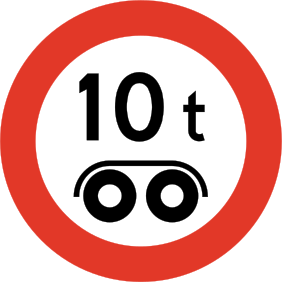
322
Boggilastgrense
Bogie load limit
A prohibitory sign (Boggilastgrense, bogie-load limit): no vehicles whose actual bogie load exceeds the figure shown.
324
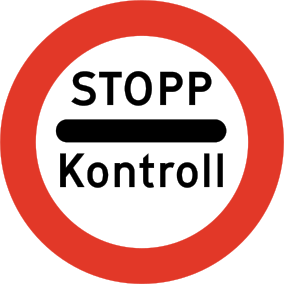
Stopp for angitt formål
Stop for specified purpose
A prohibitory sign (Stopp for angitt formål): you must stop for the purpose written on the sign before driving on.
326
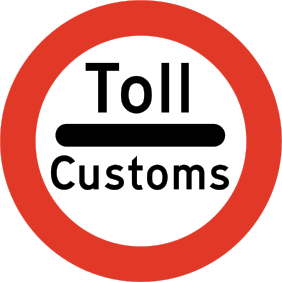
Stopp for toll
Stop for customs
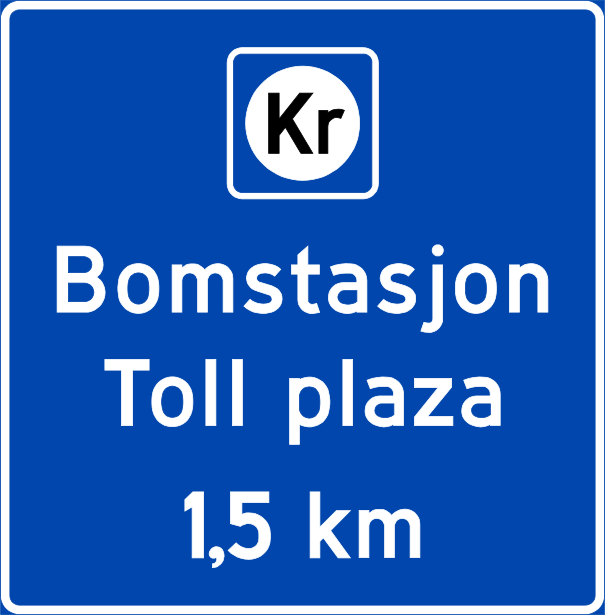
A prohibitory sign (Stopp for toll): you must stop for customs clearance in accordance with the customs rules.
330
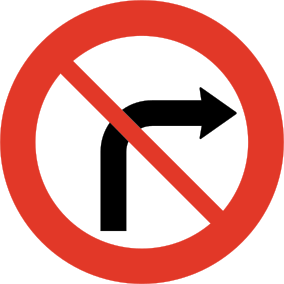
Svingeforbud
No turn
Svingeforbud (no turn): you may not turn in the direction the arrow shows. It applies only to the junction where the sign stands (or the first junction after it), unless an underskilt (subsign) states otherwise.
332
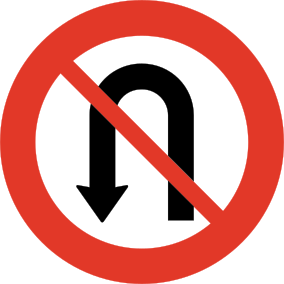
Vendingsforbud
No U-turn
Vendingsforbud (no U-turn): you may not turn around to drive in the opposite direction. The ban applies up to and including the first junction.
334
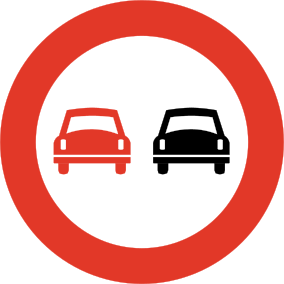
Forbikjøringsforbud
No overtaking
Forbikjøringsforbud (no overtaking): you may not overtake a motor vehicle with more than two wheels. Overtaking on the right where the traffic rules allow it is still permitted, and the ban runs until sign 336 «Slutt på forbikjøringsforbud» or over the stretch shown by a supplementary plate (underskilt).
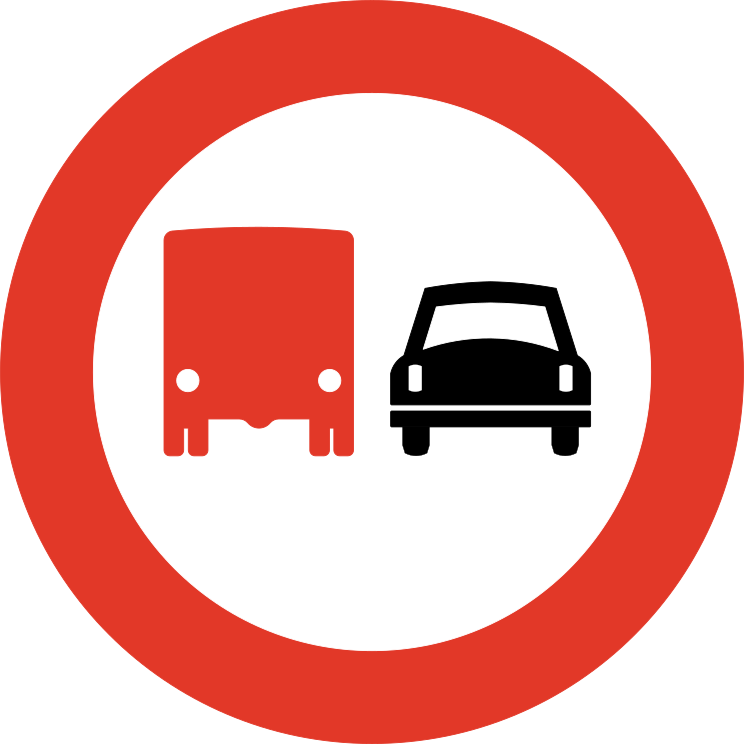
335
Forbikjøringsforbud for lastebil
No overtaking for trucks
The overtaking prohibition applies to a lorry with a permitted total weight over 3500 kg when overtaking a motor vehicle with more than two wheels. Overtaking lawfully permitted on the right under the traffic rules is exempt. The prohibition applies until sign 337 «Slutt på forbikjøringsforbud for lastebil», or over the stretch indicated by a supplementary sign plate.
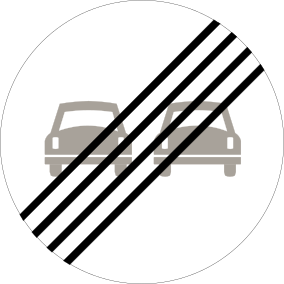
336
Slutt på forbikjøringsforbud
End of no overtaking
Slutt på forbikjøringsforbud (end of no-overtaking): the sign shows that the overtaking ban from sign 334 ends, and you may overtake again under the normal rules.
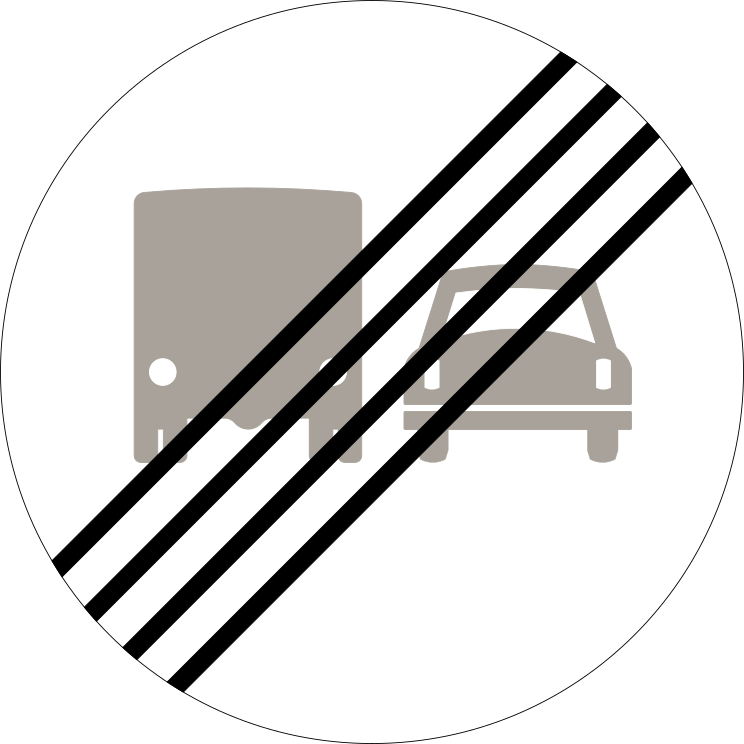
337
Slutt på forbikjøringsforbud for lastebil
End of no overtaking for trucks
A prohibitory sign: end of the lorry overtaking ban introduced by sign 335.
362
Fartsgrense
Speed limit
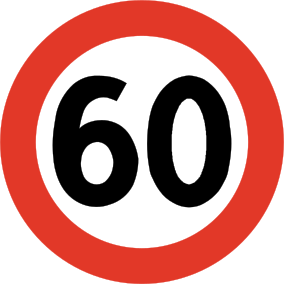
Fartsgrense shows the maximum allowed speed in km/h on the stretch; driving faster is prohibited. It applies until a new speed limit is signed (including sign 362, 366, 364, 540 or 548). For temporary regulation the sign may have a yellow background.
364
Slutt på særskilt fartsgrense
End of special speed limit
Slutt på særskilt fartsgrense means the special speed limit ends. After the sign the general speed limit for that type of road applies again.
366
Fartsgrensesone
Speed limit zone
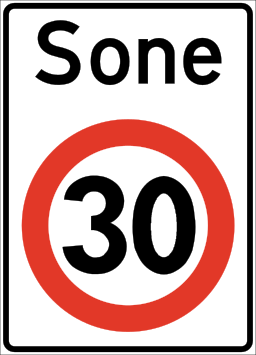
Fartsgrensesone marks the start of a zone where driving faster than the stated km/h is prohibited. It applies until cancelled by sign 368, 540 or 548, and it also warns that physical speed-reducing devices (such as speed humps) may be in the road.
367
Fartsgrensesone for liten elektrisk motorvogn
Speed limit zone for small electric vehicle
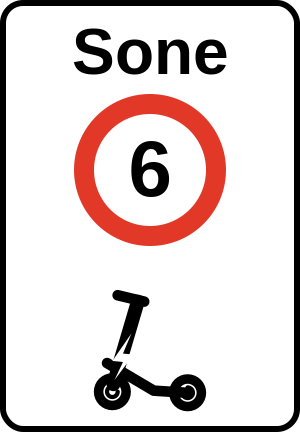
A prohibitory sign (speed-limit zone for small electric vehicles): inside the zone a liten elektrisk motorvogn must not go faster than 6 km/h on road or pavement, until sign 369.
368
Slutt på fartsgrensesone
End of speed limit zone
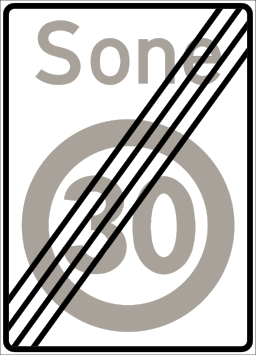
Slutt på fartsgrensesone means the speed-limit zone ends. After the sign the general speed limit for that type of road applies again.
369
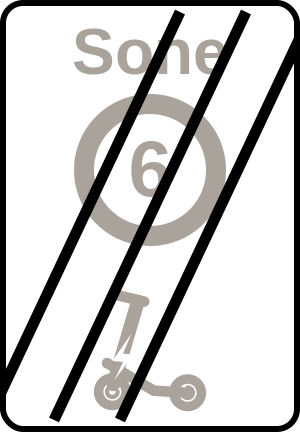
Slutt på fartsgrensesone for liten elektrisk motorvogn
End of speed limit zone for small electric vehicle
A prohibitory sign: end of the 6 km/h speed-limit zone for small electric vehicles.
370
Stans forbudt
No stopping
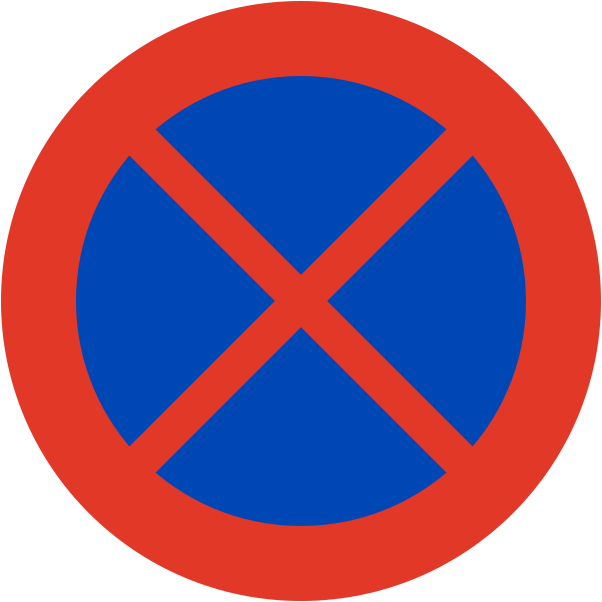
Stans forbudt (no stopping): you may not stop the vehicle on the side of the road where the sign stands. It applies up to the nearest junction or to a new sign 370, 372, 376, 378 or 552.
372
Parkering forbudt
No parking
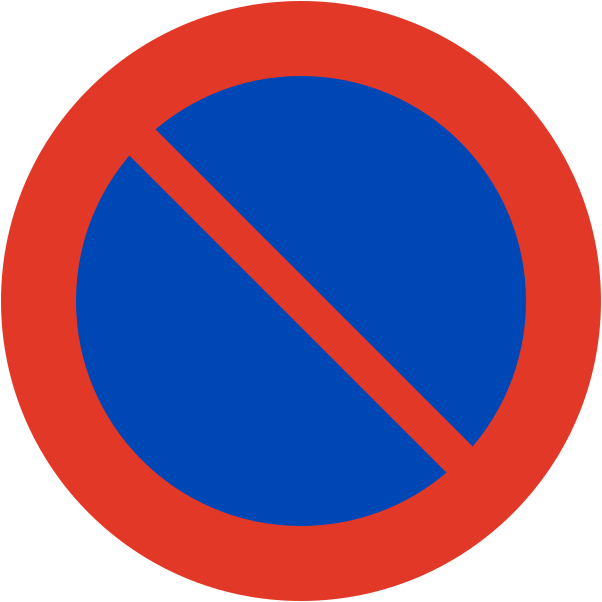
Parkering forbudt (no parking): you may not park on the side of the road where the sign stands (a brief stop for loading/unloading or picking up/dropping off is allowed). It applies up to the nearest junction or to a new sign 372, 370, 376, 378 or 552.
376
Parkeringssone
Parking zone
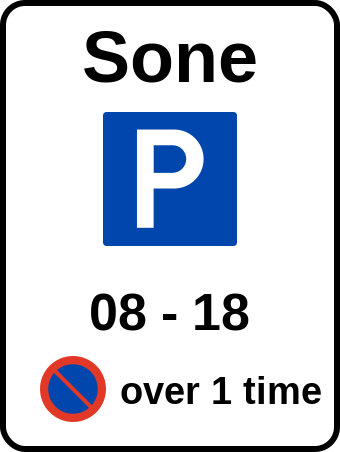
The sign marks the boundary of a zone with special parking or stopping provisions, shown by symbols and text on the sign. These provisions apply until sign 378 «Slutt på parkeringssone». Signs may establish different provisions for particular road stretches within the zone; the zone sign’s provisions do not apply on those stretches.
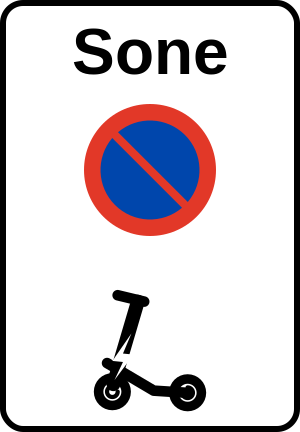
377
Sone med parkeringsforbud for liten elektrisk motorvogn
Zone prohibiting parking of small electric motor vehicles
The sign marks the boundary of a zone where parking a small electric motor vehicle is prohibited, until sign 379. At places within the zone where different parking or stopping provisions have been established, the zone sign’s provisions do not apply.
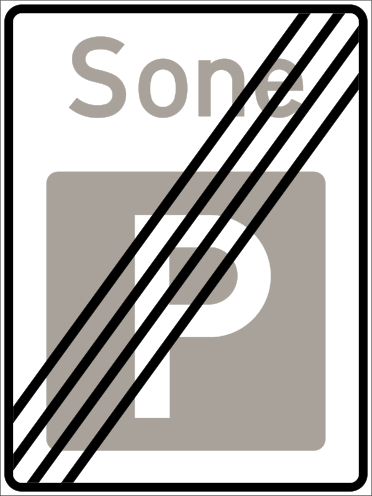
378
Slutt på parkeringssone
End of parking zone
A prohibitory sign: end of the parking zone introduced by sign 376, so the zone's special parking rules stop applying.
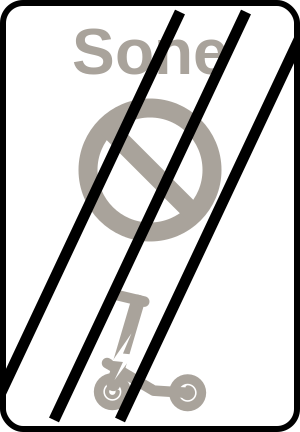
379
Slutt på sone med parkeringsforbud for liten elektrisk motorvogn
End of zone prohibiting parking of small electric motor vehicles
A prohibitory sign: end of the zone where parking a small electric vehicle is prohibited.
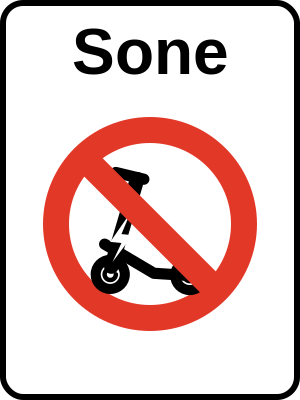
380
Sone med bruksforbud for liten elektrisk motorvogn
Zone prohibiting use of small electric motor vehicles
A prohibitory sign: a zone where using a small electric vehicle is prohibited altogether, until sign 382.
382
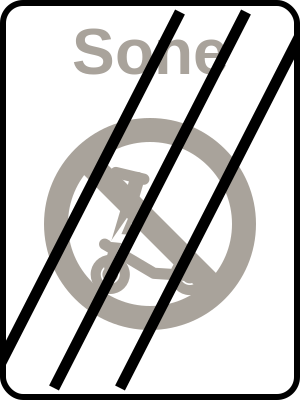
Slutt på sone med bruksforbud for liten elektrisk motorvogn
End of zone prohibiting use of small electric motor vehicles
A prohibitory sign: end of the zone where using a small electric vehicle is prohibited.
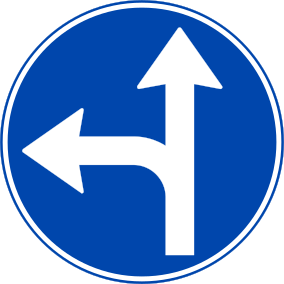
A mandatory sign (påbudsskilt) «Påbudt kjøreretning» indicating that you must leave the junction in the direction shown by the arrow. You must drive in the direction ordered.
404
Påbudt kjørefelt
Mandatory traffic lane
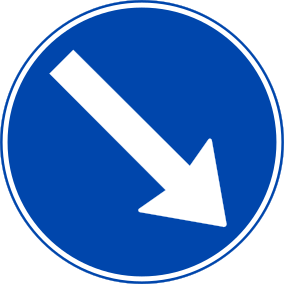
A mandatory sign (påbudsskilt) «Påbudt kjørefelt» indicating that you must pass the sign on the side the arrow points to. Drive past on the ordered side.
406
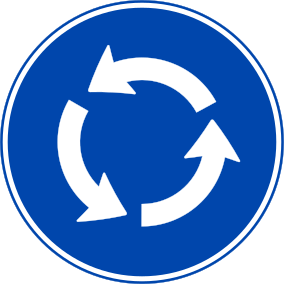
Påbudt rundkjøring
Mandatory roundabout
A mandatory sign (påbudsskilt) «Påbudt rundkjøring» indicating that you must drive through the roundabout in the direction of the arrows, i.e. anticlockwise with the central island on your left. Follow the ordered direction of travel.
408
Påbudt kjøreretning i rundkjøring
Mandatory direction at roundabout
A mandatory sign (påbudsskilt) «Påbudt kjøreretning i rundkjøring» indicating which direction of travel you must follow in the roundabout. Drive in the direction ordered.
Opplysningsskilt — Information signs
Indicate traffic regimes: motorway (motorveg), one-way traffic, pedestrian crossings, parking, lanes. Often change applicable rules — such as where a pedestrian zone (gågate) starts and ends. Class guide: information signs — dedicated page
502
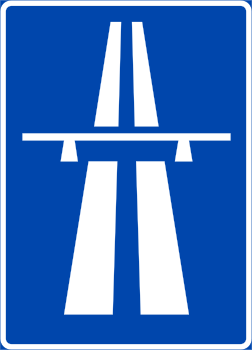
Motorveg
Motorway
Motorveg (motorway): from this sign the special motorveg rules apply, lasting until sign 504 «Slutt på motorveg», sign 503 «Motortrafikkveg», or an exit onto a road that is not motorveg.
503
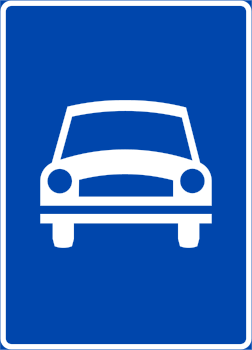
Motortrafikkveg
Motor road
Motortrafikkveg (expressway): from this sign the motortrafikkveg rules apply, until sign 505 «Slutt på motortrafikkveg», sign 502 «Motorveg», or an exit onto a road that is not motortrafikkveg.
504
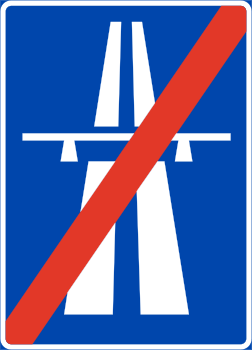
Slutt på motorveg
End of motorway
Slutt på motorveg (end of motorway): the motorveg section ends here and the special motorway rules no longer apply.
505
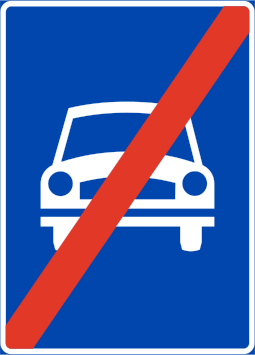
Slutt på motortrafikkveg
End of expressway
Slutt på motortrafikkveg (end of expressway): the motortrafikkveg ends here and its special rules no longer apply.
506
Tungtrafikkfelt
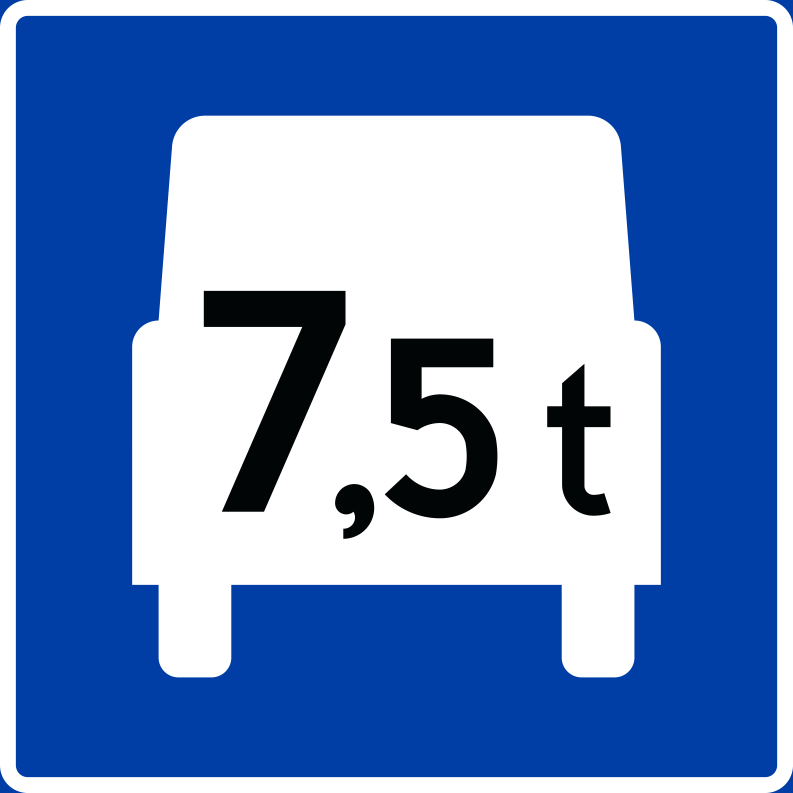
Heavy vehicle lane
A heavy-traffic lane (tungtrafikkfelt) is a lane for motor vehicles with a permitted total weight above the value on the sign. The sign marks the start of the lane and the application of heavy-traffic-lane rules. It applies until sign 507 «Slutt på tungtrafikkfelt» or the first junction, and is also cancelled by a direction sign indicating another use of the lane.
507
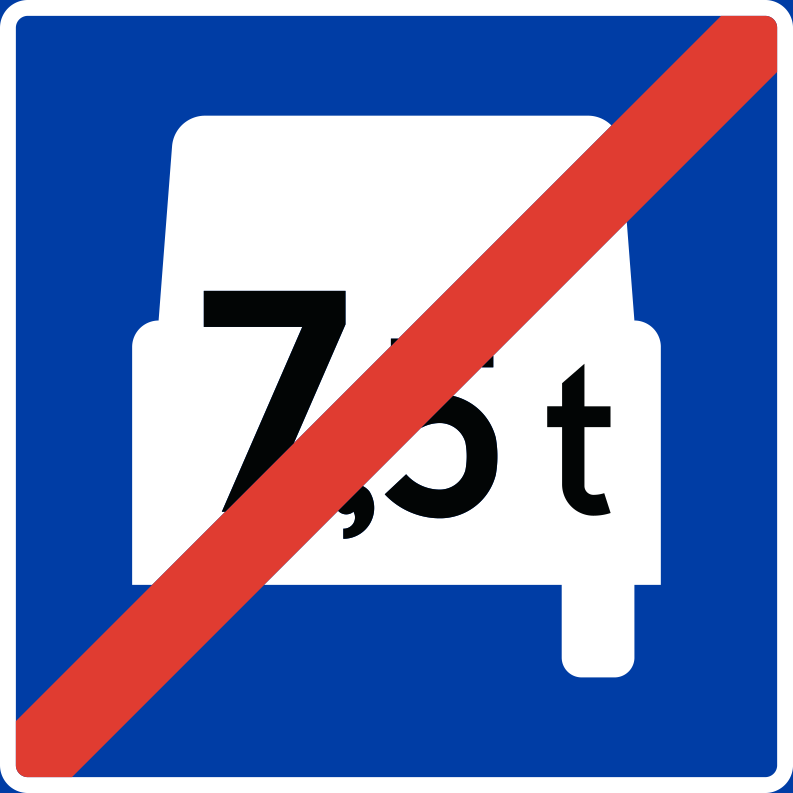
Slutt på tungtrafikkfelt
End of heavy vehicle lane
Slutt på tungtrafikkfelt (end of heavy-traffic lane): the tungtrafikkfelt ends here.
508
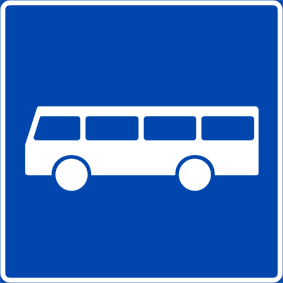
Kollektivfelt
Bus lane
A bus/transit lane (kollektivfelt) is indicated by 508.1 for buses or 508.2 for buses and taxis. A bus with up to 16 passenger seats besides the driver's seat may use the lane only in licensed passenger transport or with at least 7 passengers besides the driver. A taxi may use it only if fitted with a roof light. The sign applies until sign 510 «Slutt på kollektivfelt» or the first junction, and is also cancelled by a direction sign indicating another use of the lane.
509
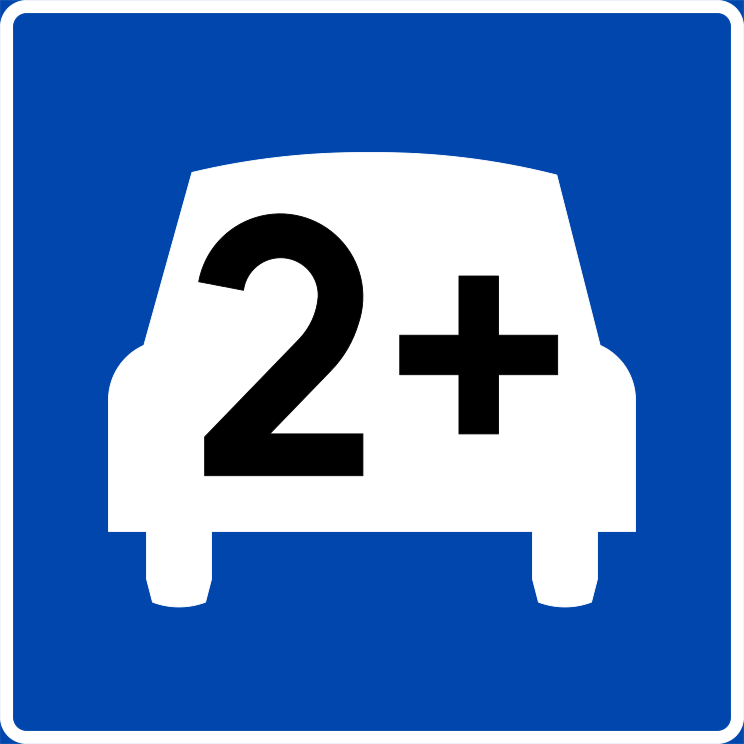
Sambruksfelt
High-occupancy vehicle lane
A carpool lane (sambruksfelt) may be used by taxis with a roof light and buses, and by motor vehicles carrying at least the number of persons shown on the sign. A bus with up to 16 passenger seats besides the driver's seat that is not used in licensed passenger transport must also meet the sign's person-number requirement. The count includes the driver. The sign applies until sign 511 «Slutt på sambruksfelt» or the first junction, and is also cancelled by a direction sign indicating another use of the lane.
510
Slutt på kollektivfelt
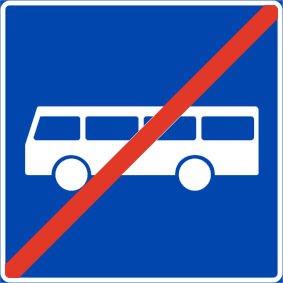
End of bus lane
Slutt på kollektivfelt (end of bus lane): the kollektivfelt ends and the lane is no longer reserved for public transport.
511
Slutt på sambruksfelt
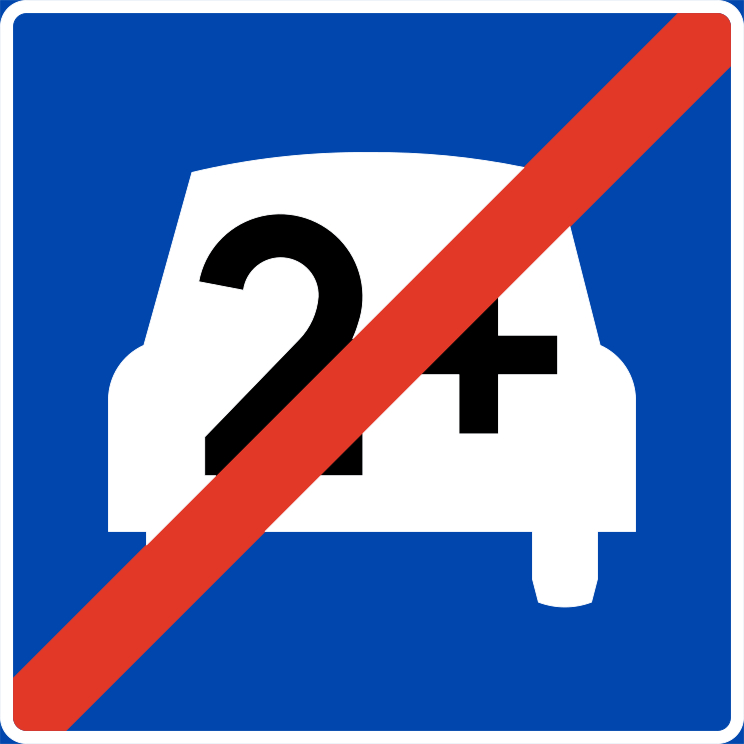
End of carpool lane
Slutt på sambruksfelt (end of carpool lane): the sambruksfelt ends and the occupancy requirement no longer applies.
512
Holdeplass for buss
Bus stop
Holdeplass for buss (bus stop): there is a bus stop here. Stopping on the widened stretch or within 20 metres of the sign is banned — except boarding and alighting that does not hinder the bus (trafikkreglene § 17).
513
Holdeplass for sporvogn
Tram stop
Tram stop. Stopping is prohibited in the road widening or closer than 20 metres to the sign, but boarding and alighting are permitted if they do not obstruct the tram. Anyone intending to pass a tram on its right at a stop without a traffic island must stop and let passengers alighting or wishing to board pass freely (traffic rules, trafikkreglene §§ 9 and 17).
514
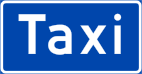
Holdeplass for drosje
Taxi stand
Holdeplass for drosje (taxi rank): there is a taxi rank here. Stopping on the widened stretch or within 20 metres of the sign is banned — except boarding and alighting that does not hinder the taxis (trafikkreglene § 17).
516
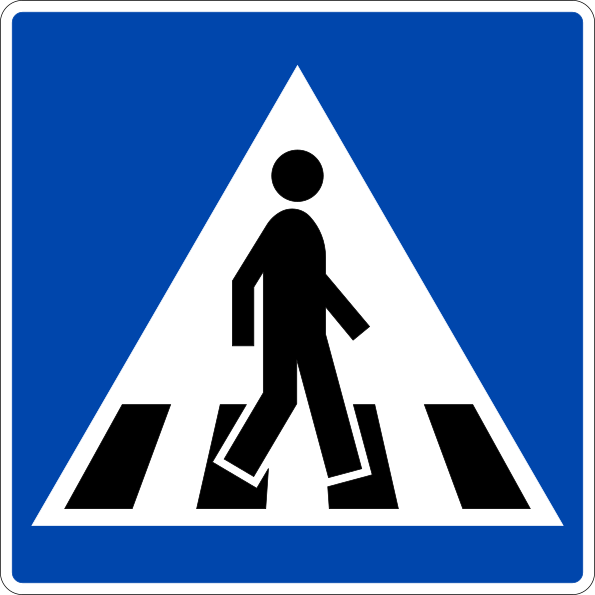
Gangfelt
Pedestrian crossing
Pedestrian crossing: the sign marks a crossing place for pedestrians. When traffic at the crossing is not regulated by police or traffic lights, drivers have a duty to give way to pedestrians who are on the crossing or about to step onto it. Stopping on the crossing or closer than 5 metres before it is prohibited (traffic rules, trafikkreglene §§ 9 and 17).
518
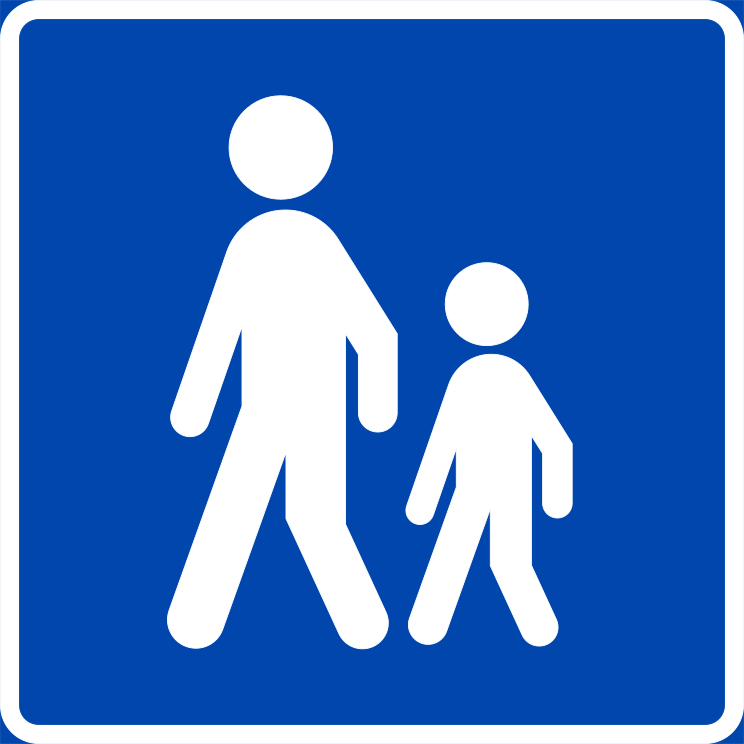
Gangveg
Pedestrian path
Gangveg (footpath): a road built for pedestrians, where the traffic rules (trafikkreglene) on using such a road apply.
520
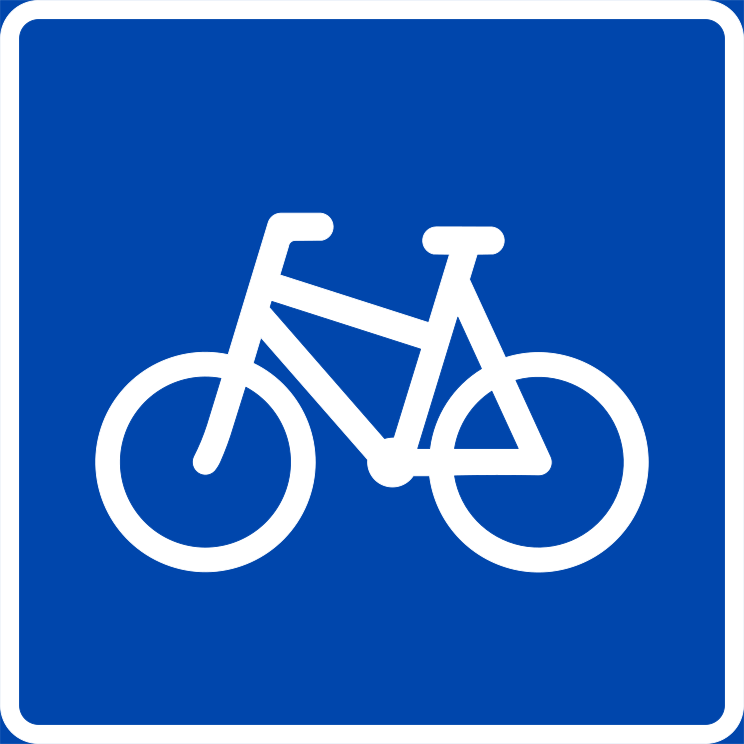
Sykkelveg
Bicycle road
Sykkelveg (cycle road): a road built for cyclists and drivers of small electric vehicles, where the rules on using such a road apply.
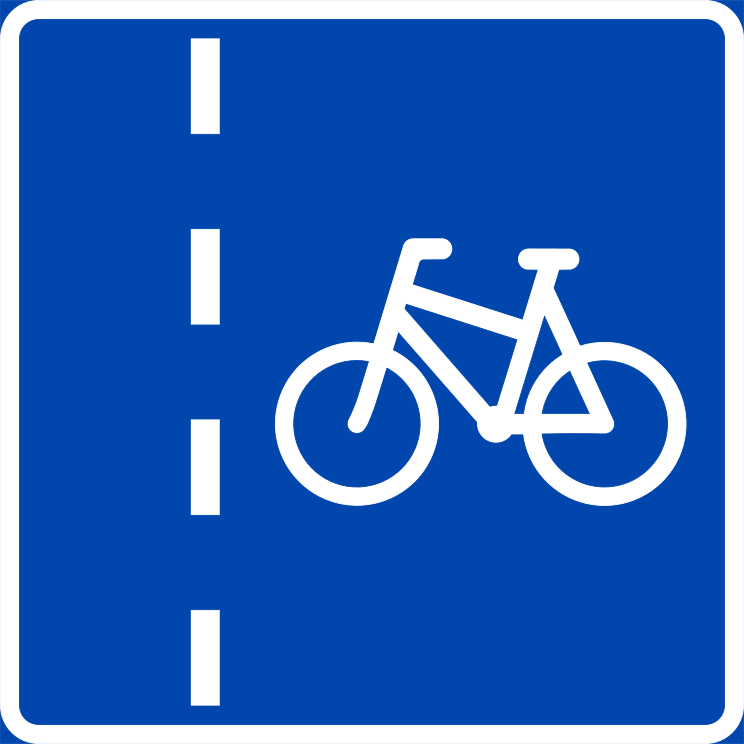
521.1
Sykkelfelt – sideplassert
Bicycle lane – side-positioned
Sykkelfelt – sideplassert (cycle lane at the side): the carriageway has its own side lane for cyclists and small electric vehicles. Other drivers must not use the lane, and stopping in it is prohibited (trafikkreglene §§ 4 and 17).
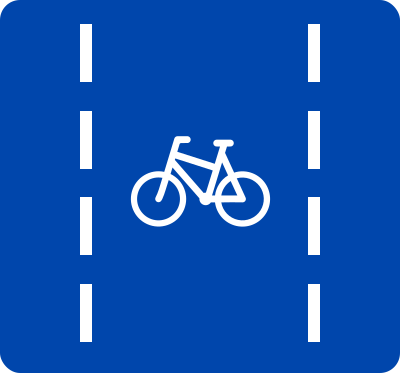
521.2
Sykkelfelt – Midtstilt
Bicycle lane – centred
Sykkelfelt – Midtstilt (centrally placed cycle lane): the carriageway has a cycle lane between the traffic lanes, for cyclists and small electric vehicles. Other drivers must not use the lane, and stopping in it is prohibited (trafikkreglene §§ 4 and 17).
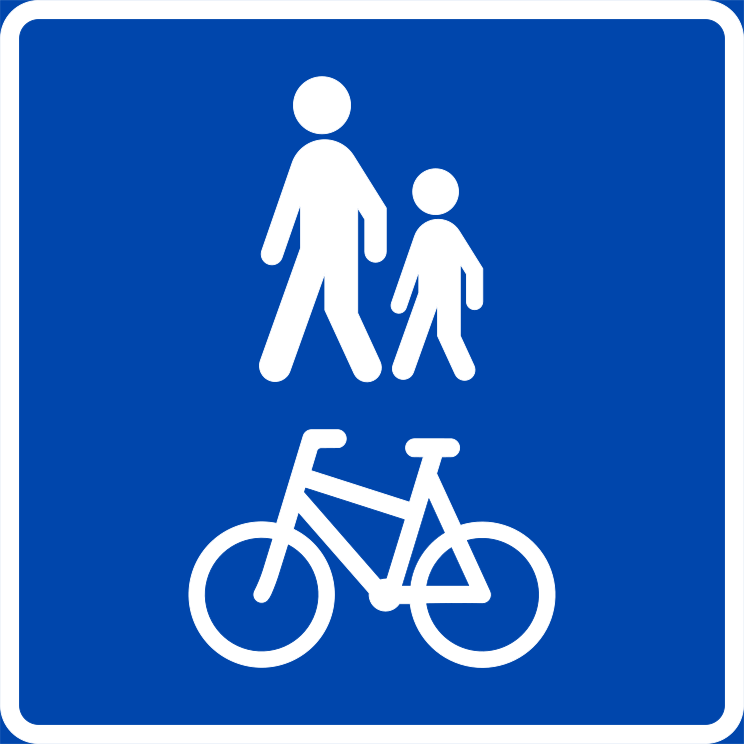
522
Gang- og sykkelveg
Pedestrian and cycle path
Gang- og sykkelveg (shared foot- and cycleway): a road built for pedestrians, cyclists and small electric vehicles, where the rules on using such a road apply.
524
Møteplass
Passing place
Møteplass (passing place): the sign marks a place on a narrow road where oncoming vehicles can pass each other. Parking at the passing place is prohibited across the whole width of the road for the length over which the carriageway is widened (trafikkreglene § 17 nr. 2 bokstav b).
526
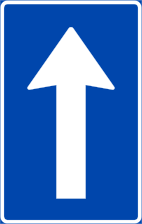
Envegskjøring
One-way traffic
Envegskjøring (one-way street): driving is only allowed in the direction of the arrow, and the sign applies up to the first junction.
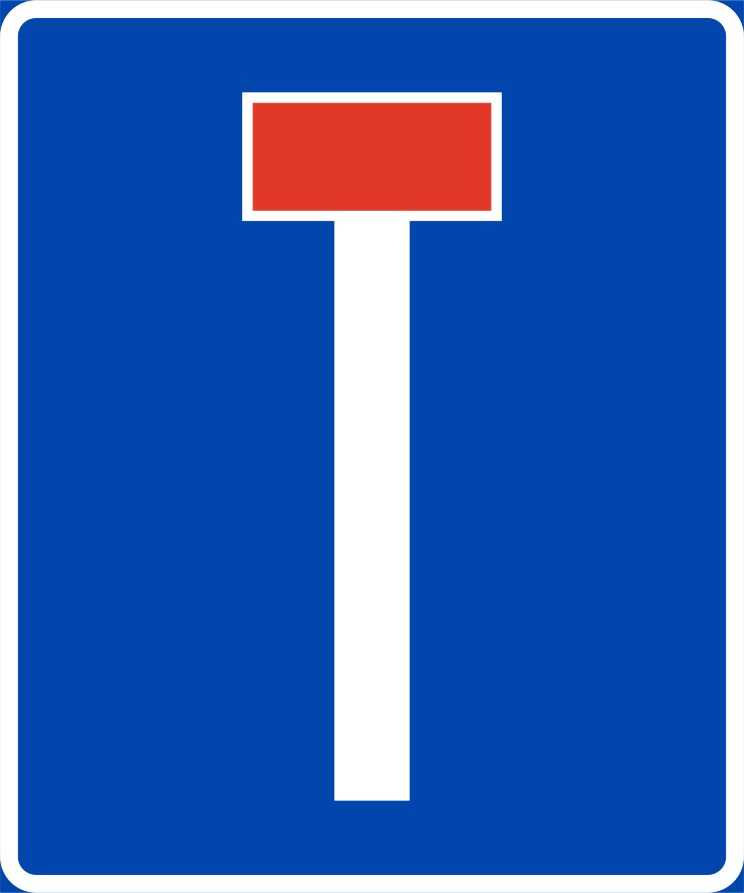
527
Blindveg
Dead end road
Dead end: 527.1 shows the road is physically closed, and 527.2 that the crossing road is physically closed. 527.3 and 527.4 show the corresponding roads closed to car traffic but open to pedestrians and cyclists. If the road ahead is intended only for pedestrians, the cycle symbol on 527.3 or 527.4 may be replaced by a pedestrian symbol; the sign then does not indicate an onward connection for cyclists.
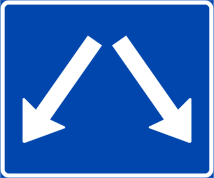
528
Valgfritt kjørefelt
Optional lane
Valgfritt kjørefelt (optional lane): an information sign showing that drivers may freely choose between the lanes indicated.
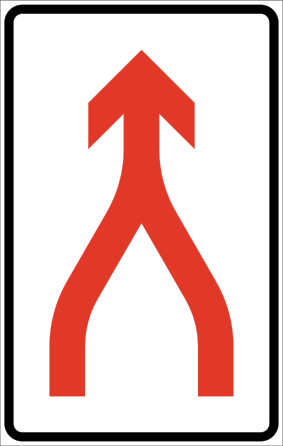
530
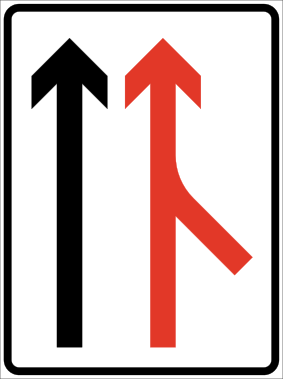
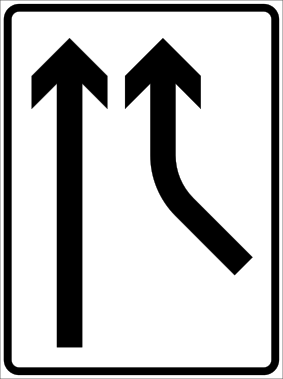
Sammenfletting
Merging lanes
Sammenfletting (merging): two lanes are brought together into one, and you must merge with mutual adaptation under the merging rule in the traffic rules (trafikkreglene).
531
Felt for fartsøkning
Acceleration lane
Felt for fartsøkning (acceleration lane): the acceleration lane joins the other lane by merging with mutual adaptation under the traffic rules (trafikkreglene).
532
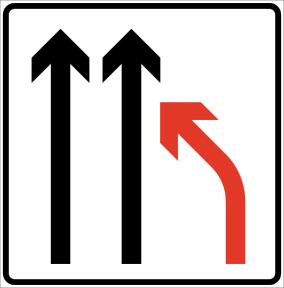
Kjørefelt slutter
Lane ends
Kjørefelt slutter (lane ends): your lane ends, you must change lane, and you must give way (vikeplikt) under the traffic rules.
534
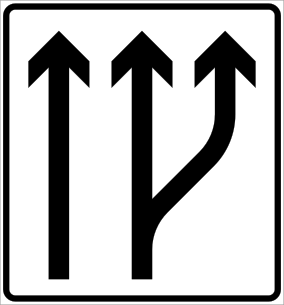
Kjørefelt begynner
Lane begins
Kjørefelt begynner (lane begins): an information sign showing that a new traffic lane starts.
536
Påkjøring fortsetter i eget kjørefelt
Merging traffic continues in separate lane
Påkjøring fortsetter i eget kjørefelt (slip road continues as its own lane): the sign tells you the entry lane carries on as a separate traffic lane.
538
Kjørefeltinndeling
Lane division
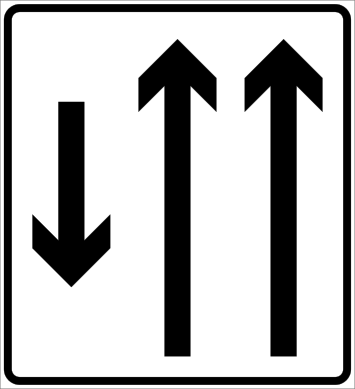
Kjørefeltinndeling (lane layout): the sign shows how many lanes the carriageway has and the direction of travel for each lane.
539
Endret kjøremønster
Changed traffic pattern
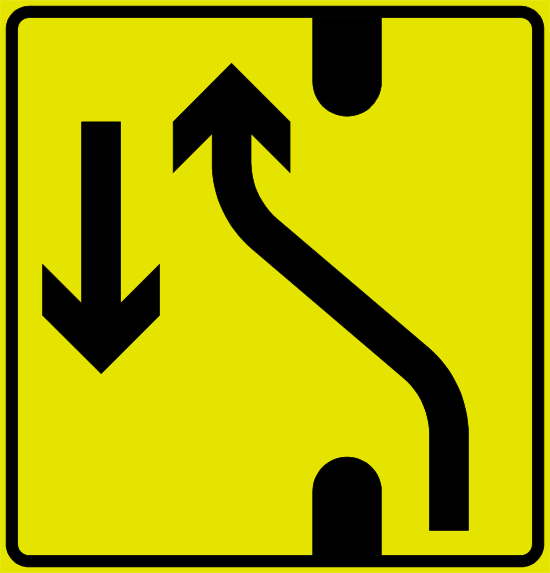
Endret kjøremønster (changed traffic pattern): an information sign warning that the traffic pattern here has been altered.
540
Gatetun
Home zone
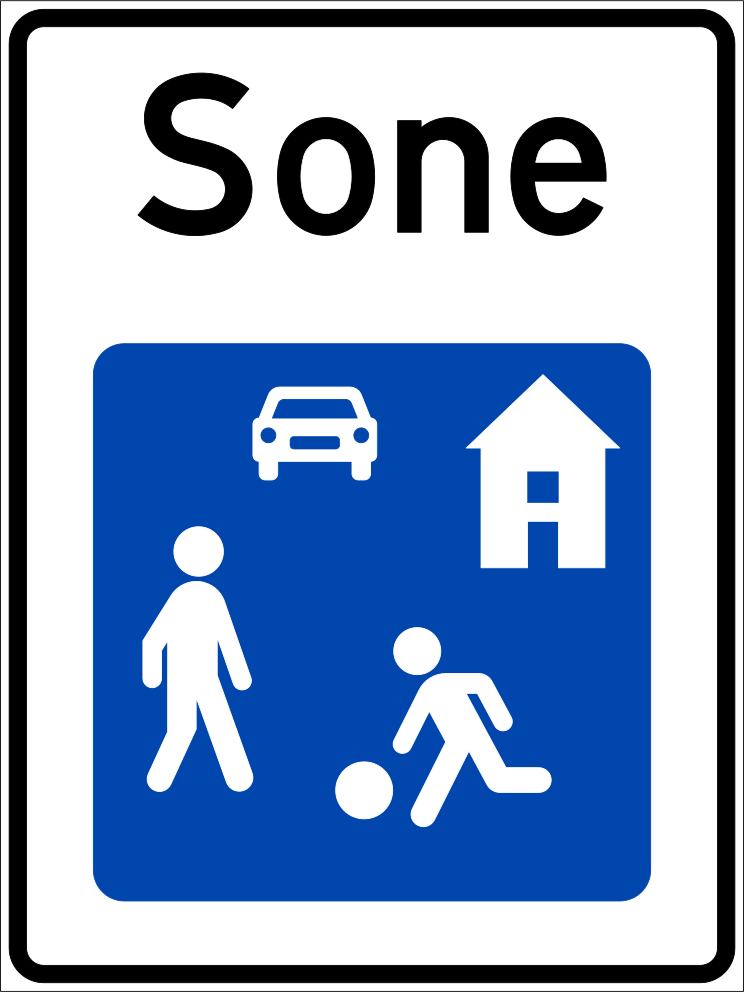
Gatetun (home zone): drive at walking pace and give way to pedestrians; parking is allowed only in specially marked spots. Obstacles are not specially marked, and the sign lasts until sign 542 «Slutt på gatetun» (trafikkreglene §§ 9, 13 and 17).
542
Slutt på gatetun
End of home zone
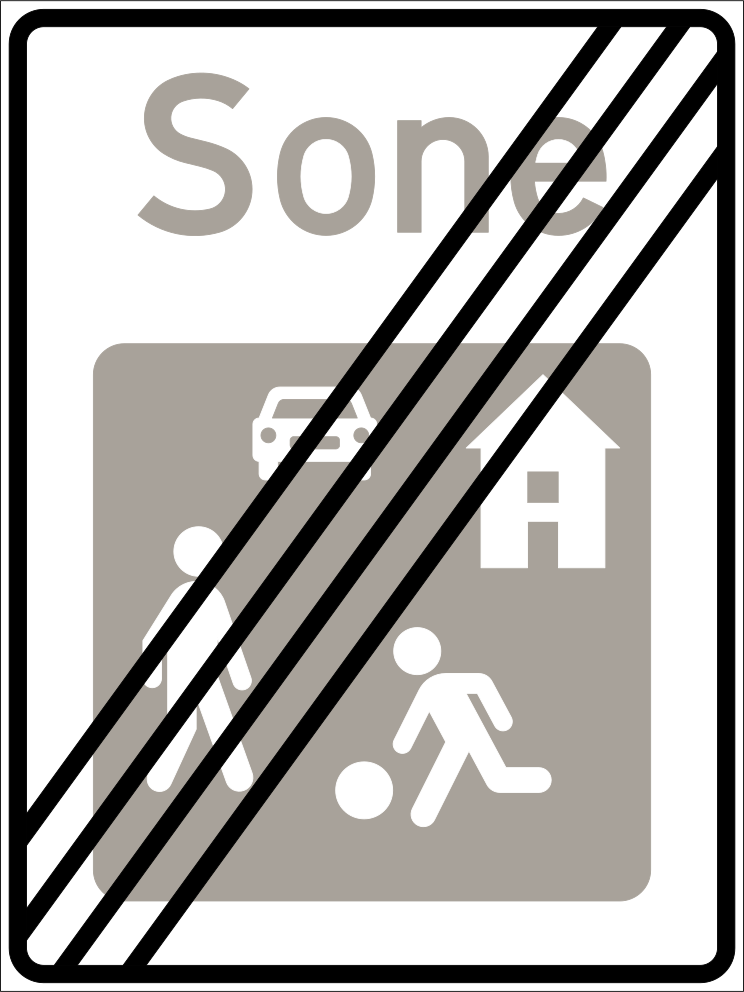
Slutt på gatetun (end of home zone): the gatetun ends and the ordinary traffic rules apply again.
548
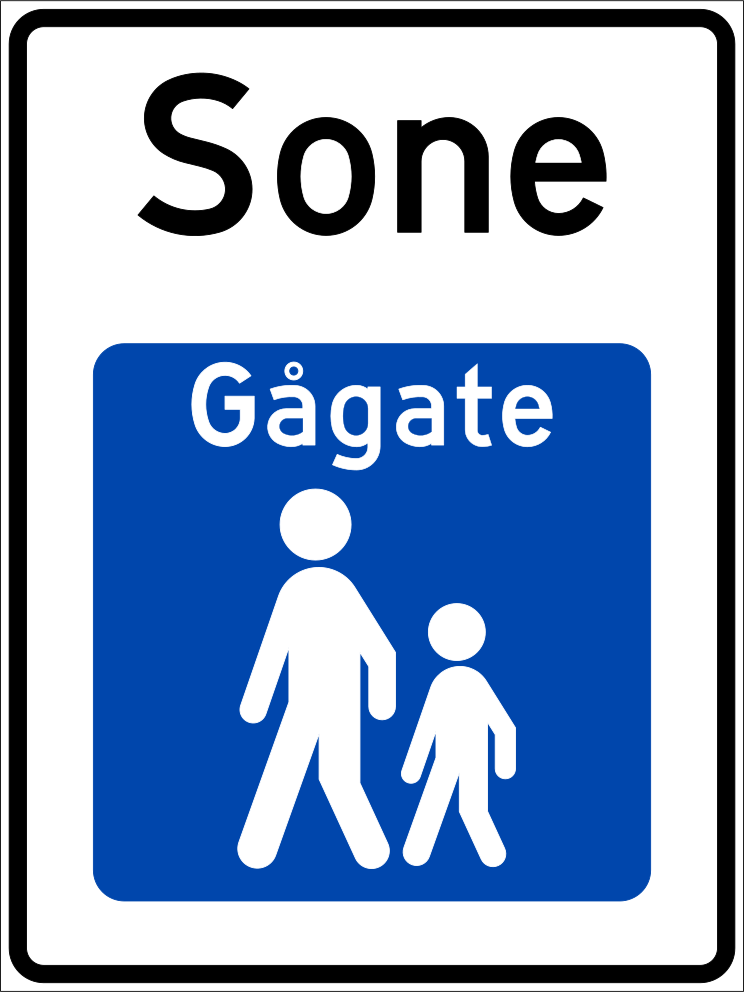
Gågate
Pedestrian street
Gågate (pedestrian street): motor vehicles are prohibited in the area, except small electric motor vehicles (liten elektrisk motorvogn). Anyone who does drive there must keep to walking pace and must give way to pedestrians; parking is prohibited. The sign applies until sign 550 «Slutt på gågate» (trafikkreglene §§ 9, 13 and 17).
550
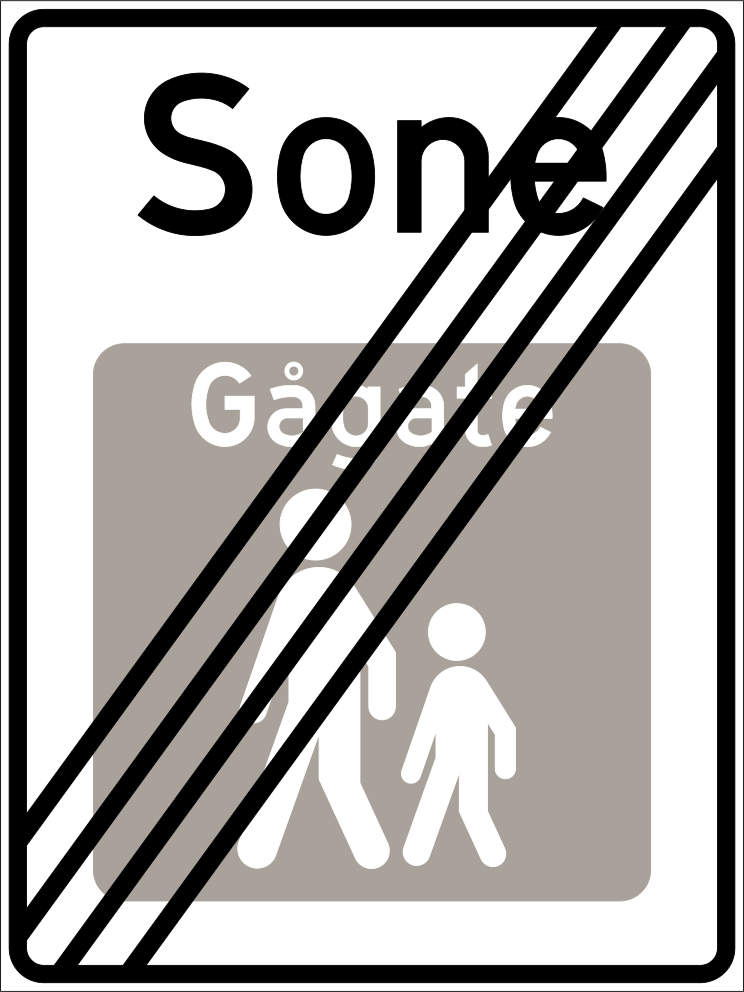
Slutt på gågate
End of pedestrian street
Slutt på gågate (end of pedestrian street): the gågate ends and the ordinary traffic rules apply again.
552
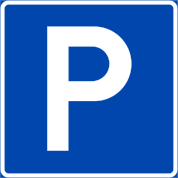
Parkering
Parking
As a general rule, parking is permitted at the location if it does not conflict with the traffic rules on stopping and parking. Supplementary sign (underskilt) 828 nevertheless permits parking in the indicated direction even where those rules would otherwise prevent it. If parking is reserved for particular vehicle or road-user groups, it is prohibited for others. At a specially delimited area the sign applies to the whole area; otherwise it applies only on the side of the road where the sign stands, until the nearest junction or a new sign 552, 370, 372 or 376. A miniature on a parking meter applies to the relevant parking bay under the special rules on paid parking, regardless of the traffic rules on stopping and parking.
555
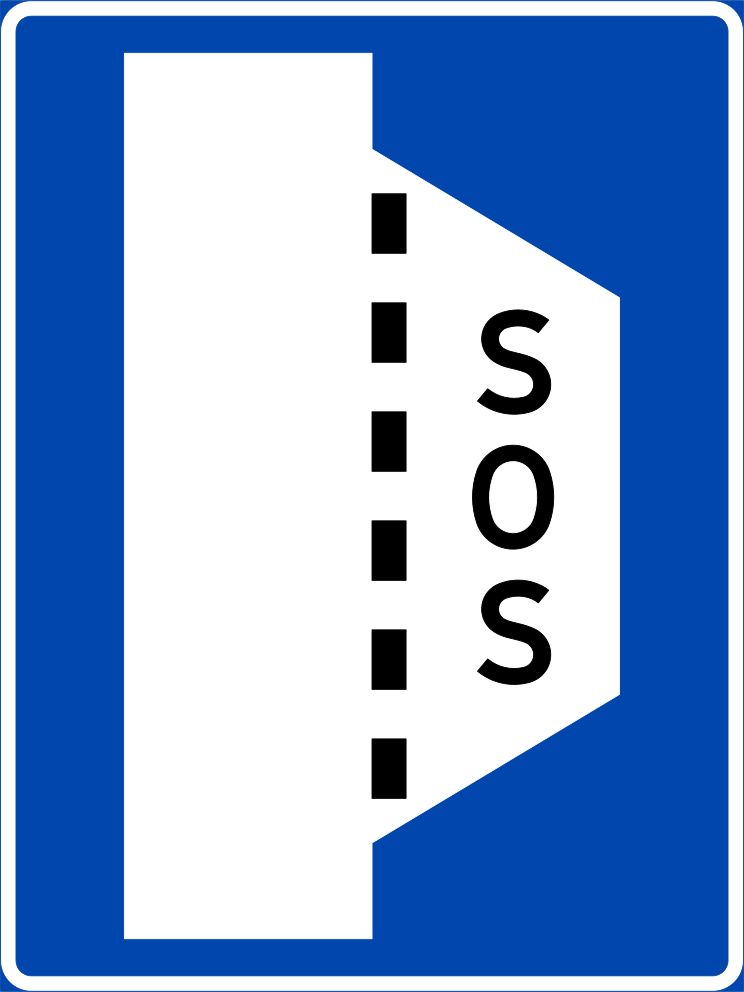
Havarilomme
Emergency bay
Havarilomme (emergency lay-by): marks a lay-by beside the road for use in a breakdown or emergency.
556.1
Automatisk trafikkontroll – punktmåling
Automatic traffic control – point measurement
Automatisk trafikkontroll – punktmåling (automatic speed check, spot measurement): warns of an automatic speed camera measuring speed at a single point.
556.2
Automatisk trafikkontroll – strekningsmåling
Automatic traffic control – section measurement
Automatisk trafikkontroll – strekningsmåling (average-speed check): warns of automatic control measuring your average speed over a stretch of road.
558
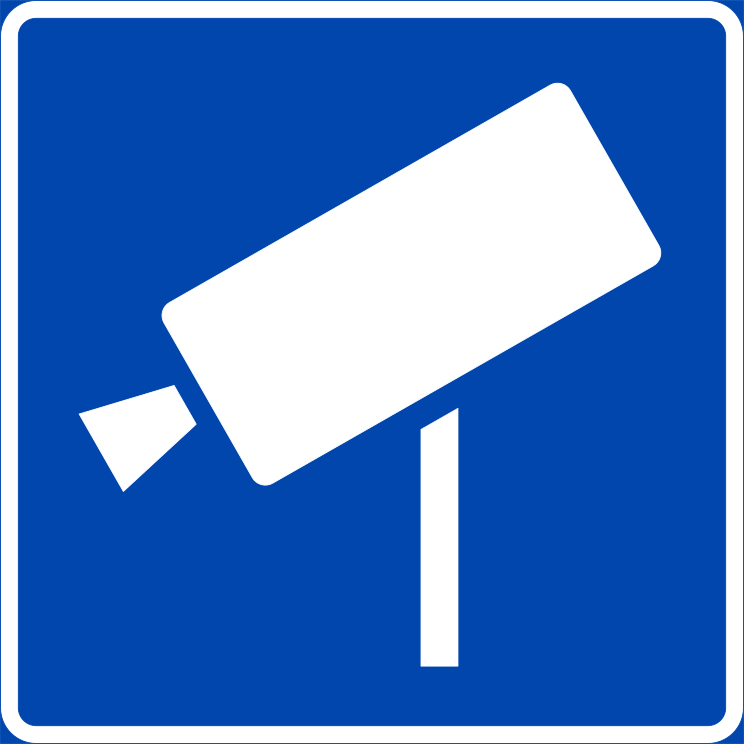
Videokontroll/-overvåking
Video control/surveillance
Videokontroll/-overvåking (video monitoring): the sign informs you that the place or stretch is under video surveillance.
560
Opplysningstavle
Information board
Opplysningstavle (information board): gives information about road and traffic conditions that other signs cannot convey, with the background colour varying by type of information.
565
Feil kjøreretning
Wrong direction of travel
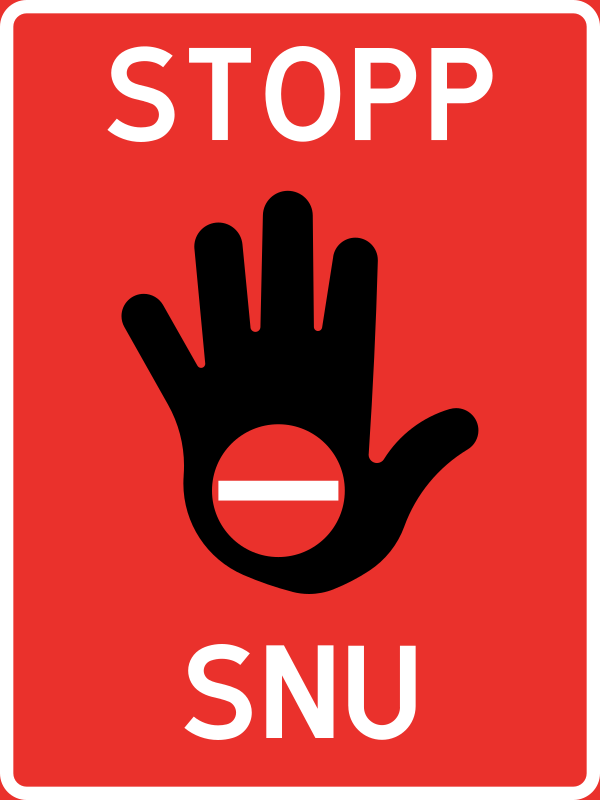
Feil kjøreretning (wrong way): the sign warns that you are travelling in the wrong direction on this road.
570.1
Nødutgang
Emergency exit
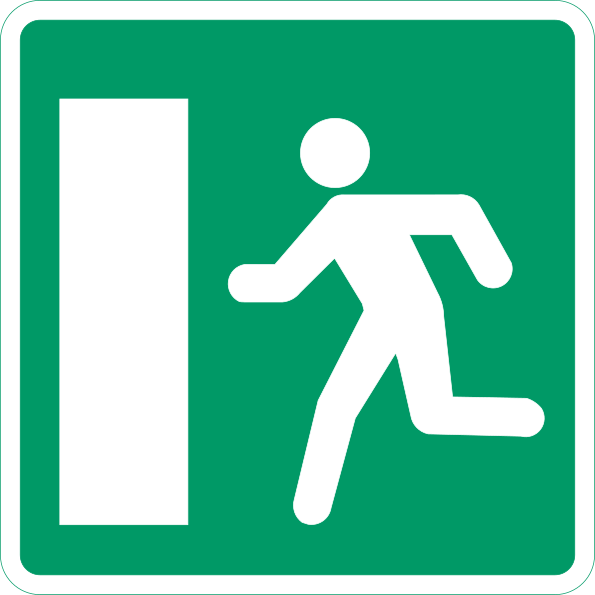
Nødutgang (emergency exit): one of the two tunnel emergency-exit signs (nødutgangsskilt for tunnel) — this one stands at the exit itself.
570.2
Retning og avstand til nødutgang
Direction and distance to the emergency exit
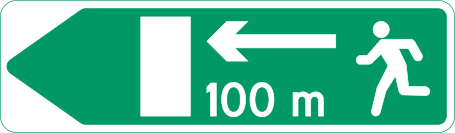
Retning og avstand til nødutgang: the second tunnel emergency-exit sign — it shows which way and how far it is to the nearest exit.
Serviceskilt — Service signs
Brown and blue service signs: petrol stations, toilets, rest areas, camping, emergency telephones, fire extinguishers, sights. Under § 13 they provide information — they do not mandate or prohibit anything. Class guide: service signs — dedicated page
601
Lytt til radio
Tune to radio
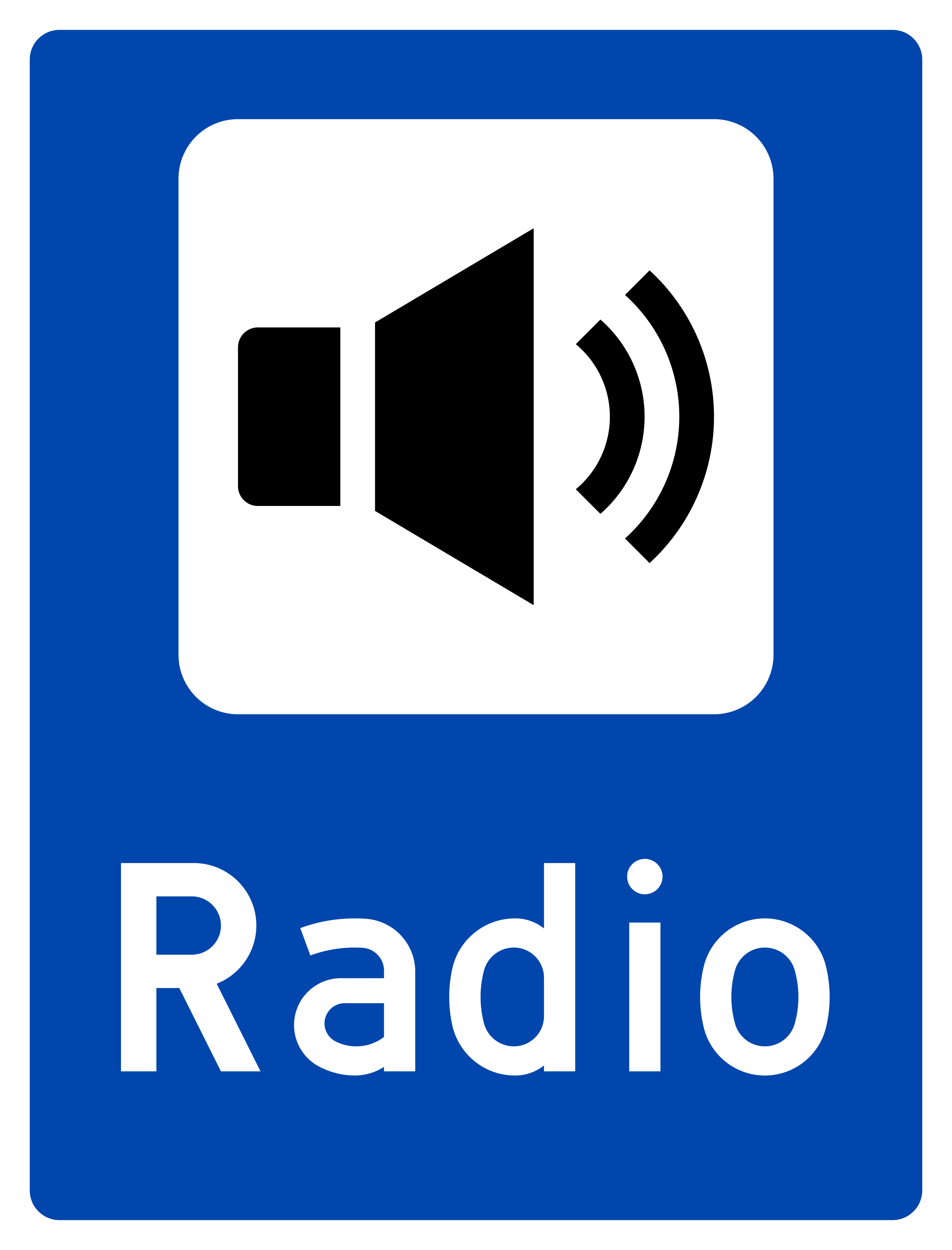
Tune to radio: the sign tells you traffic information is broadcast on radio here, often before long tunnels.
602
Førstehjelp
First aid
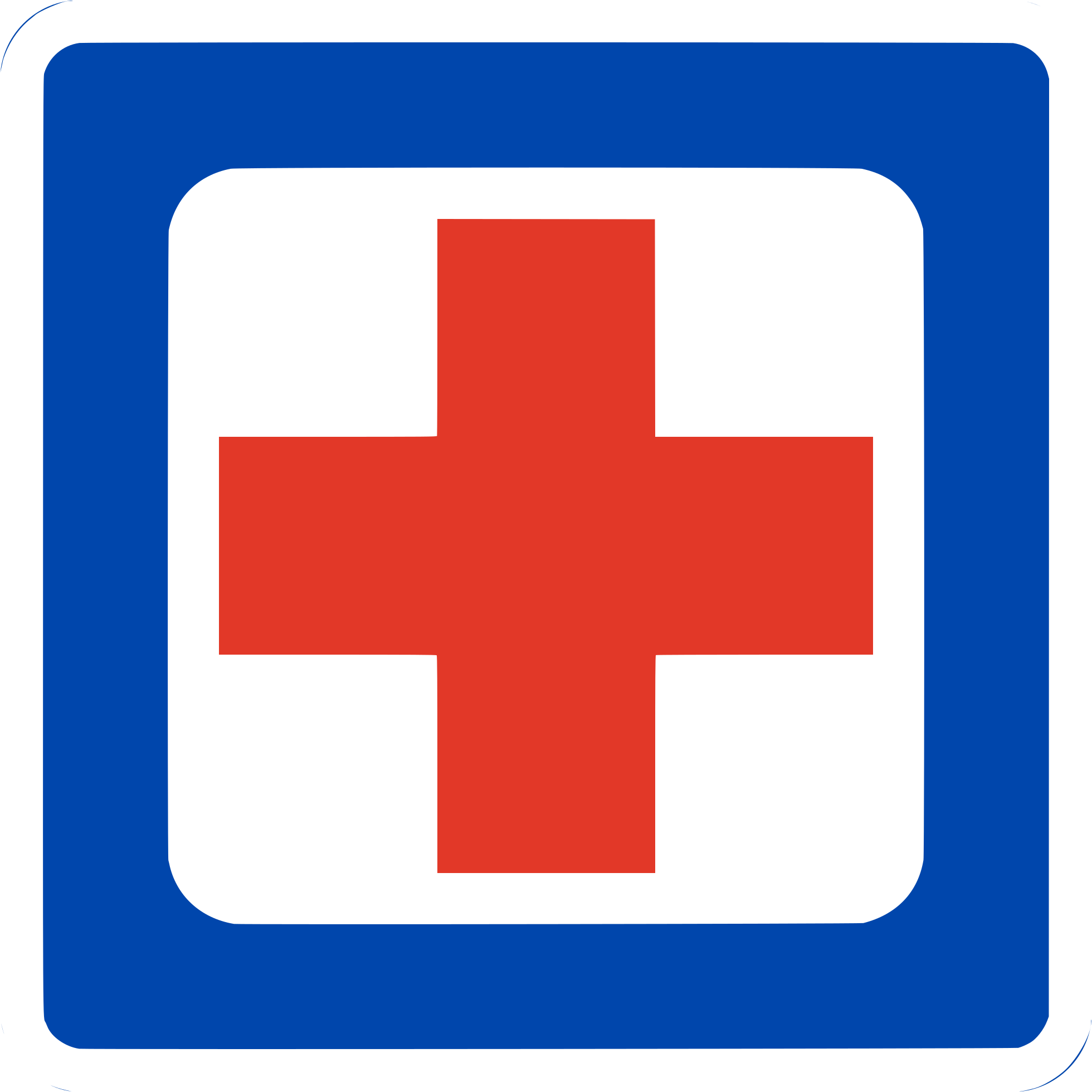
First aid: the sign shows where first aid is available.
605
Nødtelefon
Emergency telephone
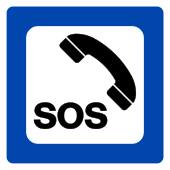
Emergency telephone: the sign shows where the nearest emergency telephone is.
606
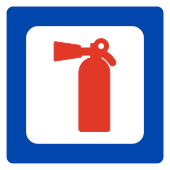
Brannslokningsapparat
Fire extinguisher
Fire extinguisher: the sign shows where a fire extinguisher is, typically in a tunnel.
608
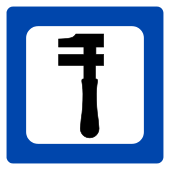
Kjøretøyverksted
Vehicle workshop
Vehicle workshop: the sign points to a vehicle workshop.
609
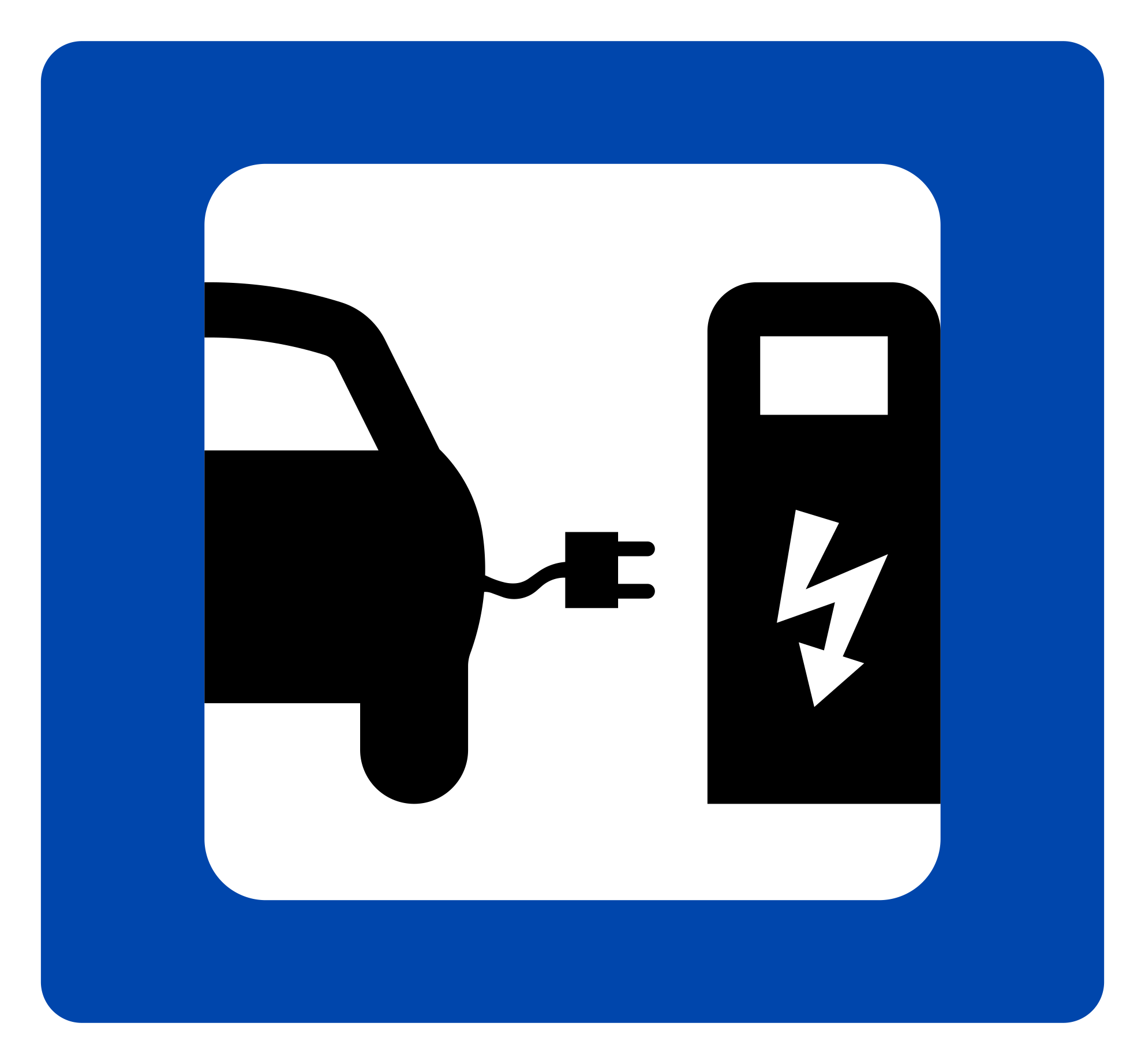
Hurtiglading av motorvogn
Fast charging
Fast charging: the sign points to fast charging for an electric vehicle.
610.1
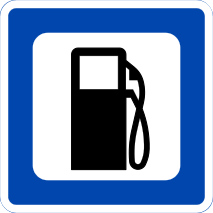
Drivstoff
Fuel
Fuel: the sign points to a filling station.
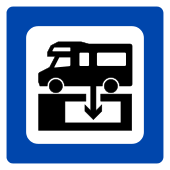
611
Toalettømmeanlegg
Toilet waste disposal facility
Toilet waste disposal facility: the sign marks a disposal point for toilet waste from motorhomes, caravans and buses.
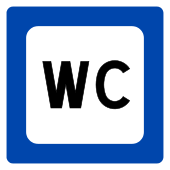
612
Toalett
Toilet
Toilet: the sign shows where there is a toilet.
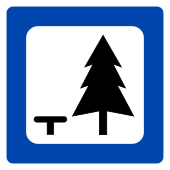
613.1
Rasteplass
Rest area
Rest area: the sign marks a rest area beside the road.
614
Enklere servering
Refreshments
Refreshments: the sign points to simple refreshments, a kiosk or a café.
616
Spisested
Restaurant
Restaurant: the sign points to a place to eat.
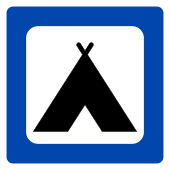
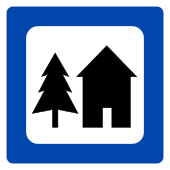
618
Campingplass
Camping site
Camping site: the sign points to a camping site.
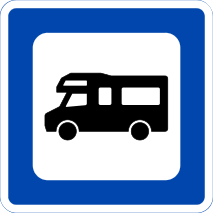
621
Bobilplass
Motorhome site
Motorhome site: the sign points to a site laid out for motorhomes.
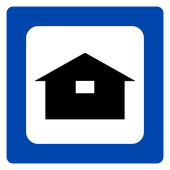
622
Campinghytter
Camping cabins
Camping cabins: the sign points to camping cabins.
624
Vandrerhjem
Youth hostel
Youth hostel: the sign points to a youth hostel.
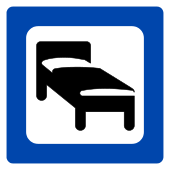
626
Overnattingssted
Accommodation
Accommodation: the sign points to accommodation.
635
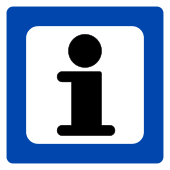
Informasjon
Information
Information: the sign shows where there is information for travellers.
637
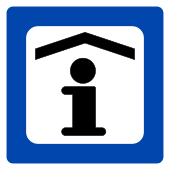
Turistkontor
Tourist office
Tourist office: the sign points to a tourist office.
640.10
Severdighet
Place of interest
Place of interest: the sign points to a place of interest.
640.101
Verdensarv
World heritage site
World heritage site: the sign points to a world heritage site.
640.102
Nasjonale festningsverk
National fortification
National fortification: the sign points to a national fortification.
640.12
Museum/galleri
Museum or gallery
Museum or gallery: the sign points to a museum or a gallery.
640.20
Utsiktspunkt
Viewpoint
Viewpoint: the sign points to a viewpoint.
640.30
Naturvernområde
Nature conservation area
Nature conservation area: the sign marks a nature conservation area.
650.10
Badeplass
Bathing place
Bathing place: the sign points to a bathing place.
650.11
Fiskeplass
Fishing spot
Fishing spot: the sign points to a fishing spot.
650.20
Tursti
Walking trail
Walking trail: the sign points to a walking trail.
650.21
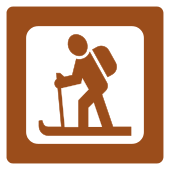
Skiløype
Ski trail
Ski trail: the sign points to a ski trail.
650.22
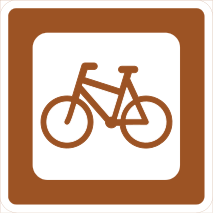
Sykkelløype
Cycle trail
Cycle trail: the sign points to a cycle trail.
650.40
Gardsmat/bygdeturisme
Farm food and rural tourism
Farm food and rural tourism: the sign points to farm food or rural tourism.
650.41
Olavsrosa
Olavsrosa quality mark
Olavsrosa quality mark: the sign points to a place carrying the Olavsrosa quality mark.
Vegvisningsskilt — Direction and route signs
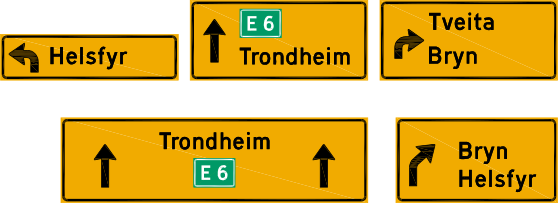
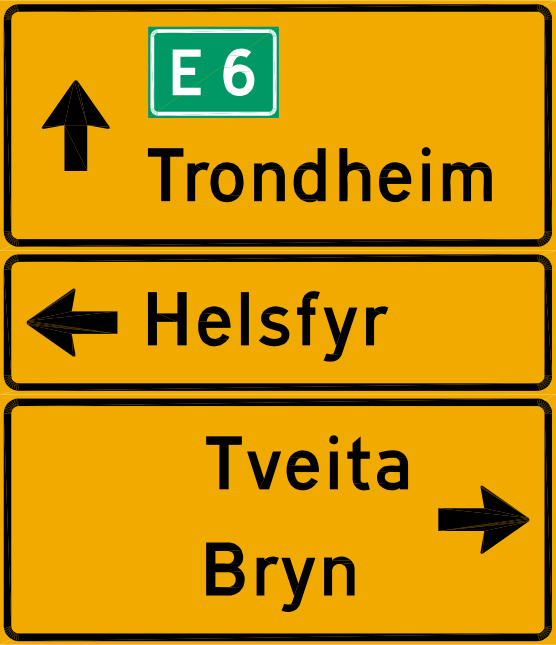
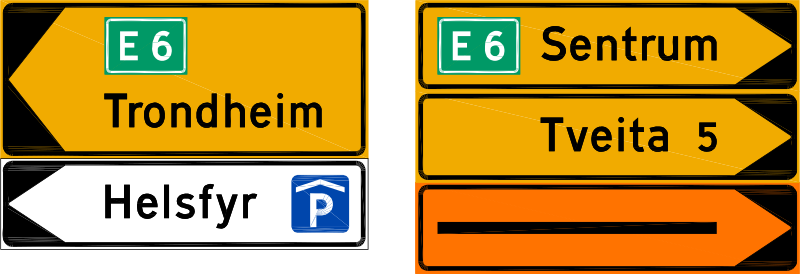
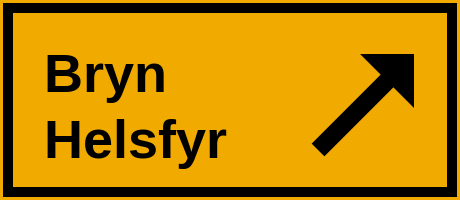
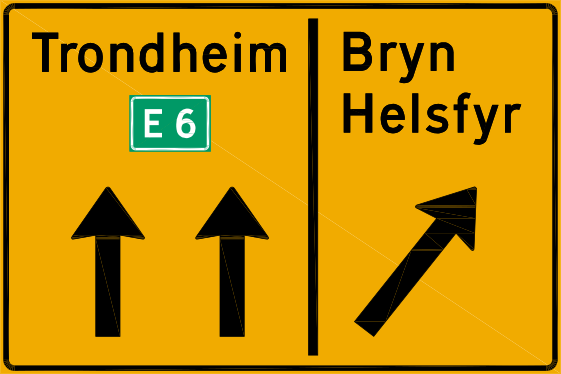
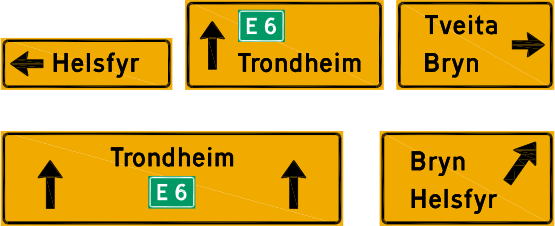
Direction signs and place names: destinations, distances in km, route numbers (E6, national and county roads), detours, cycle routes. For signs 701–719 and 725, § 15 distinguishes geographic destinations (blue on motorways, yellow on other roads), non-geographic destinations (white), temporary diversions (orange), and destinations of particular tourist interest (brown). Class guide: direction and route signs — dedicated page
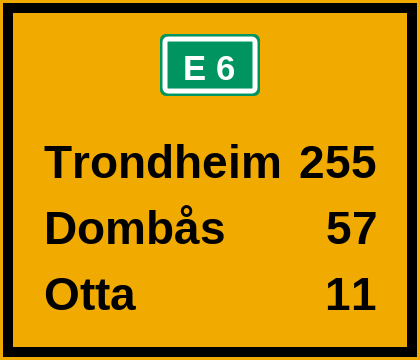
701
Tabellorienteringstavle
Table advance direction sign
Table advance direction sign: the sign gives advance warning of a junction and lists road numbers and destinations in a table.
703
Diagramorienteringstavle
Diagram advance direction sign
Diagram advance direction sign: the sign gives advance warning of a junction and draws its shape as a diagram.
705
Avkjøringstavle
Exit advance sign
Exit advance sign: the sign gives advance warning of an exit road and shows where it leads.
707
Kjørefeltorienteringstavle
Lane advance direction sign
Lane advance direction sign: the sign shows how many lanes run up to the junction and where each lane leads.
709
Portalorienteringstavle
Gantry advance direction sign
Gantry advance direction sign: the sign hangs over the carriageway and shows which direction or destination each lane is for.
711
Tabellvegviser
Table direction sign
Table direction sign: the sign stands at the junction and lists the destinations of each arm in a table.
713
Vanlig vegviser
Ordinary direction sign
Ordinary direction sign: the sign is the ordinary arrow-shaped direction sign at the junction.
715
Avkjøringsvegviser
Exit direction sign
Exit direction sign: the sign stands at the exit itself and shows where the exit road leads.
717
Kjørefeltvegviser
Lane direction sign
Lane direction sign: the sign shows which destinations each lane is intended for.
719
Portalvegviser
Gantry direction sign
Gantry direction sign: the sign hangs over the carriageway at the junction and shows the destinations for each lane.
723.11
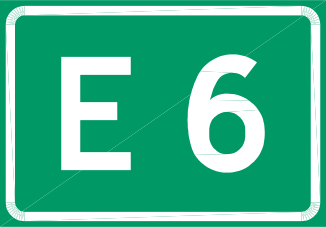
Vegnummer for europaveg
European route number
European route number: the sign shows the number of a European route, for example E6.
723.13
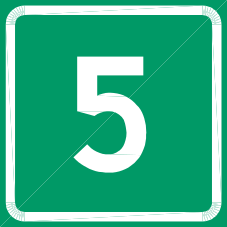
Vegnummer for riksveg som ikke er europaveg
Road number for a national road that is not a European route
Road number for a national road that is not a European route: the sign shows the number of a national road that is not a European route.
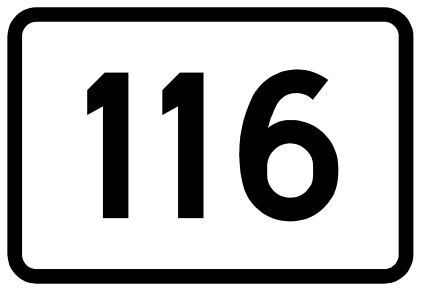
723.15
Vegnummer for nummerert fylkesveg
County road number
County road number: the sign shows the number of a numbered county road.
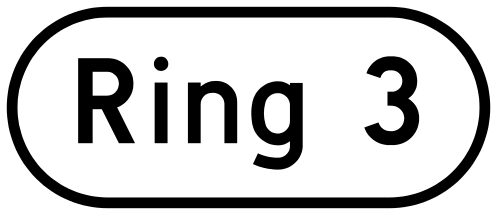
723.21
Ringveg/ringrute
Ring road or ring route
Ring road or ring route: the sign marks a ring road or ring route, for example Ring 3.
723.31
Nasjonal turistveg
National tourist route
National tourist route: the symbol shows that the road is a national tourist route.
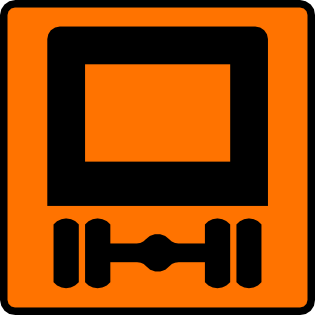
723.41
Omkjøringsrute for store kjøretøy
Diversion route for large vehicles
Diversion route for large vehicles: the sign shows the diversion route for large vehicles.
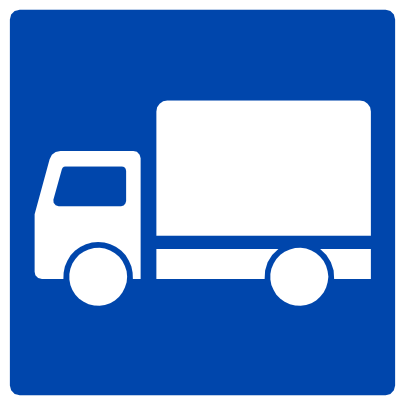
723.51
Rute for transport av farlig gods
Dangerous goods route
Dangerous goods route: the sign shows the route for the transport of dangerous goods.
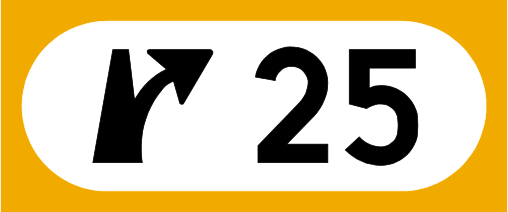
723.61
Andre omkjøringsruter
Other diversion routes
Other diversion routes: the sign marks a diversion route other than those with their own symbols.
723.71
Kryssnummer på flerfeltsveg
Junction number on a multi-lane road
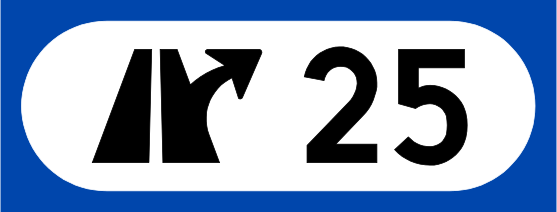
Junction number on a multi-lane road: the sign shows the number of the junction on a multi-lane road.
723.73
Kryssnummer på tofeltsveg
Junction number on a two-lane road
Junction number on a two-lane road: the sign shows the number of the junction on a two-lane road.
725
Avstandsskilt
Distance sign
Distance sign: the sign shows how many kilometres remain to the stated destinations or to the nearest junction or exit.
727
Stedsnavnskilt
Place-name sign
Place-name sign: the sign shows the name of the place you are entering, or an administrative boundary.
729
Gate-/vegnavnskilt
Street or road name sign
Street or road name sign: the sign shows the name of the street or road.
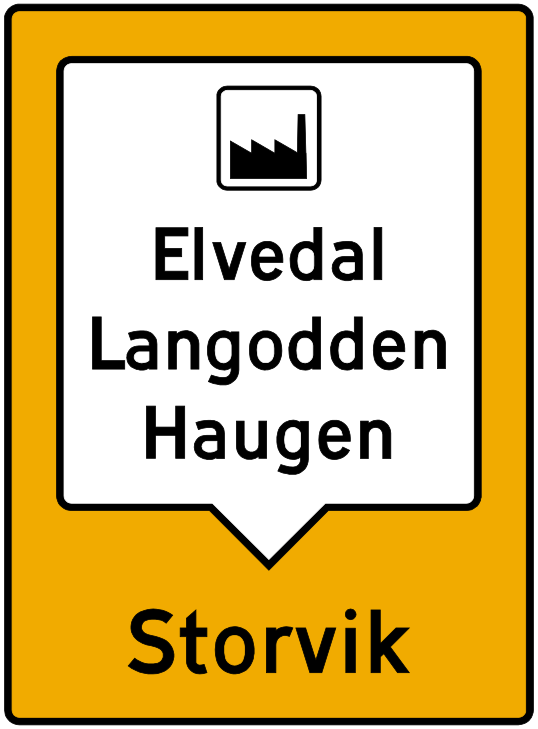
731
Samleskilt for vegvisning
Collective direction sign
Collective direction sign: the sign gathers several destinations reached through one and the same choice of road ahead.
741
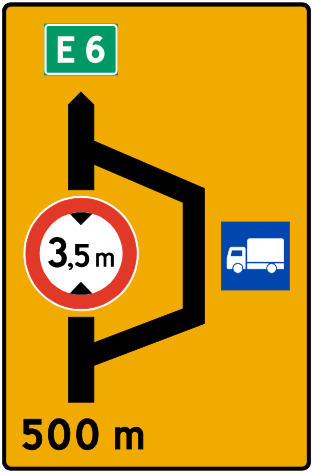
Omkjøring for bestemte kjøretøygrupper
Diversion for certain vehicle groups
Diversion for certain vehicle groups: the sign warns that the road is closed to certain vehicle groups, which must follow a diversion.
743
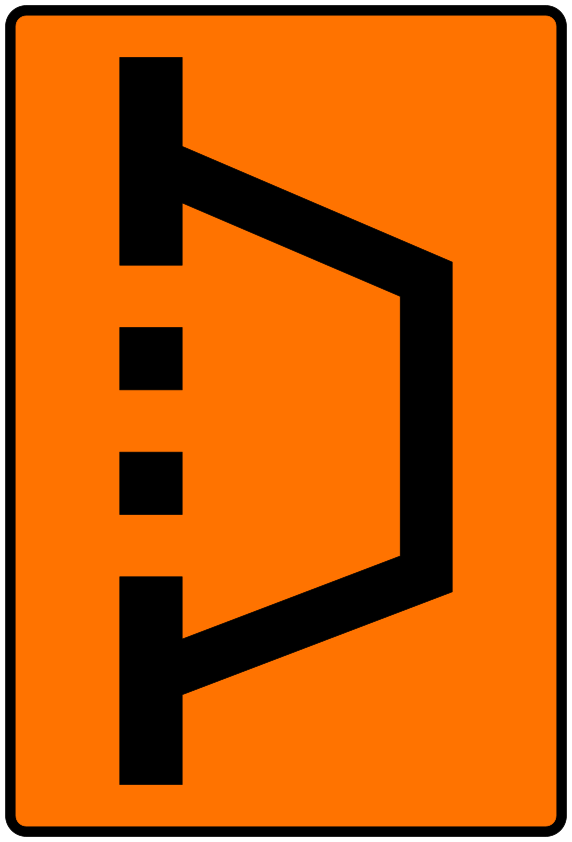
Midlertidig omkjøring
Temporary diversion
Temporary diversion: the sign warns that the road is temporarily closed and that through traffic must follow the diversion.
745
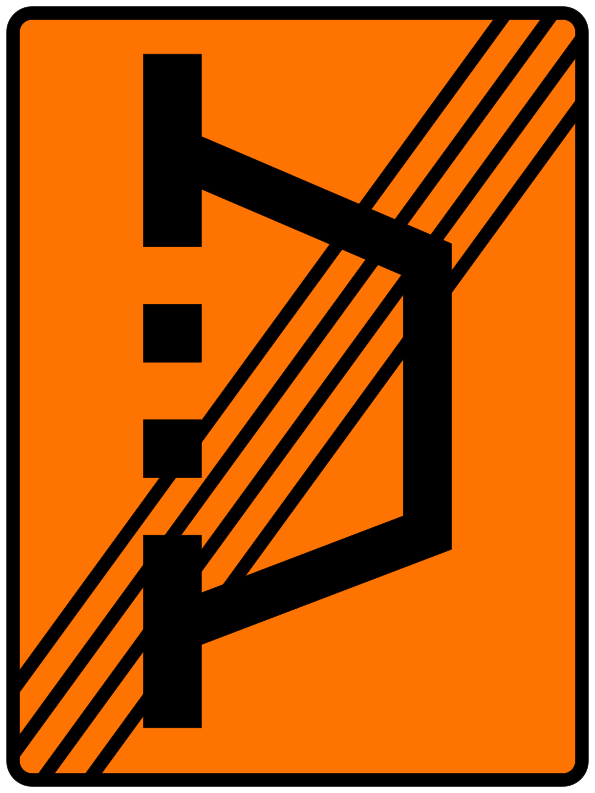
Slutt på midlertidig omkjøring
End of temporary diversion
End of temporary diversion: the sign shows that the temporary diversion ends here.
749
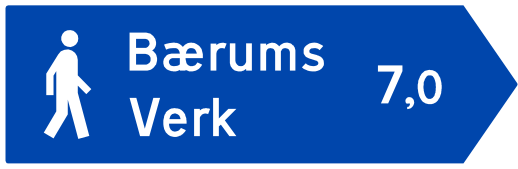
Vegviser for gangtrafikk
Pedestrian direction sign
Pedestrian direction sign: the sign shows the way for pedestrians and may carry the symbol for the mobility impaired.
751
Vegviser for sykkelrute
Cycle route direction sign
Cycle route direction sign: the sign is the arrow-shaped direction sign for a cycle route.
753
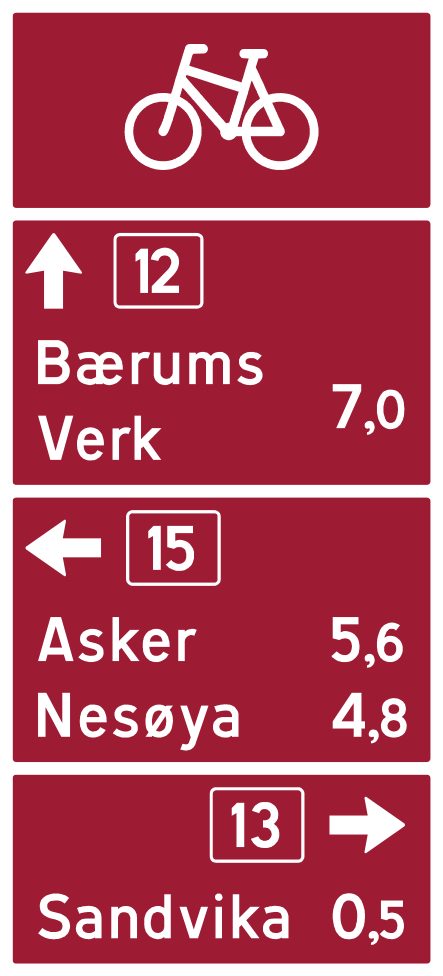
Tabellvegviser for sykkelrute
Table cycle route direction sign
Table cycle route direction sign: the sign lists several cycle route destinations in a table.
755
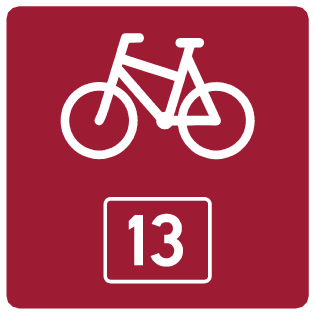
Sykkelruteskilt
Cycle route sign
Cycle route sign: the sign confirms that you are following a particular cycle route and shows its number.
757
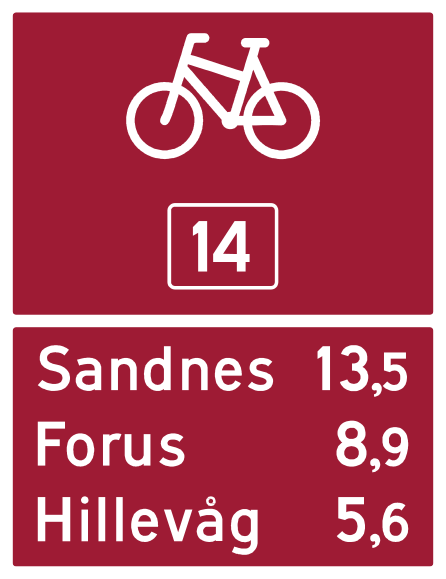
Avstandsskilt for sykkelrute
Cycle route distance sign
Cycle route distance sign: the sign shows the distance along the cycle route to the destinations.
Underskilt — Supplementary plates
Plates for a main sign: distance, stretch of road, times, vehicle group symbols, arrows for stopping and parking. Under § 17 nr. 1 a plate (underskilt) has effect only together with a main sign. Class guide: supplementary plates — dedicated page
802
Avstand
Distance
Distance (Avstand): the supplementary sign plate (underskilt) shows how far it is to the place where the main sign begins to apply, or to the place where the same main sign is erected (advance warning).
804
Utstrekning
Extent
Extent (Utstrekning): the supplementary sign plate (underskilt) shows that the main sign applies to a specific stretch of road. The figures show the distance to the start and end of the stretch.
806
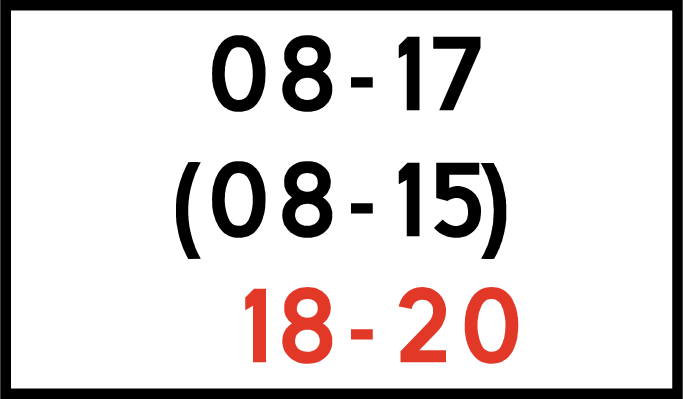
Tid
Time
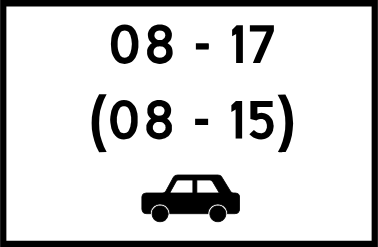
Time (Tid): the main sign applies only during the periods shown on the supplementary sign plate (underskilt). Black figures apply to weekdays except Saturday, black figures in brackets apply to Saturday, and red figures apply to Sunday, holy days and public holidays.
807.1
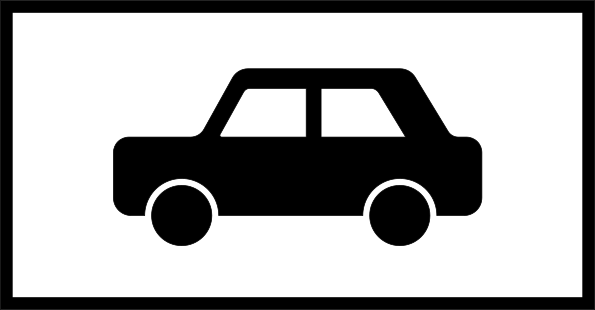
Personbil
Passenger car
Symbol for a passenger car (personbil): on a supplementary sign plate (underskilt) the symbol means that the main sign applies to passenger cars.
807.2
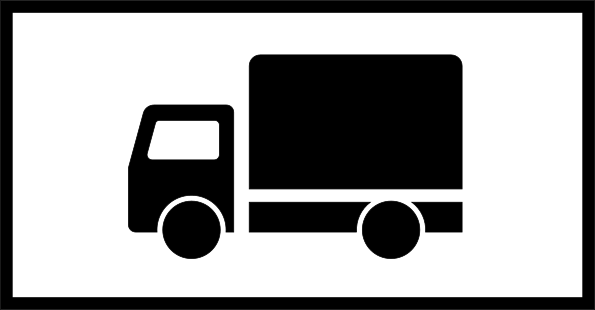
Varebil, lastebil og trekkbil
Van, lorry and tractor unit
Symbol for a van, lorry and tractor unit (varebil, lastebil og trekkbil): on a supplementary sign plate (underskilt) the symbol means that the main sign applies to these vehicles.
807.3
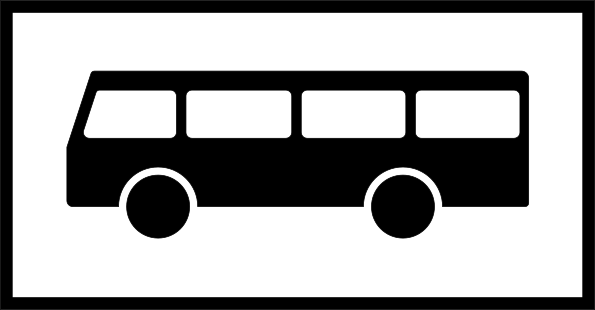
Buss
Bus
Symbol for a bus (buss): on a supplementary sign plate (underskilt) the symbol means that the main sign applies to buses.
807.4
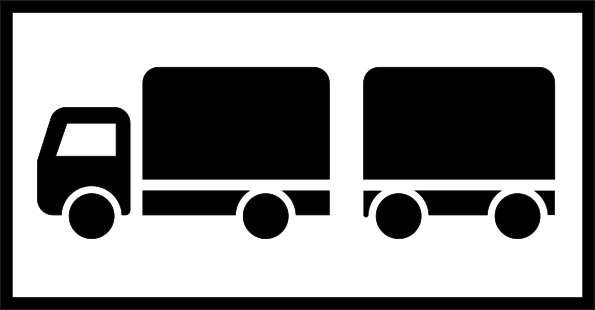
Vogntog
Vehicle combination
Symbol for a vehicle combination (vogntog): on a supplementary sign plate (underskilt) the symbol means that the main sign applies to vehicle combinations.
807.5
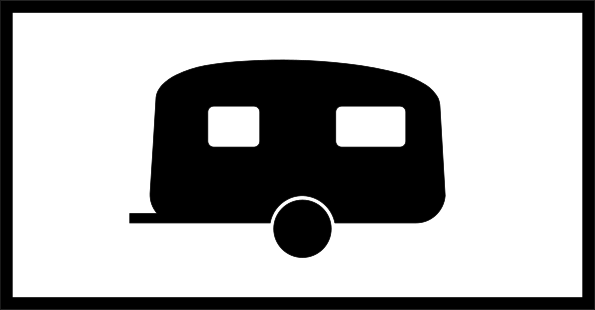
Tilhenger særskilt innredet til campingbruk, samt eventuell trekkvogn
Trailer specially fitted out for camping, and any towing vehicle
Symbol for a trailer specially fitted out for camping, and any towing vehicle: on a supplementary sign plate (underskilt) the symbol means that the main sign applies to these vehicles.
807.6
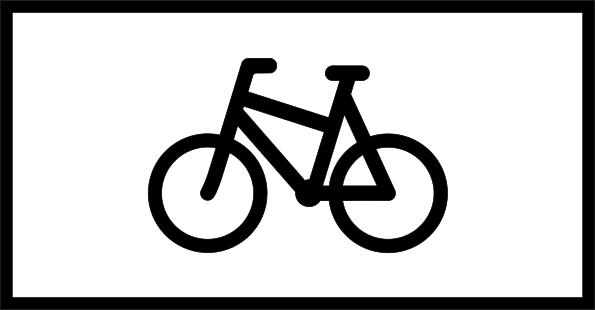
Sykkel og liten elektrisk motorvogn
Bicycle and small electric motor vehicle
Symbol for a bicycle and small electric motor vehicle: on a supplementary sign plate (underskilt) the symbol means that the main sign applies to these.
807.7
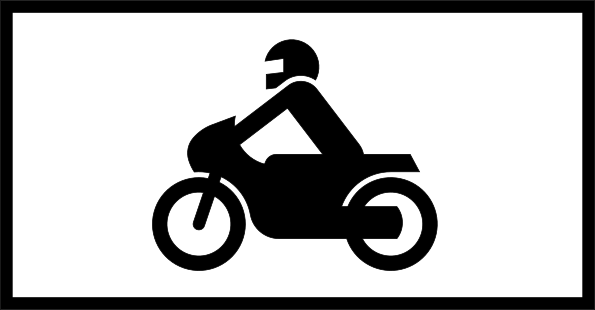
Tohjuls motorsykkel med og uten sidevogn og tohjuls moped
Two-wheeled motorcycle with and without a sidecar, and two-wheeled moped
Symbol for a two-wheeled motorcycle with and without a sidecar, and a two-wheeled moped: on a supplementary sign plate (underskilt) the symbol means that the main sign applies to these vehicles.
807.8
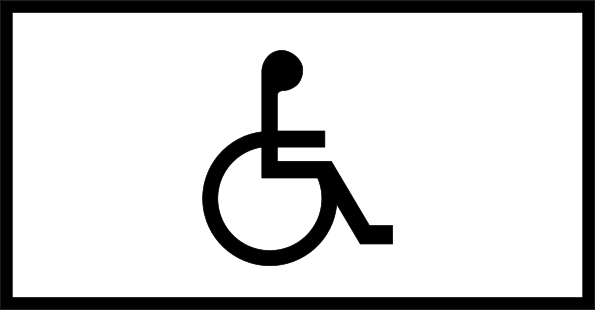
Forflytningshemmede med parkeringstillatelse
People with impaired mobility with a parking permit
Symbol for people with impaired mobility with a parking permit: on a supplementary sign plate (underskilt) the symbol means that the main sign applies to this group. Under sign 552 «Parkering» (parking) the parking is reserved for this group, loading and unloading are prohibited, and boarding and alighting are allowed.
807.9
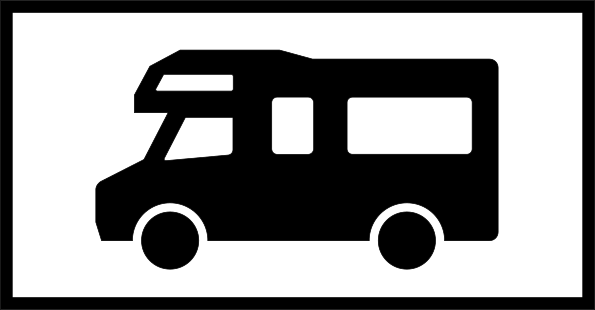
Kjøretøy særskilt innredet til campingbruk (bobil)
Vehicle specially fitted out for camping (motorhome)
Symbol for a vehicle specially fitted out for camping (motorhome, bobil): on a supplementary sign plate (underskilt) the symbol means that the main sign applies to motorhomes.
808
Tekst
Text
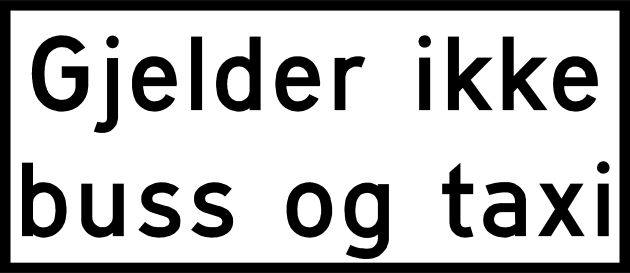
Text (Tekst): a supplementary sign plate (underskilt) with text is used when the regulation or information cannot suitably be given by a symbol, figures or the like.
810
Svingpil
Turn arrow
Turn arrow (Svingpil): the supplementary sign plate (underskilt) shows that the main sign applies after turning at the junction.
812
Anbefalt fart
Recommended speed
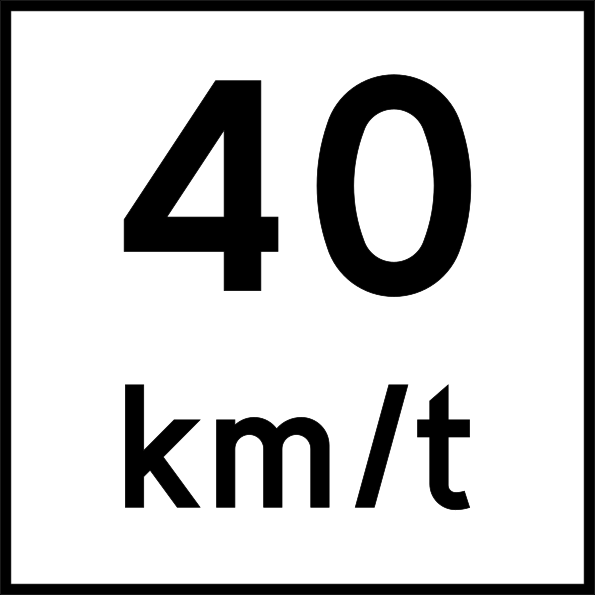
Recommended speed (Anbefalt fart): a supplementary sign plate (underskilt) under a warning sign (fareskilt). It shows the highest speed the danger allows under normal weather, road, visibility and light conditions.
813
Stigningsgrad
Gradient
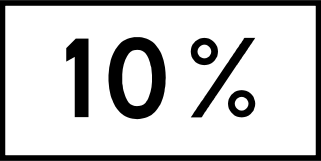
Gradient (Stigningsgrad): a supplementary sign plate (underskilt) under a warning sign (fareskilt). It shows how steep the road is, as a percentage.
814
Virkelig fri vegbredde
Actual clear road width
Actual clear road width (Virkelig fri vegbredde): a supplementary sign plate (underskilt) under a warning sign (fareskilt). It shows how wide the road actually is where it is clear, in metres.
816
Kryssende tømmertransport
Crossing timber transport
Crossing timber transport (Kryssende tømmertransport): a supplementary sign plate (underskilt) under a warning sign (fareskilt). It warns of timber transport crossing the road.
817
Særlig ulykkesfare
Special accident hazard
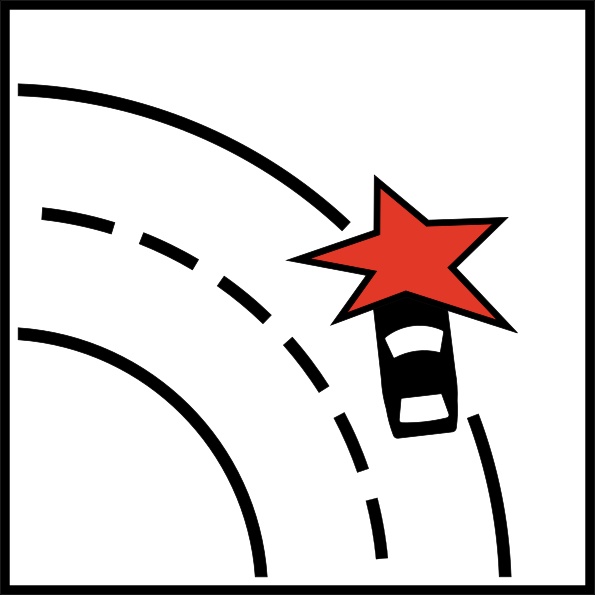
Special accident hazard (Særlig ulykkesfare): a supplementary sign plate (underskilt) under a warning sign (fareskilt). The design is adapted to the hazardous situation in question.
822
Forløp av forkjørsveg
Course of the priority road
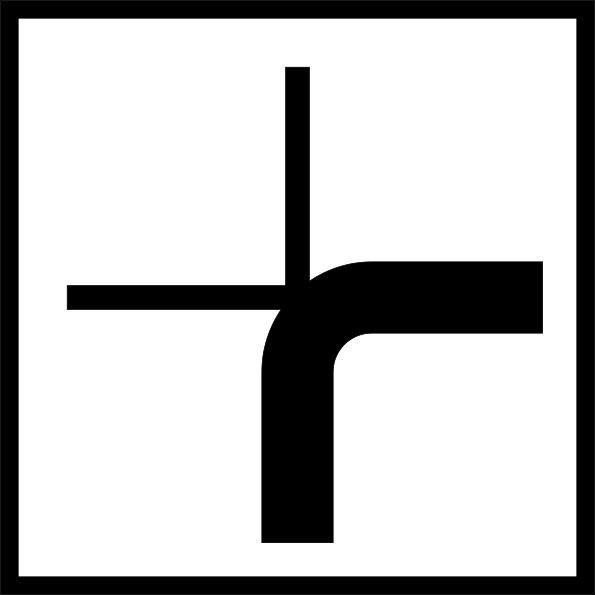
Course of the priority road (Forløp av forkjørsveg): the supplementary sign plate (underskilt) shows a schematic picture of the junction. The thick line is the priority road (forkjørsveg), the thin line is the road with sign 202 «Vikeplikt» (give way) or 204 «Stopp» (stop).
828
Utstrekning av stans- og parkeringsregulering
Extent of stopping and parking regulation
Extent of stopping and parking regulation (Utstrekning av stans- og parkeringsregulering): the supplementary sign plate (underskilt) shows that the regulation applies in the direction of the arrow and, where a specified distance is given, for that distance. Arrow both ways: applies in both directions of travel. Arrow pointing down: applies against the direction of travel. Arrow pointing up: applies in the direction of travel.
829
Oppstilling av parkert kjøretøy
Positioning of a parked vehicle
Positioning of a parked vehicle (Oppstilling av parkert kjøretøy): the supplementary sign plate (underskilt) shows how the vehicle must be positioned.
831
Parkeringsskive/gratisbillett
Parking disc/free ticket
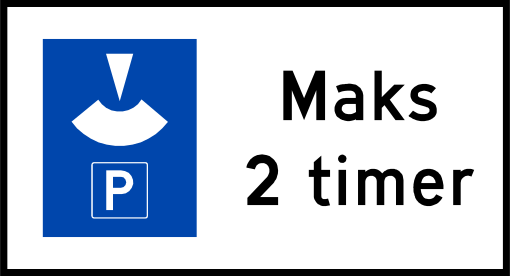
Parking disc/free ticket (Parkeringsskive/gratisbillett): parking is permitted only when a parking disc or a ticket from a parking machine is clearly visible behind the windscreen and shows the time.
834
Kombinert regulering
Combined regulation
Combined regulation (Kombinert regulering): the supplementary sign plate (underskilt) shows a parking regulation by a combination of text, figures, symbols and the like from other supplementary sign plates.
Vegoppmerking — Road markings
Lines and road surface markings: longitudinal yellow lane separators divide opposing traffic flows; white lines can separate lanes in the same direction or mark the road edge. Edge lines alone do not establish one-way traffic. Also included are stop lines, pedestrian crossings, lane arrows. Road markings work together with signs — and form part of the official theory exam topic Skilt og oppmerking. Class guide: road markings — dedicated page
1000
Kjørefeltlinje
Lane line
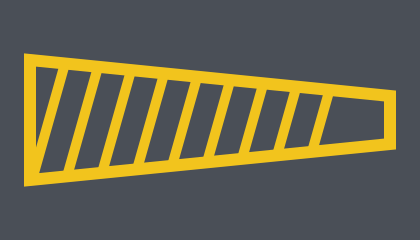
Kjørefeltlinje is the broken line between lanes, and it may be crossed when the lane change is made in accordance with the traffic rules.
1002
Varsellinje
Warning line
A yellow varsellinje means the view ahead is too short for a normal overtaking, while a white varsellinje warns that changing lane is hazardous.
1004
Sperrelinje
Barrier line
Sperrelinje is a solid line separating lanes: you must not drive on or across it, and never to the left of a yellow sperrelinje.
1006
Kombinerte linjer
Combined lines
Where a varsellinje and a sperrelinje run side by side, the line nearest you applies, but a driver who has already moved into the oncoming lane may still return to the right-hand side.
1008
Skillelinje
Dividing line
Skillelinje separates an ordinary lane from a lane for special use, such as kollektivfelt, sambruksfelt, tungtrafikkfelt, sykkelfelt or an acceleration/deceleration lane.
1010
Ledelinje
Guide line
Ledelinje shows how the lane or the turning movement is guided through a junction.
1012
Kantlinje
Edge line
Kantlinje marks the outer edge of the kjørebane (carriageway) — where the carriageway ends.
1014
Sperreområde
Closed area
You must not drive on a sperreområde bounded by a solid line, and two parallel sperrelinjer no more than 100 cm apart with milling between them also count as a sperreområde.
1020
Stopplinje
Stop line
Stopplinje shows where the vehicle must stop when an official traffic sign or a light signal requires stopping.
1022
Vikelinje
Give way line
Vikelinje shows the point at which your vikeplikt (duty to give way) takes effect.
1024
Gangfelt
Pedestrian crossing
There is a marked pedestrian crossing here, even when sign 516 «Gangfelt» has not been erected. At a pedestrian crossing where traffic is not controlled by police or traffic-light signals, a person who is driving has a duty to give way to pedestrians in the crossing or on their way into it, cf. trafikkreglene § 9 nr. 2.
1026
Sykkelkryssing
Bicycle crossing
Sykkelkryssing marks the place where cyclists and riders of a liten elektrisk motorvogn cross the carriageway.
1027
Fartshump
Speed bump
Road marking 1027 is painted on the physical speed hump (fartshump) itself, making it visible from a distance. It has no regulating effect of its own — it only warns of the hump.
1028
Parkeringsfelt
Parking bay
A parked vehicle must stand inside the marked parkeringsfelt, though an electric or hydrogen-powered vehicle may park across the bay if all wheels are inside it and the overhang is no more than 40 cm on each side.
1034
Piler
Arrows
Arrows in the lane ahead of a junction show which directions the lane must be used for; where the lane is bounded by a sperrelinje the direction is mandatory, and slanted arrows warn that the lane is ending.
1036
Vikesymbol
Give way symbol
The vikeplikt triangle on the road surface gives advance warning of the give-way duty signed with 202 «Vikeplikt»; it is normally painted 50–100 m before the vikelinje.
1037
Gangsymbol
Pedestrian symbol
Shows pedestrians where they belong: it supplements signs 518 «Gangveg» and 522 «Gang- og sykkelveg», and is also used on footways adjoining a cycle path.
1038
Delesymbol
Sharing symbol
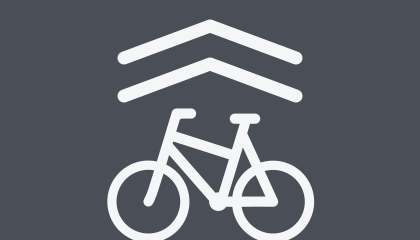
A «sharrow» — a bicycle with chevrons above it — showing that cyclists and cars share the lane. It links cycle routes over short stretches with no dedicated cycling infrastructure, at 30–40 km/h speed limits.
1039
Sykkelsymbol
Bicycle symbol
Sykkelsymbol marks a sykkelfelt (cycle lane): where the symbol is painted, the lane is for cyclists and small electric vehicles, and stopping in it is banned (trafikkreglene §§ 4 and 17).
1040
Parkeringssymbol
Parking symbol
The P painted on the surface marks parking bays signed with 552 «Parkering» and parking areas in a gatetun. It has no regulating effect of its own — the sign sets the rules.
1041
Liten elektrisk motorvogn
Small electric vehicle
Marks parking bays for a liten elektrisk motorvogn (e.g. an e-scooter) signed with 552 «Parkering», and designates parking areas for such vehicles.
1042
Symbol for forflytningshemmede
Symbol for persons with reduced mobility
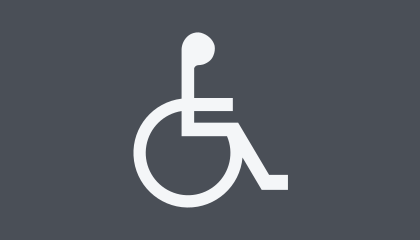
Supplements parking-regulation signs by marking a bay reserved for people with impaired mobility (forflytningshemmede). Where the bay is reserved around the clock, the symbol must be painted.
1044
Skinnekjøretøy
Rail vehicle
The symbol warns of rail vehicles: it is painted where pedestrians cross tram tracks at a specially designated crossing point.
1050
Tekst
Text
Text on the road surface supplements signs and road markings: «STOPP» (stop) at sign 204 and the stop line, «BUSS» (bus) and «TAXI» in bus lanes and at stops, «SKOLE» (school) near a school by the road, road numbers and place names supplementing direction signs.
1052
Sambruksfelt
High-occupancy vehicle lane
The number in the sambruksfelt states the minimum number of people that must be in the vehicle for it to use the lane.
1053
Tungtrafikkfelt
Heavy vehicle lane
Marks a tungtrafikkfelt (heavy-vehicle lane): the lane is introduced by sign 506 «Tungtrafikkfelt», ended by 507, and is marked like a bus lane, separated by a skillelinje.
1054
Fartsgrense
Speed limit
Speed-limit digits on the road surface supplement the signs: «30» is used in 30 km/h zones in urban areas, «50»–«70» to underline the limit in force at speed cameras (ATK).
1055
Bildeling
Car sharing
The text «Bildeling» (car sharing) marks parking bays for car-sharing: it supplements sign 552 «Parkering» (parking) with a sub-sign reserving the bay for car-share vehicles.
Lyssignaler — Light signals
Traffic lights and special signals: standard three-colour signals, arrows, lane control signals, flashing red lights at crossings. Traffic light signals take precedence over priority signs, but yield to instructions from the police or traffic controllers. Class guide: light signals — dedicated page
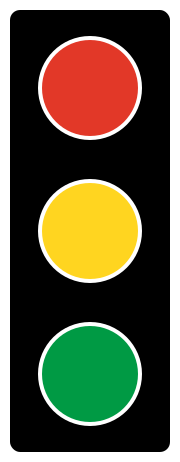
1080
Hovedsignal
Main signal
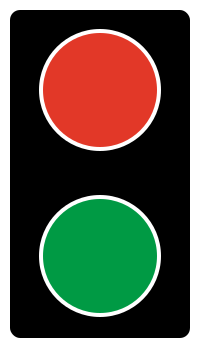
Red means you must not pass the signal or the stop line (stopplinje), red with amber warns that green is about to appear, green means you may drive on if the road is clear, and amber alone means you must stop unless you are so close that stopping cannot be done safely.
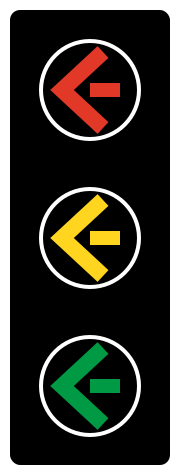
1082
Pilsignal
Arrow signal
An arrow signal (pilsignal) applies only to those driving in the direction the arrow shows, and it may have one, two or three light apertures.
1084
Sykkelsignal
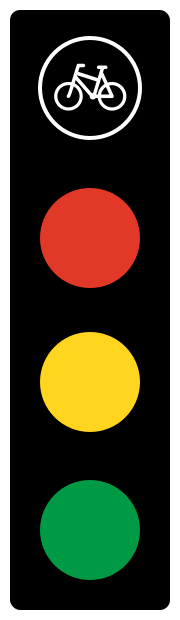
Bicycle signal
A bicycle signal (sykkelsignal) applies to those riding in a cycle lane (sykkelfelt) or across a cycle crossing (sykkelkryssing), and it may be built as an arrow signal.
1086
Fotgjengersignal
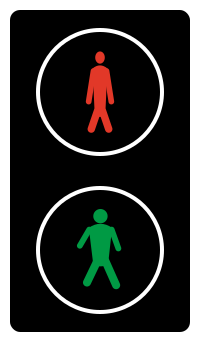
Pedestrian signal
At a red pedestrian signal, pedestrians must not begin crossing the carriageway if doing so would obstruct a person who is driving or involve danger. Those already on the carriageway may continue crossing. Green permits crossing. Flashing green warns of an imminent change to red and has the same meaning as red.
1088
Signal for kollektivtrafikk
Signal for public transport
The lights in a signal for public transport mean the same as the lights in the corresponding aperture of the main signal (hovedsignal).
1090
Kjørefeltsignal
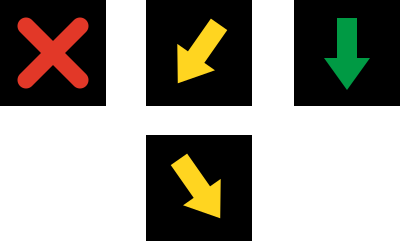
Lane signal
A red cross means the lane must not be used in the direction facing the signal, a green arrow that the lane may be used, and a yellow arrow that the lane is being closed and you must change lane at once in the direction of the arrow.
1092
Tolyssignal
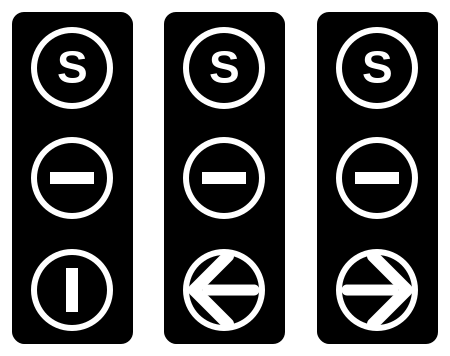
Two-light signal
A red two-light signal (tolyssignal) means you must not pass the signal or the stop line (stopplinje) and green that it may be passed; breaching a two-light signal is not punishable.
1094
Rødt stoppblinksignal
Red flashing stop signal
A red flashing stop signal (rødt stoppblinksignal) shows one or two alternately flashing red lights and means you must not pass, but stop at the stop line (stopplinje) or at a safe distance in front of the signal.
1096
Blinkende signal foran jernbane
Flashing signal ahead of railway
A red flashing signal in front of a railway means you must stop at the stop line (stopplinje) or at a safe distance before the signal, while a white flashing signal shows the installation is in operation and the level crossing (planovergang) may be crossed in accordance with the traffic rules.
1098
Gult blinksignal
Yellow flashing signal
A yellow flashing signal means road users must show particular alertness and caution.
1100
Blinkende lyspil
Flashing light arrow
A flashing light arrow (blinkende lyspil) indicates on which side road users are to pass.
Sign figures are official illustrations from skiltforskriften (Lovdata), public domain vector drawings from Wikimedia Commons, and custom vectors based on official figures. English translations and explanations are our unofficial guides; only the Norwegian statutory text has legal force.
FAQ
Where is the official list of all Norwegian road signs?
In skiltforskriften on Lovdata — the official regulations defining every sign, its code, figure, and legal meaning. Our catalogue is built directly on its statutory definitions.
What does the sign number mean — for example, 362?
It is the official sign code from skiltforskriften: 362 is Fartsgrense (speed limit). In this catalogue, each sign displays its code so you can easily find it in the law.
How should I learn the signs for the theory exam?
Browsing the catalogue is helpful, but active recall in practice tests is where memory sticks. In the Teorix trainer, sign questions include instant step-by-step explanations: start with the first question — the first questions are free.