Giving Way Means Showing It in Advance
The Norwegian rule requires not merely "letting someone pass", but making your intention clearly visible in advance: slowing down or stopping early enough so that the driver with right of way can proceed without hesitating. The important point is to show your intention early enough for others to understand it.
«Trafikant som det skal vikes for, må ikke hindres eller forstyrres. Den som har vikeplikt, skal tydelig vise dette ved i god tid å sette ned farten eller stanse.»
A road user who must be given way to must not be obstructed or disturbed. Whoever has vikeplikt shall show this clearly by slowing down or stopping in good time. (unofficial translation)
The practical implication: rolling up to a junction at normal speed and braking hard at the last second is an error, even if no collision occurs. You are legally required to demonstrate that you are giving way well in advance.
Priority to the Right — The Default Rule
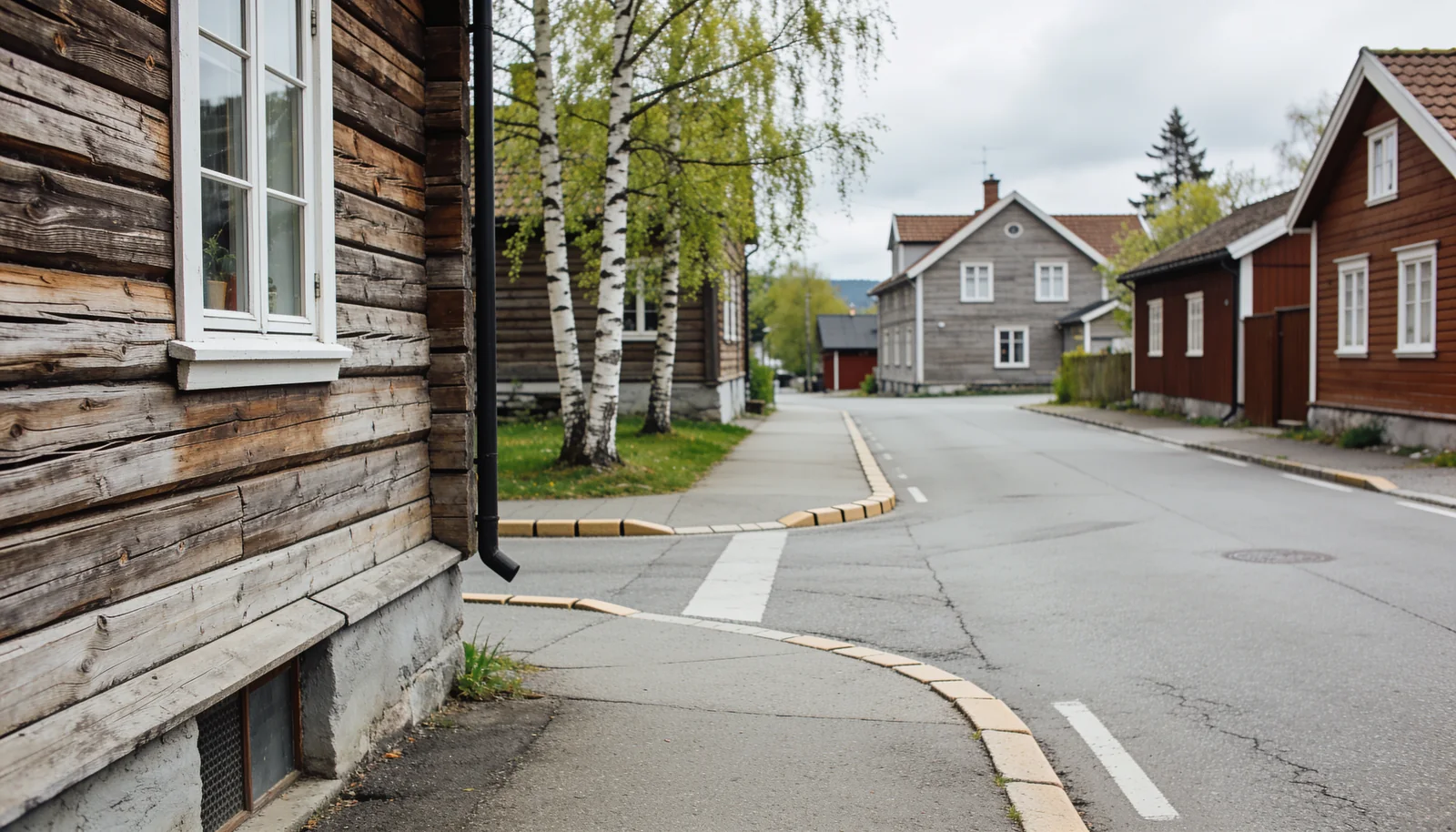
At an ordinary road junction, unless traffic controls or a special give-way rule applies, høyreregelen (priority to the right) applies: you must give way to traffic approaching from your right. In Norway, this is not an exception but the general rule: residential areas are full of uncontrolled junctions without a single sign.
«Kjørende har vikeplikt for kjøretøy som kommer fra høyre. Det samme gjelder når kjørende som vil svinge til venstre, vil få kjøretøy på sin høyre side.»
Drivers have vikeplikt for vehicles coming from the right. The same applies when a driver who intends to turn left will have a vehicle on their right-hand side. (unofficial translation)
The second sentence of the norm governs left turns: when turning left, oncoming traffic ends up on your right-hand side — meaning you must give way to oncoming vehicles proceeding straight ahead or turning right.
Crucially, on roads designated as priority roads by the Forkjørsveg sign, priority to the right does not apply — priority is determined by signs (see class below).
Signs That Override the General Rule
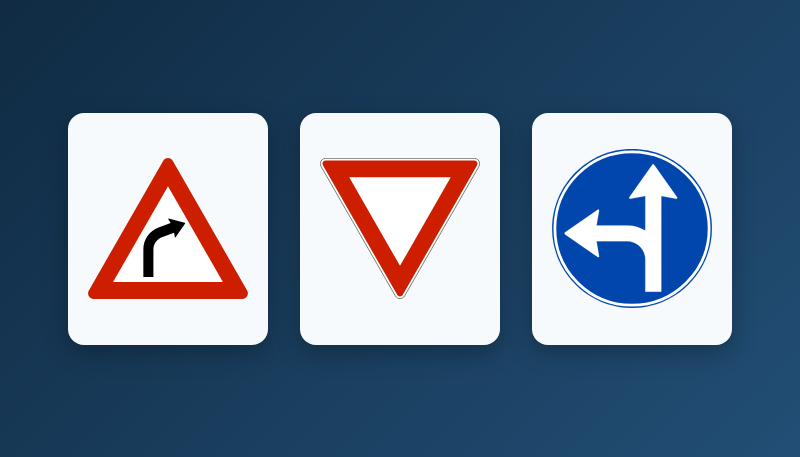
Class 200 of skiltforskriften comprises seven priority signs that override the default rule: the inverted triangle imposes a duty to yield, STOPP requires a complete stop when that sign governs your movement, and Forkjørsveg designates a priority road until revoked. Each sign is listed below with official terminology:
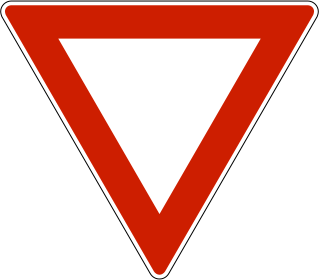



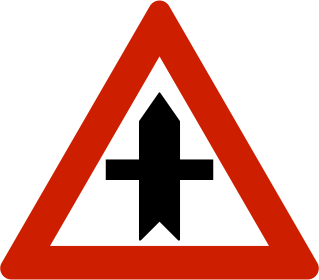
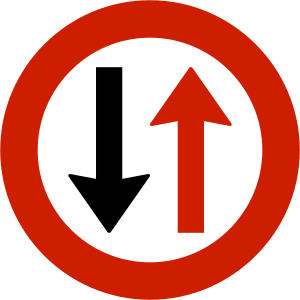
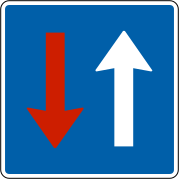
Detailed analysis of priority signs can be explored in our priority signs catalogue.
Emerging: Car Parks, Petrol Stations, Private Roads
Another major exam theme is emerging from adjacent properties and service areas. Here, priority to the right does not apply: the emerging driver must give way to all other traffic.
«Kjørende som kommer fra parkeringsplass, holdeplass, torg, eiendom, bensinstasjon, gågate, gatetun eller liknende område har vikeplikt for annen trafikant.»
Drivers coming from a car park, a stop, a square, a property, a petrol station, a gågate, a gatetun or a similar area have vikeplikt for other road users. (unofficial translation)
The same applies when emerging from farm roads or other roads not open to general traffic, or entering the carriageway from its shoulder. Road surface alone does not determine priority. When entering or crossing a road from a cycle path, footpath or pavement, drivers give way to traffic on the road; that duty does not apply towards drivers coming from or going to the areas listed in § 7 nr. 4, first paragraph, such as a property or parking area. Related duties appear in neighbouring paragraphs: reversing or making a U-turn requires yielding to everyone (§ 11), changing lanes requires yielding to vehicles already in the lane (§ 8), and on roads with speed limits of 60 km/h or lower, you must yield to buses signalling to leave a bus stop (§ 7 nr. 5). All are detailed in our theory test guide.
Priority Hierarchy: Police → Traffic Light → Sign → Right Hand Rule
Several traffic controls may apply at the same junction. The legal hierarchy is strict: instructions from police or traffic controllers override traffic lights; operational traffic lights override priority signs; priority signs override the general priority to the right rule. In practice: on a green light, you may proceed if the road is clear, while respecting remaining turning and give-way duties, even if a yield sign is mounted on the post; if the light is flashing yellow or switched off, the signs take effect; if there are no signs, check for special give-way duties before applying priority to the right at an ordinary road junction.
Practice scenarios
Typical scenarios include: an uncontrolled junction with three cars arriving simultaneously; turning left across oncoming traffic; emerging from a petrol station onto a street; and a yield sign mounted under a working green light. A useful order of checks is: first identify what controls the junction (police officer? traffic light? signs?), then check for special duties when emerging from properties, parking areas, footways or similar places; apply priority to the right only when no overriding rule applies. You can try practice questions in the simulator: first question free without sign-up.
Sources
Verbatim statutory quotes are from the official Norwegian text on Lovdata; translations and commentary are unofficial study aids. Only the Norwegian text is legally binding.