What the law requires
Vegtrafikkloven § 23: before the trip starts, the driver must make sure the car is in working order and meets the requirements, and keep an eye on this during the trip. If you are unsure about the brakes, the steering or another important system, we advise putting the trip off until the car has been checked.
Forskrift om bruk av kjøretøy § 1-4 requires sufficient grip on the road. When needed, you fit winter tyres with or without studs, chains or something similar. This rule is not tied to dates: if the road is covered in snow in April, the grip must still be sufficient.
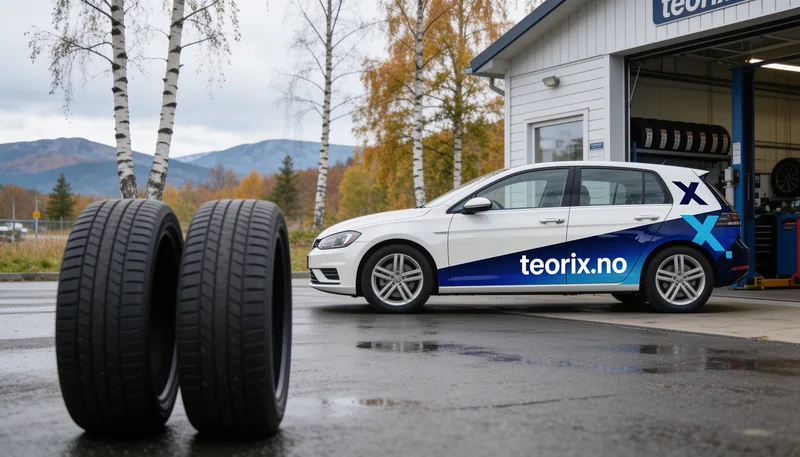
For a passenger car up to 3 500 kg, the tread must be at least 3 mm in winter. The winter period runs from 1 November through the first Sunday after Easter Monday, inclusive. This winter that is 4 April 2027. In Nordland, Troms and Finnmark it runs from 16 October to 30 April. Even so, the right marking and tread depth do not on their own guarantee good grip.
Studded tyres may be used on the same winter dates. Outside them, studs and chains are allowed if the road conditions call for them. Studs go on all wheels. The law also allows another option: studs on one axle and chains on the other wheels.
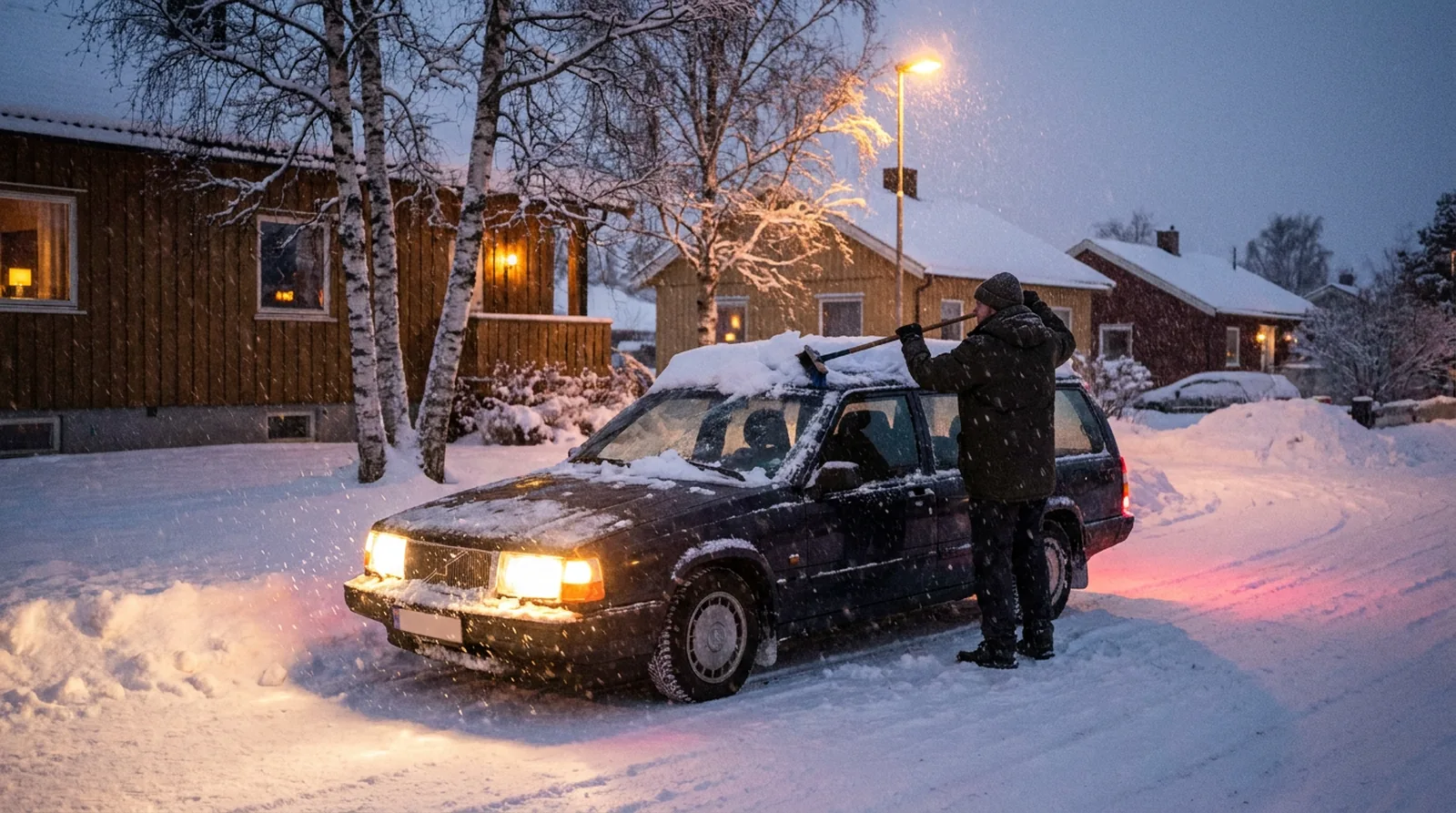
Under § 1-3 of the same forskrift, the driver must be able to see the road in all directions. Clear all the windows, mirrors, lights and the roof: snow on the roof slides down onto the windscreen when you brake.
«Føreren skal sørge for å ha tilstrekkelig utsyn til alle sider, derunder påse at snø, is, dugg eller merke eller annen gjenstand ikke hindrer sikten eller virker forstyrrende.»
The driver must ensure sufficient visibility in all directions, including making sure that snow, ice, condensation, a sticker or any other object does not obstruct the view or cause a distraction. (unofficial translation)
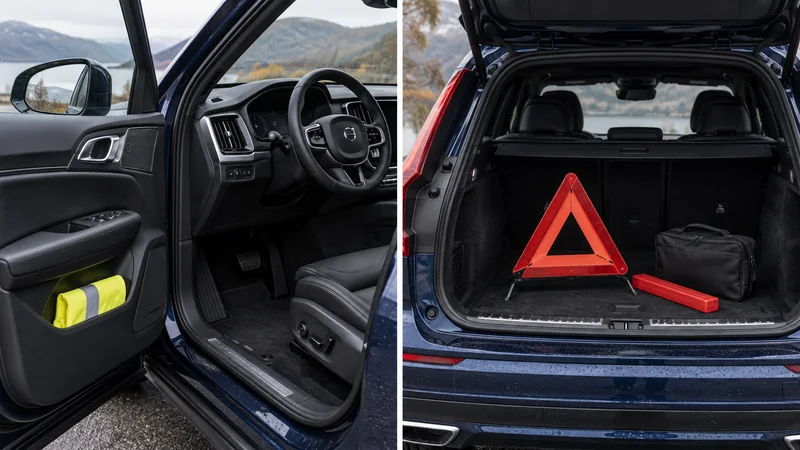
§ 1-6 requires you to carry at least one warning sign for a stopped vehicle in the car, a warning triangle (varseltrekant). If the car is stopped where it gets in the way of others or puts them in danger and cannot be moved to a suitable place straight away, you mark it with the triangle, the hazard lights or in some other way. Place the triangle at a good distance, if possible no closer than 150 m. A reflective vest is also mandatory and is kept where the driver can reach it straight away, not under all the luggage.
Checking the car before you leave
Start with the tyres: tread, sidewalls, pressure. After changing the wheels, tighten the wheel bolts again after about 40 km. Summer tyres do not give the grip you need on snow and ice. If you drive without studs, carry quick-fit chains (hurtigkjettinger).
Check that the headlights and rear lights are on. The Auto setting does not guarantee that the rear lights are on too, and in Norway you drive with lights on in all weather and at all times of day. Fill the washer with antifreeze fluid and check the wiper blades. Put the ice scraper and brush where you can reach them without stepping out into the road.
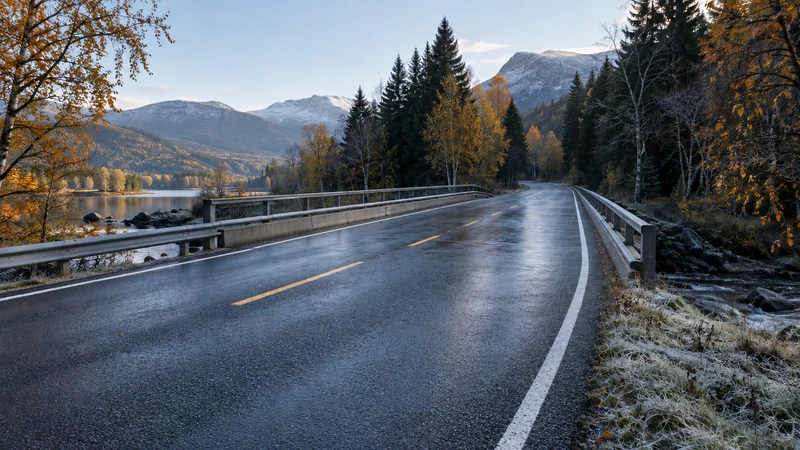
Keep the braking distance in mind. On snow it is at least twice as long as on dry asphalt. On a slippery road at 80 km/h it is about 128 m, four times longer than on a dry road (Trygg Trafikk). If you are unsure about the road surface, brake gently at a very low speed when nobody is behind you. That tells you how slippery it is.
The editorial team worked out the 32 m on a dry road and 64 m on snow from the Trygg Trafikk ratios.
There should be no loose items in the car: under hard braking a heavy object flies forward. Heavy things go in the boot, and everyone wears a seat belt.
What to put in the car for a long trip
From here on these are not legal requirements but our own list for a winter road. If the pass is closed or the car breaks down, these things help you wait for help calmly.
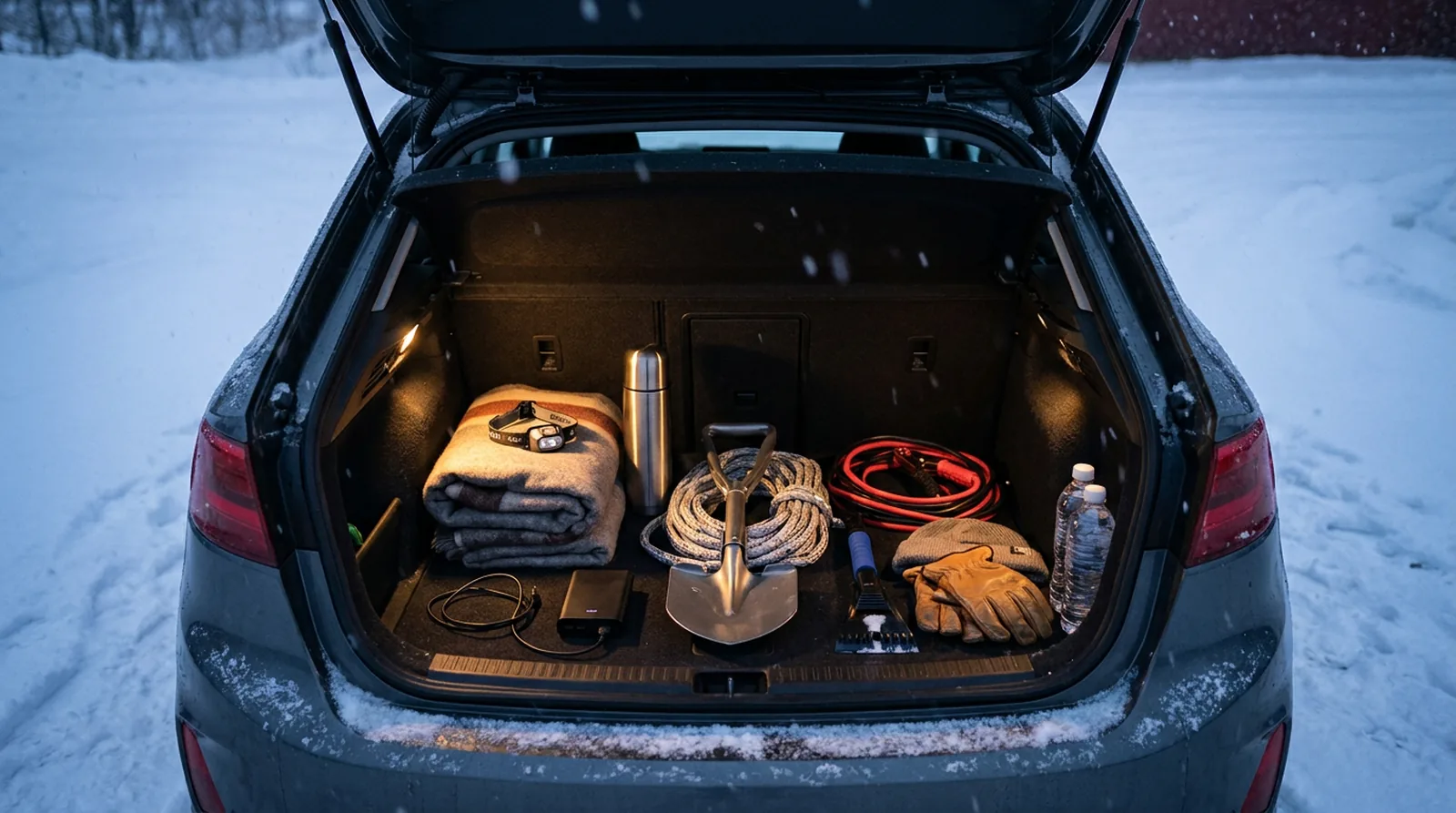
A warm jacket, a hat, gloves and winter shoes are needed for everyone in the car, not only the driver. Pack a blanket or a sleeping bag. If the car stops in the frost and you have to switch off the engine, the inside of the car cools down very quickly.
Take water, a flask of something hot and filling food that keeps for a long time. A convoy over a mountain pass can stand still for hours.
A head torch is best, with spare batteries. Charge your phone fully and take a power bank with a cable: in the cold the battery drains faster, and in this situation you need the phone to call 112 or 175. Charge the power bank at home, not on the road.
In case you get stuck: a shovel, a tow rope, jump leads, an ice scraper and a brush. Chains, if your tyres have no studs. If someone in the car takes medicine regularly, bring enough for an extra day.
Route and time to spare
Before you leave, check the weather forecast and road reports. In the Vegvesen trafikk app you can sign up for notifications about closed roads, tunnels and convoys.
Fill up or charge with plenty to spare, especially before a mountain pass. In an electric car, plan for a bigger charge margin than in summer and check in advance where the chargers are along the way.
Tell someone where you are going and when you plan to arrive. If you lose contact, people will start looking for you in time.
Leave so that you drive the difficult stretch in daylight and well rested. An example: the car is ready, but the night drive over the pass starts after a hard day at work. A car in good working order is no substitute for a rested driver. If you are tired, it is better to put the trip off. On a difficult or unfamiliar winter road, do not use cruise control.
If the car stops or the road is closed
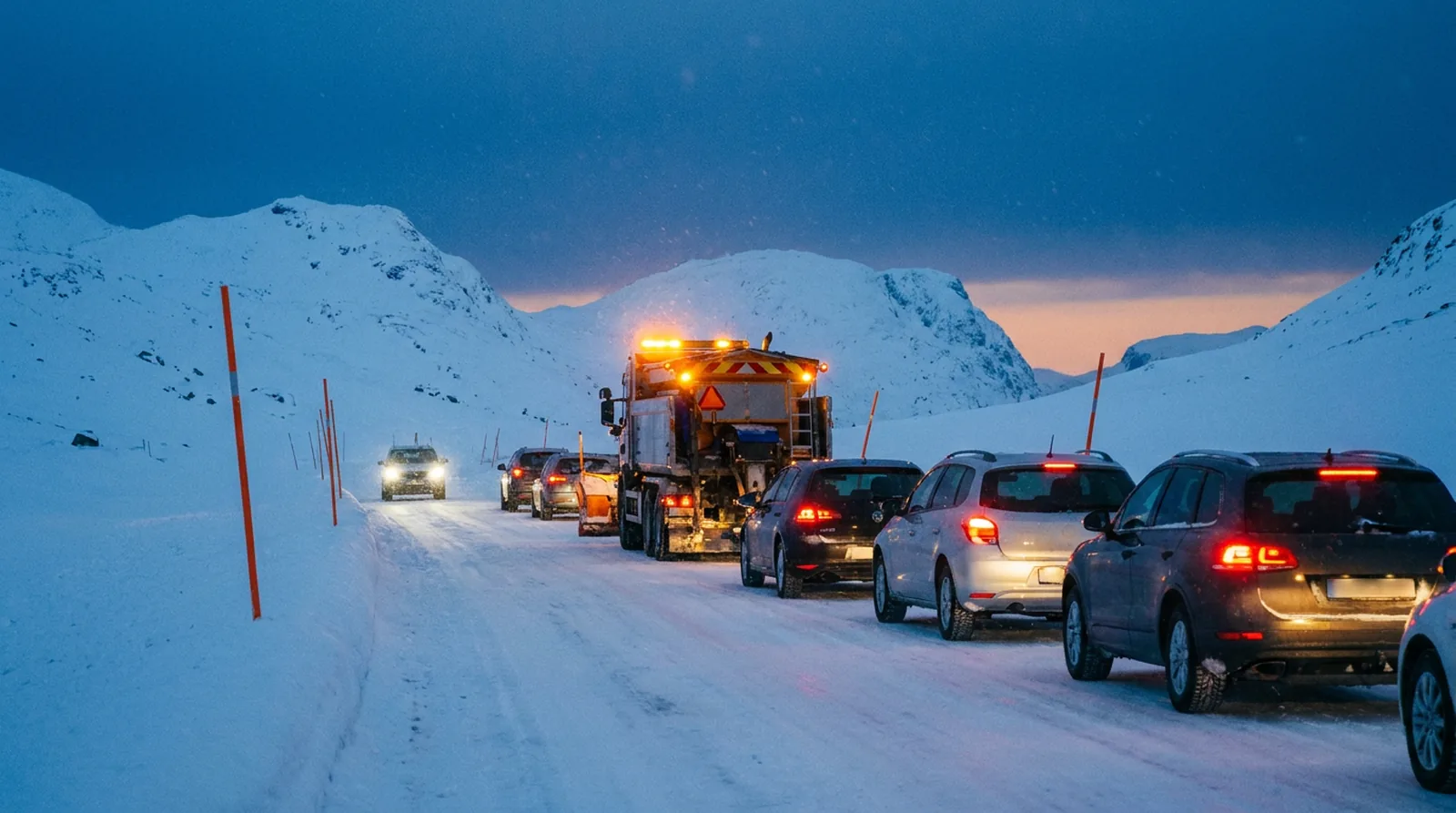
On some mountain passes in winter, traffic drives in a convoy behind a snowplough or an escort vehicle. You do not overtake the lead vehicle or turn around until the convoy has reached its destination. Keep your distance, but close enough to see the rear lights of the car in front. If the convoy stops, do not leave your car: it is life-threatening. A car without suitable tyres may not be let into the convoy.
If you stop on the road, switch on the hazard lights and put on the vest before you get out. Place the triangle, if possible no closer than 150 m. If the car is blocking traffic or standing in a dangerous place, call 175, the Statens vegvesen traffic control centre. If lives are at risk, call 112 (police), 113 (ambulance) or 110 (fire service).
Carbon monoxide comes out of the exhaust pipe and is dangerous where ventilation is poor. If the car gets snowed in while the engine runs for heat, exhaust fumes can get inside the car. So keep the exhaust pipe clear of snow and open a window slightly from time to time. If someone in the car has a headache, feels sick or drowsy, switch off the engine, air the car and call 113.
It is best not to overtake a snowplough. Wait until it lets you pass.
Check yourself
Can a set of useful things in the boot take the place of checking your tyres?
Explanation: No. A shovel and a blanket will help if something happens, but grip comes from tyres suited to the road and, when needed, chains. Under § 1-4 a vehicle must not be used without sufficient grip.
Try it in practice
Open Teorix, choose questions on the topic “Kjøretøyet” and read the explanation together with the official rule. Look separately at the questions on grip (§ 1-4). Questions on visibility (§ 1-3) are in the topic “Fører og eiers ansvar”. If you got it wrong, go back to the situation and explain which detail changed the decision.
Sources
- Vegtrafikkloven § 23 (ansvar for kjøretøyets stand)
- Forskrift om bruk av kjøretøy § 1-3 (utsyn), § 1-4 (hjul, mønsterdybde, piggdekk), § 1-6 (varseltrekant, refleksvest)
- Trygg Trafikk — Kjøring på vinterføre (bremselengde)
The requirements come from vegtrafikkloven and forskrift om bruk av kjøretøy (Lovdata). The 128 m braking distance and the ratios for snow and a dry road come from Trygg Trafikk, and the editorial team worked out the 32 m and 64 m. The advice for winter trips is our own. The “Check yourself” question was written by the Teorix editorial team and is not an official Statens vegvesen question.