Signs · class 200

Vikeplikt- og forkjørsskilt — priority and right-of-way signs

7 signs — each with its official statutory code and name from skiltforskriften, English translation and clear plain explanation. The exact data powering the Teorix theory test trainer.

Updated: 2026-09-23

Vikeplikt- og forkjørsskilt — priority and right-of-way signs
Official statutory definition — skiltforskriften § 5
«Vikeplikt- og forkjørsskilt regulerer vikepliktforholdene på vedkommende strekning eller sted.»

Priority and right-of-way signs regulate priority conditions on the relevant road section or location. (unofficial translation)

This class concerns priority and the duty to give way: Vikeplikt (the duty to give way) is one of the seven official topics on the class B theory test, and class 200 signs form its backbone. They directly answer the fundamental question at every intersection: who goes first.

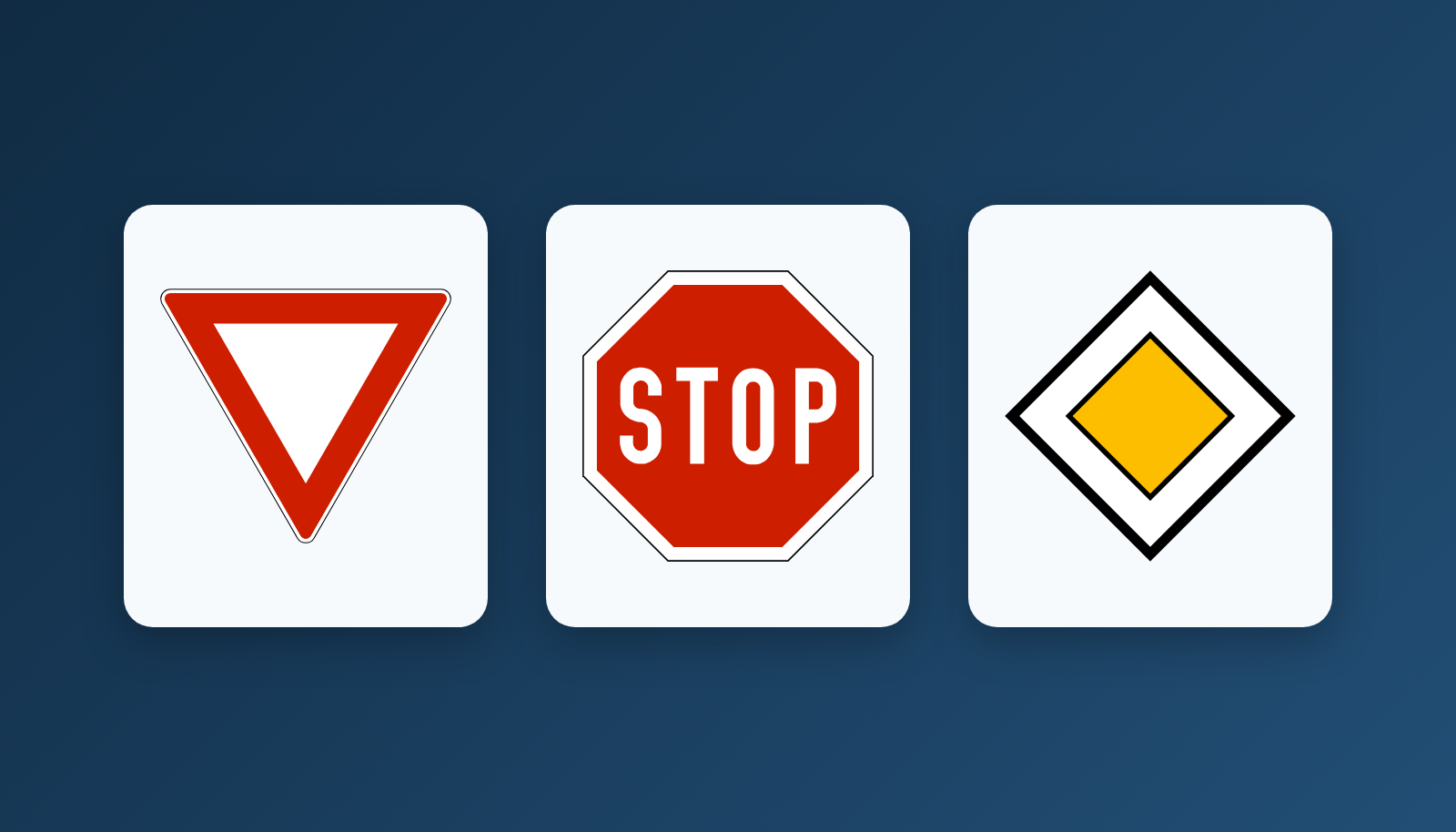
The baseline rule: at ordinary unregulated road junctions, subject to other give-way duties such as those when leaving a property or car park, the default duty to give way to traffic from the right applies (høyreregelen, trafikkreglene § 7). Class 200 signs override this default rule: the inverted triangle sign 202 (Vikepliktskilt) establishes the duty to give way; the octagonal sign 204 (Stoppskilt) adds a mandatory full stop; and the yellow diamond sign 206 (Forkjørsveg) designates a priority road until sign 208, 202 or 204. An acceleration lane is a specific exception to the side-road give-way rule; its merging rules still apply.

Study sign hierarchies: a functioning traffic light overrides priority signs beneath it; directions from police officers and other authorized traffic controllers override both traffic lights and signs. Study how signs interact with signals rather than memorising images in isolation.

Entries in this study catalogue 7 in catalogue
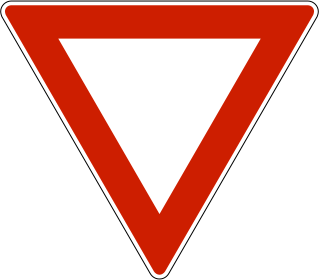
Vikeplikt (202)
202
Vikeplikt
Give way
Vikeplikt means you must give way to traffic in both directions on the crossing road. You do not have to stop completely, but you must let traffic on the crossing road pass first.
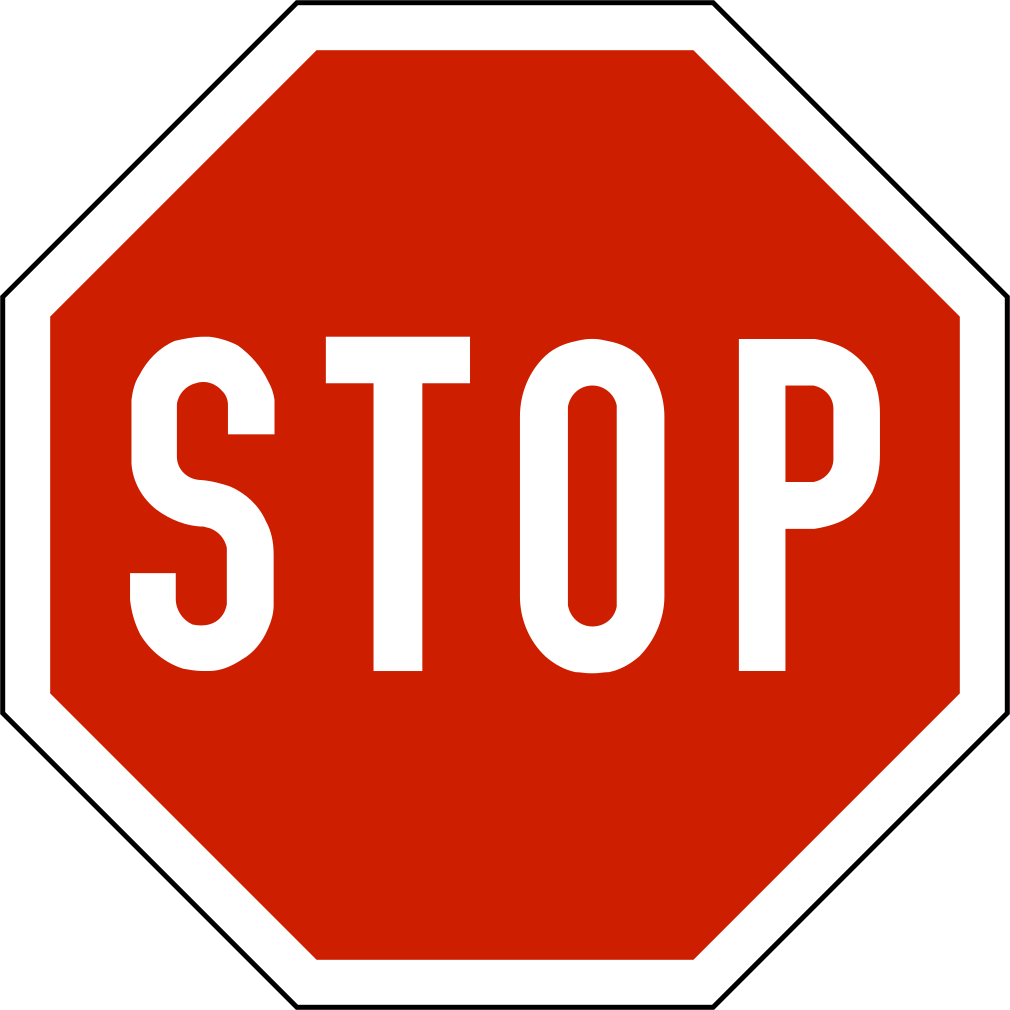
Stopp (204)
204
Stopp
Stop
Stopp means you must come to a full stop before entering the crossing road or crossing a level crossing, then give way to traffic in both directions or let a tram or train pass. Stop at the stop line, or as close to the crossing road as possible if there is no stop line.
Forkjørsveg (206)
206
Forkjørsveg
Priority road
Forkjørsveg means you are on a priority road: traffic from side roads or crossing roads must give way to you (they have sign 202 «Vikeplikt» or 204 «Stopp»). It applies until cancelled by sign 208, 202 or 204.
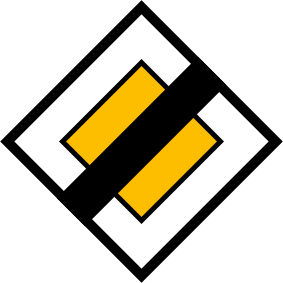
Slutt på forkjørsveg (208)
208
Slutt på forkjørsveg
End of priority road
Slutt på forkjørsveg means your priority-road status ends. After this sign the normal give-way rules apply, and you can no longer count on having priority.
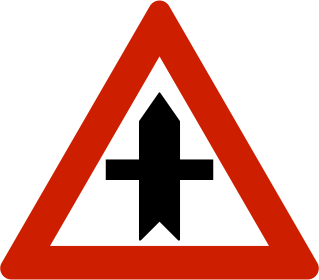
Forkjørskryss (210)
210
Forkjørskryss
Priority intersection
Forkjørskryss warns of a dangerous junction where traffic from side roads or crossing roads must give way to you (they have sign 202 «Vikeplikt» or 204 «Stopp»). Stay alert, but you have priority at the junction.
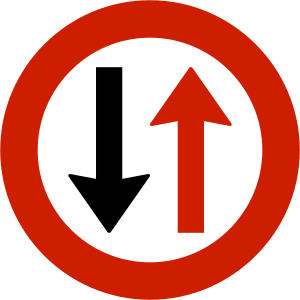
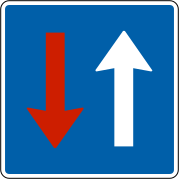
Vikeplikt overfor møtende kjørende (212)
212
Vikeplikt overfor møtende kjørende
Give way to oncoming traffic
Vikeplikt overfor møtende kjørende means you may not enter a narrow stretch of road if doing so would obstruct oncoming traffic. You must wait and let oncoming vehicles pass first.
Møtende kjørende har vikeplikt (214)
214
Møtende kjørende har vikeplikt
Oncoming traffic must give way
Møtende kjørende har vikeplikt means the oncoming traffic must give way to you (they have sign 212 «Vikeplikt overfor møtende kjørende»). You may drive through the narrow stretch first.

Other sign classes

Sources

Illustrations are official figures from skiltforskriften (Lovdata), vector artwork from Wikimedia Commons (public domain), and our own vector renderings based on official figures. Translations, explanations, and advice are our unofficial study aids; only the Norwegian statute text carries legal force.

FAQ

How does sign 202 «Vikeplikt» differ from sign 204 «Stopp»?
When the sign governs your movement, sign 204 (STOPP) requires a full stop even if the junction is empty and visibility is clear, as well as giving way. Active traffic signals or instructions from authorized traffic controllers can override priority signs. Sign 202 does not itself require a full stop, but you must stop when necessary to give way or comply with other applicable rules.
What does forkjørsveg mean?
Sign 206 designates a priority road and applies until sign 208 (end of priority road), 202 (give way) or 204 (stop). Traffic entering or crossing generally has a duty to give way; the sign definition makes an exception for traffic entering from an acceleration lane, where the merging rules apply.
What if an intersection has neither signs nor traffic lights?
At an ordinary unregulated road junction, the priority-to-the-right rule (høyreregelen) generally applies. Other rules can take precedence: for example, a driver leaving a property or car park must give way under trafikkreglene § 7 nr. 4. The absence of signs alone is not enough to determine priority.

Test yourself on the real rules

Questions in bokmål — explanations in English, with the statute behind every answer. First question with no sign-up.

Start the first question