The rule of the stretch you can see: what the law requires
The Norwegian traffic rules (Trafikkreglene § 13 nr. 1) set out the main requirement for speed as follows:
«Kjørende må kunne stanse på den vegstrekning som den kjørende har oversikt over, og foran enhver påregnelig hindring.»
A driver must be able to stop within the stretch of road they can see, and before any foreseeable obstacle. (unofficial translation)
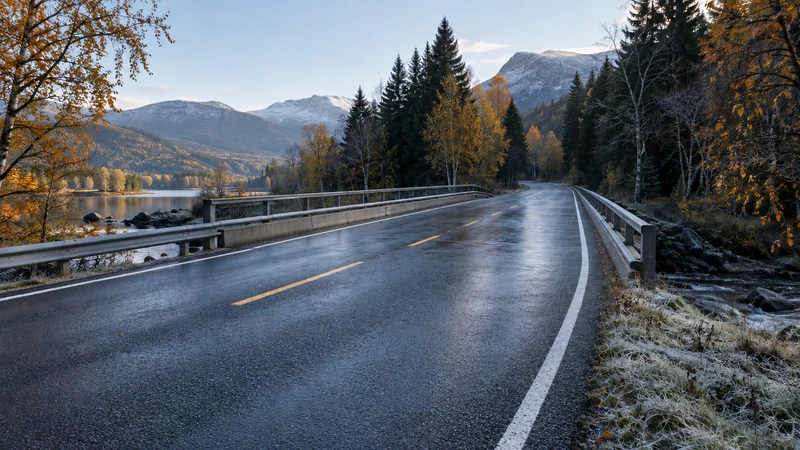
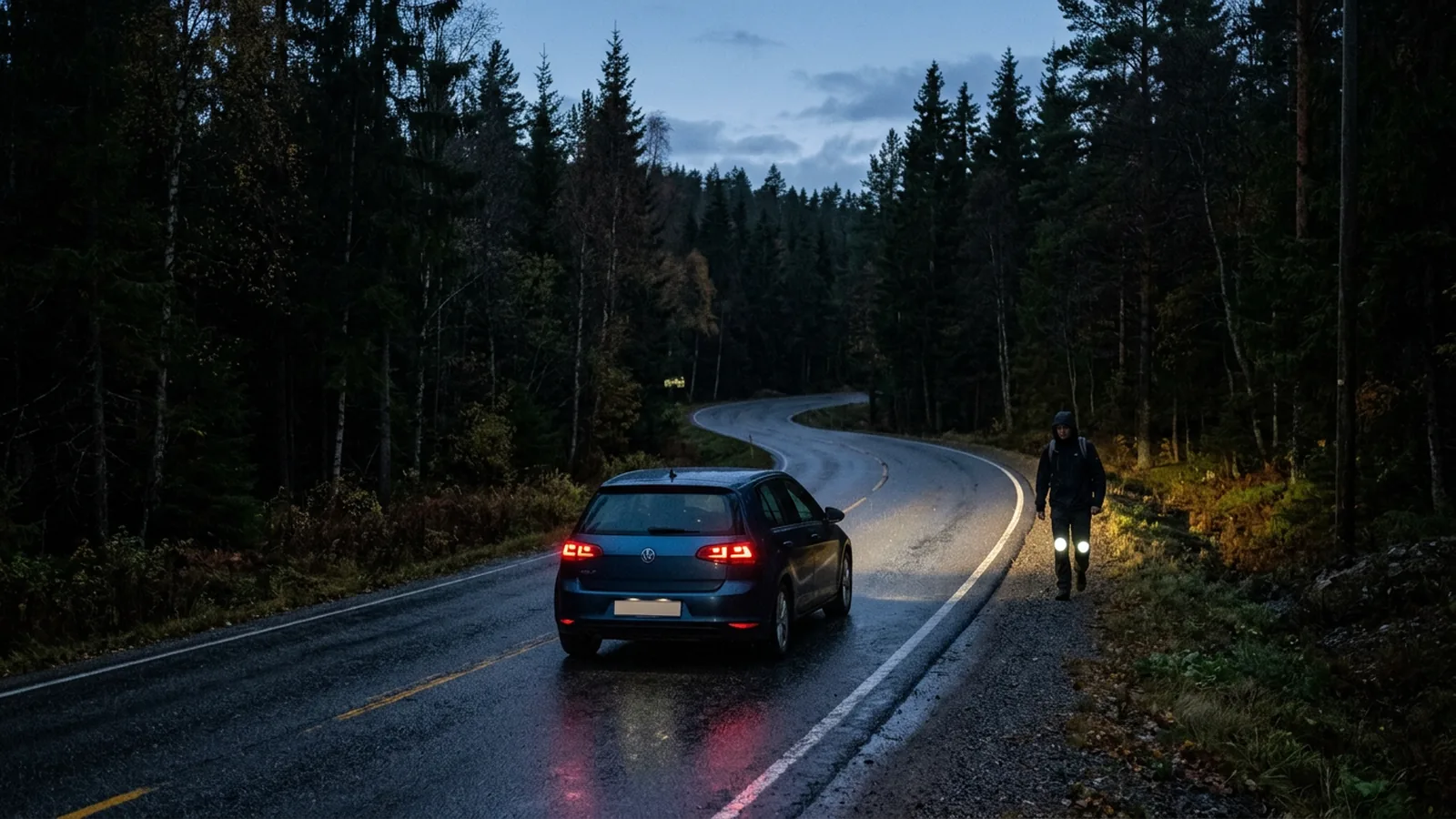
At night, the stretch of road you can see is not the distance to a far-off street lamp or to the rear lights of the car ahead. In the dark, there may be an unlit obstacle, a pothole or a person between you and that light. Judge only the part of the road and verge that your headlights are actually lighting up right now.
The physics of stopping: why speed decides everything
Stopping distance always consists of two parts. The first part is called reaction distance. This is the distance the car travels at its previous speed while you notice the danger and move your foot to the brake pedal. According to Statens vegvesen, a normal reaction time is about one second. At 80 km/h you travel 22 m in that second, at 50 km/h about 14 m.
The second part is called braking distance: the distance from pressing the pedal to coming to a complete stop. A strict law of physics applies here: braking distance increases in proportion to the square of speed. If you double your speed, for example from 40 to 80 km/h, reaction distance doubles, while braking distance becomes four times as long.
According to the course “Synlighet i trafikken” (Statens vegvesen), the picture when braking from 80 km/h is as follows. An attentive driver on dry tarmac needs 22 m to react and 32 m to brake, 54 m in total. On wet tarmac braking distance is twice as long, which makes 86 m altogether. If the driver is distracted and takes 3 seconds to react, 98 m is needed, and 130 m on a wet road.
- Reaction distance
- Braking distance
Figures: Statens vegvesen, course “Synlighet i trafikken”.
The dipped headlights trap: when it is already too late to brake
At night it is not enough to know your stopping distance. You need to understand from what distance you will notice a hazard at all. According to Statens vegvesen and Trygg Trafikk, the difference is huge. A pedestrian without a reflector can be seen on dipped headlights from roughly 25–30 m. With a reflector they can be seen from 140 m on dipped headlights and from 400 m on high beam.
Now let us compare the figures. You are driving at 80 km/h on dipped headlights on a dry road, and a person without a reflector emerges from the darkness 30 m in front of your bumper. Just taking in the situation will use up 22 m. The braking itself needs another 32 m, 54 m in total. Stopping before you reach the pedestrian is physically impossible: only 8 m will be left for braking, and by the same figures the impact will come at roughly 70 km/h. According to Statens vegvesen's estimate, even at 50 km/h you have only about two seconds to notice a person without a reflector and react.
That is why at night the “80” sign means an upper limit, not a recommended speed when driving on dipped headlights.
Figures: Statens vegvesen and Trygg Trafikk. For a pedestrian without a reflector, 25–30 m is given. On high beam a pedestrian with a reflector can be seen from 400 m.
Peripheral vision and switching headlights
Statens vegvesen's guide V127 notes one more effect: the lower the speed, the wider the driver's field of vision. Official Norwegian sources do not give viewing angles for each speed, so we do not state them.
When you slow down in the dark, you gain two advantages. Your view becomes wider, and you can see the verges better, where an animal or a pedestrian may step out. And when an oncoming car appears and you switch from high beam to dipped headlights, visibility drops sharply. Reduce your speed in advance and adjust it to the new, short corridor of light.
Lower speed: wider view
Higher speed: narrower view
Diagram not to scale. Official sources give no viewing angles for each speed.
Check yourself
After you switch to dipped headlights you can see less of the road, but the speed sign is the same. Should you reconsider your speed?
Explanation: Yes. The upper limit has not changed, but the safe speed depends on what you can now see.
Try it in practice
Open Teorix, choose a question on this topic and read the explanation together with the official rule. If you got it wrong, go back to the situation and explain to yourself which detail changed the decision.
Sources
- Trafikkreglene § 13 (kjørefarten) og § 15 (bruk av lys)
- Vegtrafikkloven § 6 (fartsregler)
- Statens vegvesen — Synlighet i trafikken (veileder: reaksjonstid, stopplengde, refleks)
- Statens vegvesen — Håndbok V127 Kryssingssteder for gående (fart og synsfelt)
- Statens vegvesen — Bilens lys
- Statens vegvesen — Trafikant i mørket
- Trygg Trafikk — Fart og kroppens tåleevne
- Trygg Trafikk — Refleks
The formulas for reaction distance and braking distance follow from physics, while the specific distances in metres come from Statens vegvesen and Trygg Trafikk material. The reaction distance of about 14 m at 50 km/h and the impact speed of about 70 km/h were calculated by the editorial team from the same figures. The “Check yourself” question was written by the Teorix editorial team and is not an official Statens vegvesen question.