Signals · chapter 12

Lyssignaler — Norwegian traffic light signals

11 traffic signals — each with its official statutory code and name from skiltforskriften, English translation and clear plain explanation. The exact data powering the Teorix theory test trainer.

Updated: 2026-09-23

Lyssignaler — Norwegian traffic light signals
Official statutory definition — skiltforskriften § 23
«Trafikklyssignal nyttes for å regulere kryssende trafikantgrupper i vegkryss o.l. og kjøreretningen i kjørefelt som kan anvendes i begge retninger.»

Traffic light signals are used to regulate conflicting groups of road users at road junctions and similar places, and the direction of travel in lanes that may be used in both directions. (unofficial translation)

Traffic light signals are regulated in Chapter 12 of skiltforskriften. To master exam questions, first remember the hierarchy of traffic control: instructions from police and other authorized traffic controllers take precedence over traffic lights; traffic lights take precedence over priority signs; priority signs take precedence over the statutory priority-to-the-right rule. A functioning traffic light «disables» a give-way sign mounted beneath it — and a police officer directing traffic overrides both traffic lights and signs.

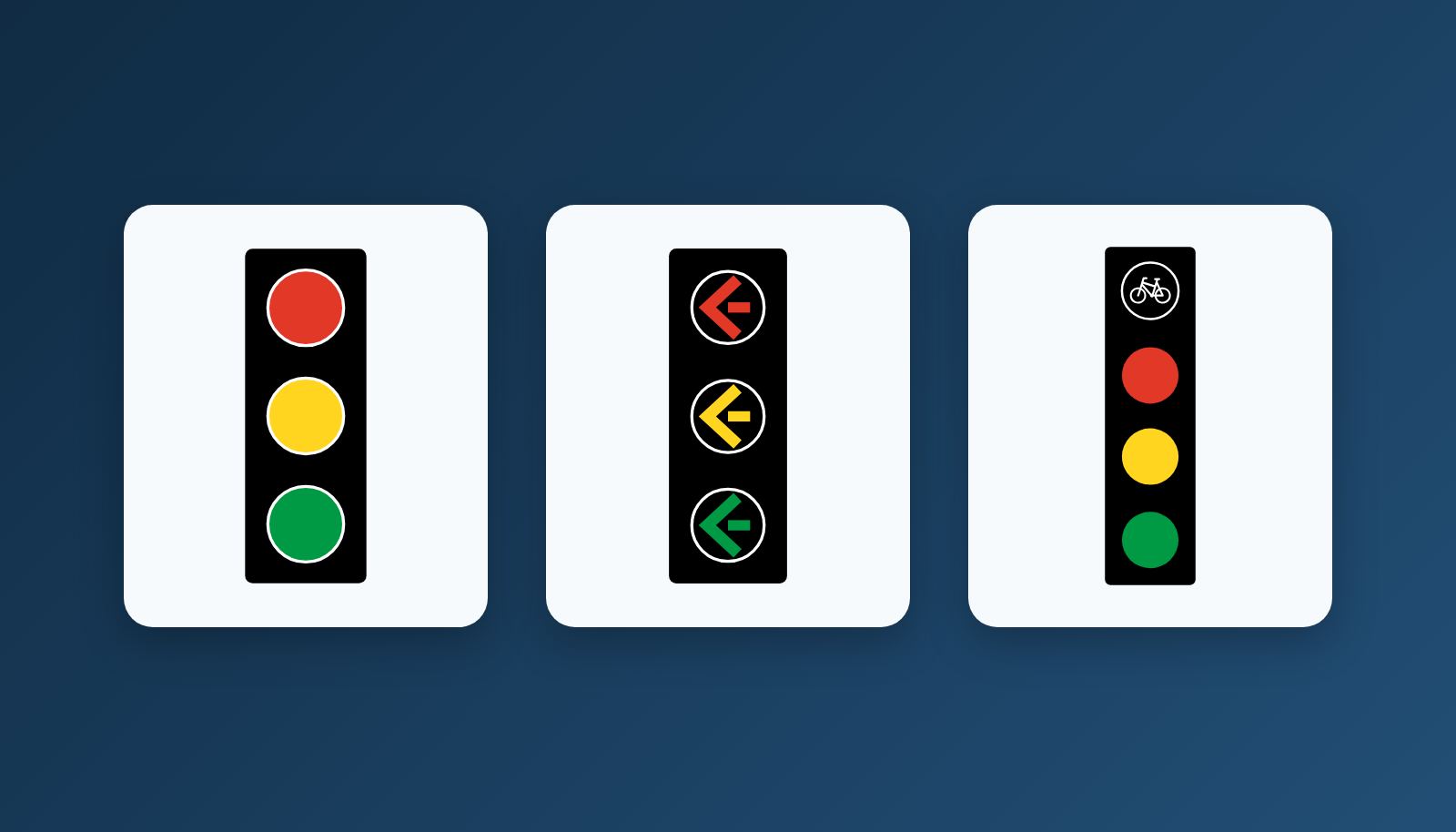
The standard three-aspect signal works as follows: red means stop before the stop line; red with amber means green is about to appear, but you must not proceed yet; amber alone requires you to stop if you can do so safely; flashing amber means the traffic light is out of service, and normal signs and general road rules govern the intersection. Beyond standard lights, specialised signals appear in the cards below: red cross and lane control arrows, flashing red lights at level crossings and bridges, and dedicated signals for trams and buses. Headlamp usage on the vehicle itself — low beam, daytime running lights, and parking lights — is regulated under trafikkreglene § 15: see our guide «Car lights & headlamps».

Entries in this study catalogue 11 in catalogue
Hovedsignal (1080)
1080
Hovedsignal
Main signal
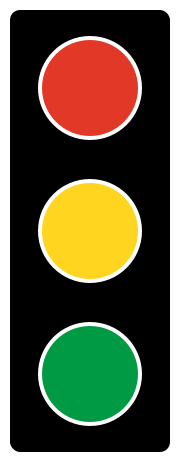
Red means you must not pass the signal or the stopplinje, red with amber warns that green is about to appear, green means you may drive on if the road is clear, and amber alone means you must stop unless you are so close that stopping cannot be done safely.
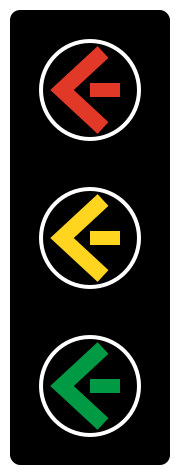
Pilsignal (1082)
1082
Pilsignal
Arrow signal
A pilsignal applies only to those driving in the direction the arrow shows, and it may have one, two or three light apertures.
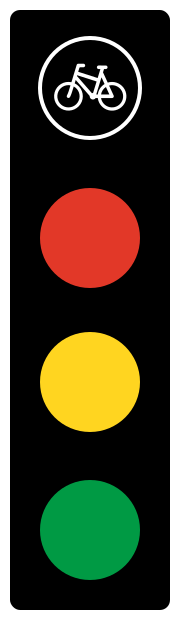
Sykkelsignal (1084)
1084
Sykkelsignal
Bicycle signal
Sykkelsignal applies to those riding in a sykkelfelt or across a sykkelkryssing, and it may be built as an arrow signal.
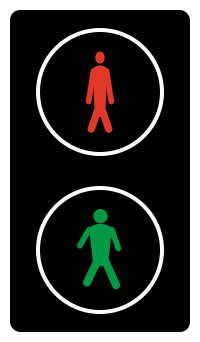
Fotgjengersignal (1086)
1086
Fotgjengersignal
Pedestrian signal
A red fotgjengersignal means pedestrians must not start crossing, green means they may cross, and flashing green warns that red is coming and has the same meaning as red.
Signal for kollektivtrafikk (1088)
1088
Signal for kollektivtrafikk
Signal for public transport
The lights in a signal for public transport mean the same as the lights in the corresponding aperture of the hovedsignal.
Kjørefeltsignal (1090)
1090
Kjørefeltsignal
Lane signal
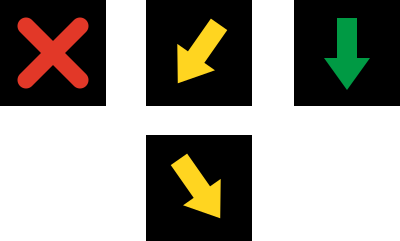
A red cross means the lane must not be used in the direction facing the signal, a green arrow that the lane may be used, and a yellow arrow that the lane is being closed and you must change lane at once in the direction of the arrow.
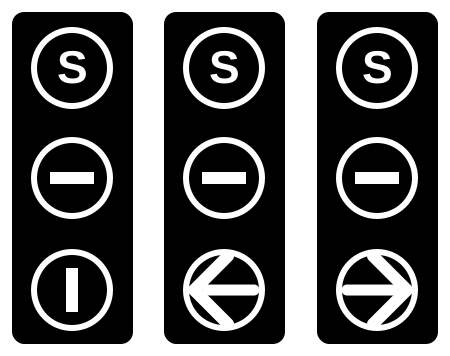
Tolyssignal (1092)
1092
Tolyssignal
Two-light signal
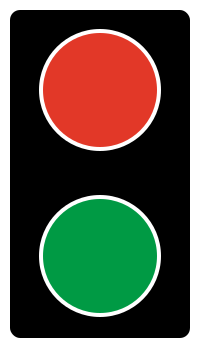
A red tolyssignal means you must not pass the signal or the stopplinje and green that it may be passed; breaching a tolyssignal is not punishable.
Rødt stoppblinksignal (1094)
1094
Rødt stoppblinksignal
Red flashing stop signal
A rødt stoppblinksignal shows one or two alternately flashing red lights and means you must not pass, but stop at the stopplinje or at a safe distance in front of the signal.
Blinkende signal foran jernbane (1096)
1096
Blinkende signal foran jernbane
Flashing signal ahead of railway
A red flashing signal in front of a railway means you must stop at the stopplinje or at a safe distance ahead of it, while a white flashing signal shows the installation is in operation and the planovergang may be crossed in accordance with the traffic rules.
Gult blinksignal (1098)
1098
Gult blinksignal
Yellow flashing signal
A yellow flashing signal means road users must show particular alertness and caution.
Blinkende lyspil (1100)
1100
Blinkende lyspil
Flashing light arrow
A blinkende lyspil indicates on which side road users are to pass.

Other sign classes

Sources

Illustrations are official figures from skiltforskriften (Lovdata), vector artwork from Wikimedia Commons (public domain), and our own vector renderings based on official figures. Translations, explanations, and advice are our unofficial study aids; only the Norwegian statute text carries legal force.

FAQ

Which takes precedence — a traffic light or a sign?
Traffic signals take precedence over priority signs. Green permits you to proceed only if the road is clear; other applicable duties remain. If the signal is dark or flashes amber, follow posted priority signs and general rules. Instructions from police and other authorized traffic controllers take precedence over signals (trafikkreglene § 3).
What does a flashing amber light mean?
The traffic signals are out of operation: proceed through the junction following posted priority signs and general traffic rules (including the priority-to-the-right rule). A flashing amber light signifies caution, not an automatic right of way.
Can you drive through on an amber light?
An amber light requires you to stop — you may only proceed if you are already so close to the stop line that bringing the vehicle to a halt cannot be done safely. Do not accelerate to try to beat an amber light.

Test yourself on the real rules

Questions in bokmål — explanations in English, with the statute behind every answer. First question with no sign-up.

Start the first question