- The Core Rule of the Road
- Lane Position and Lane Changing
- Priority and Duty to Yield (Vikeplikt)
- Speed Limits
- Overtaking
- Pedestrians
- Lights and Signals
- Stopping and Parking
- Alcohol, Mobile Phones, Seatbelts, and Fatigue
- In the Event of an Accident
The Core Rule of the Road
Everything else derives from two fundamental norms: be considerate, alert, and cautious (vegtrafikkloven § 3), and follow traffic controls in the order established by trafikkreglene § 3.
Grunnregler for trafikk
Everyone in traffic must be considerate, attentive and cautious (hensynsfull, aktpågivende, varsom) so that no danger or harm arises and other traffic is not unnecessarily hindered or disturbed. You must also show consideration for people who live or stay near the road.
Statute: vegtrafikkloven § 3
Anvisninger
Instructions from a traffic light (trafikklyssignal), official traffic sign (trafikkskilt) or road marking (oppmerking) take precedence over the ordinary traffic rules. A traffic light overrides a give-way (vikeplikt) shown by a sign, and instructions from the police, Statens vegvesen, customs or military police override everything else.
Statute: trafikkreglene § 3
Lane Position and Lane Changing
Driving on the right, choosing the correct lane before turning, and the duty to yield when changing lanes.
Kjøretøys plass på vegen
As far as conditions allow, drive on the right side of the road, and on a road with several lanes in your direction use the right lane unless the rules allow otherwise. Keep well inside your kjørefelt (lane) and keep enough distance to the vehicle ahead to stop safely if it slows or stops. When approaching or entering a junction, do not end up blocking traffic on the crossing road unnecessarily.
Statute: trafikkreglene § 5
Svinging
To turn right, move in good time into the rightmost lane and keep as close to the right edge as possible. To turn left, move in good time into the leftmost lane, and on a two-way road as close to the centre as possible. When turning onto a road with several lanes in your direction, you may enter whichever lane suits best.
Statute: trafikkreglene § 6
Kjørefeltskifte
If you want to change kjørefelt (lane) or move your vehicle sideways, you must give way (vikeplikt) to those already in the lane you are moving into. Where the number of lanes in the same direction is reduced, this duty does not apply; instead drivers adjust speed so cars can continue alternately (merging/zip). In an acceleration lane you adjust your speed to the traffic you are joining, and those already there should ease your entry.
Statute: trafikkreglene § 8
Priority and Duty to Yield (Vikeplikt)
The core of Norwegian traffic rules: how to show you yield, reversing, and giving way to emergency vehicles. Vikeplikt is one of 7 official exam topics.
Vikeplikt
If you have vikeplikt (duty to give way), show it clearly by slowing down or stopping in good time, and do not obstruct the one you give way to. You must give way to vehicles coming from the right, and to pedestrians and cyclists going straight ahead when you turn. When coming out from a parking area, property, petrol station, farm road or similar, you give way to other traffic.
Statute: trafikkreglene § 7
Rygging og vending
When reversing or turning around, you must give way (vikeplikt) to all other traffic. If your view is not good enough, you must not reverse or turn unless someone keeps watch, or you have personally made sure no danger can arise. Reversing and turning around are forbidden on a motorveg (motorway) and motortrafikkveg, and on their entry and exit roads.
Statute: trafikkreglene § 11
Fri veg
You must give a clear road to an utrykningskjøretøy (emergency vehicle) signalling with a flashing blue light, and stop if necessary. You must also give way and, if necessary, stop for a tram or train; before a planovergang (level crossing) stay alert and keep your speed low enough to stop safely if a train is approaching. You must also not obstruct a procession, funeral cortege, military column or a supervised group of pedestrians.
Statute: trafikkreglene § 10
Speed Limits
General limits are 50 km/h in built-up areas and 80 km/h outside, but the baseline rule is stricter: speed must always match conditions.
Fartsregler
You must adjust your speed to the place, road, visibility and traffic so that no danger or nuisance arises for others, and you must always have full control of the vehicle. Unless another speed limit is signposted, the limit is 50 km/h in tettbygd strøk (built-up area) and 80 km/h outside tettbygd strøk.
Statute: vegtrafikkloven § 6
Særlige bestemmelser om kjørefarten
You must always be able to stop within the stretch of road you can see, and before any hindrance you can reasonably expect. You must keep your speed low enough, and stop at once if needed, when passing children by the road, a school patrol, a blind person with a white cane or guide dog, others who may be impaired in traffic, or a bus or tram that is stopping at a stop. On a gågate (pedestrian street) or gatetun (home zone) you must not drive faster than walking pace (gangfart).
Statute: trafikkreglene § 13
Overtaking
When overtaking is permitted, from which side, and who carries responsibility for safety.
Forbikjøring
Overtaking (forbikjøring) is normally done on the left; you overtake on the right only in special cases, such as when the vehicle ahead is turning or clearly preparing to turn left. Before overtaking, make sure the road is clear far enough ahead, that no one behind has already started to overtake you, and that you can safely return to the traffic flow. Overtaking is forbidden just before or in a junction and where the view is blocked by a hill crest or curve, apart from the exceptions listed, and you must not pass a vehicle that hides any part of your view of a pedestrian crossing.
Statute: trafikkreglene § 12
Pedestrians
Driver duties at pedestrian crossings (gangfelt) and anywhere pedestrians share the road.
Særlige plikter overfor gående
You must give pedestrians enough room on the road. When crossing a gangveg (footpath) or fortau (pavement), or driving in a gågate (pedestrian street) or gatetun (home zone), you must give way to pedestrians. At a gangfelt (pedestrian crossing) without police or traffic lights, you give way to pedestrians who are in it or about to step onto it, and you must avoid stopping on the crossing.
Statute: trafikkreglene § 9
Lights and Signals
When headlights are mandatory and proper use of sound and light signals.
Bruk av lys
Required lights (påbudt lys) must be on when light or visibility conditions make it necessary for the driver to see enough or to make the vehicle visible. When driving a motor vehicle, main beam (fjernlys), dipped beam (nærlys) or approved daytime running lights (kjørelys) must always be on. Main beam must not dazzle others, and you must use dipped beam when main beam is not needed or not allowed.
Statute: trafikkreglene § 15
Signal og tegn
Unnecessary or inconsiderate use of sound or light signals is forbidden. You must signal (tegn) before turning or any significant change of your sideways position. An emergency vehicle needing a clear road warns with a flashing blue light and may add a sound signal only when necessary.
Statute: trafikkreglene § 14
Stopping and Parking
Where voluntary stopping is prohibited — including blind bends, tunnels and hill crests — and how stans differs from parkering.
Stans og parkering
Stopping (stans) is forbidden in a blind bend, in a tunnel, on the crest of a hill or any other place with poor visibility, in a junction or closer than 5 metres to it, wholly or partly on the fortau (pavement), gangveg or sykkelveg, on a gangfelt (pedestrian crossing) or within 5 metres in front of it, on motorveg and motortrafikkveg, closer than 5 metres to a planovergang (level crossing), and in a kollektivfelt, sambruksfelt or sykkelfelt. Parking (parkering) is additionally forbidden in front of an entrance or exit, on a møteplass across the full width of the road, on a gågate, and on a gatetun outside marked bays. On a forkjørsveg with a speed limit above 50 km/h, parking on the kjørebane is forbidden. Anything you may not stop for, you may not park for either — stans is the wider prohibition.
Statute: trafikkreglene § 17
Alcohol, Mobile Phones, Seatbelts, and Fatigue
Driver condition is part of the law, not a private matter: intoxication, fatigue, mobile phone use, and seatbelt requirements.
Ruspåvirkning av motorvognfører
No one may drive a motor vehicle (motorvogn) while affected by alcohol or another intoxicating or numbing substance. A person is always regarded as affected at more than 0.2 per mille alcohol in the blood or more than 0.1 milligram per litre of exhaled air. After driving where you understand there could be a police investigation, you must not consume alcohol or intoxicants for the first six hours, unless a sample has been taken or the police have decided no sample is needed.
Statute: vegtrafikkloven § 22
Alminnelige plikter
No one may drive or attempt to drive a vehicle when in a condition that leaves them unfit to drive safely. This applies whether the cause is alcohol or another intoxicating or numbing substance, or being ill, weakened, worn out or tired, or any other circumstance.
Statute: vegtrafikkloven § 21
Førers bruk av mobiltelefon under kjøring med motorvogn
The driver must not use a mobile phone while driving, but may start, hold and end a call when the phone is hands-free or sits in a properly mounted holder close to the steering wheel.
Statute: forskrift om mobiltelefon under kjøring § 2
Påbud om bruk av bilbelte og annet sikringsutstyr
Seat belts and other safety equipment must be used where fitted, children under 150 cm must use approved child restraints suited to the child, and a child must never sit in a rear-facing seat in front of an active airbag.
Statute: forskrift om bruk av personlig verneutstyr § 1
In the Event of an Accident
Duties of every party involved in a traffic accident — stop immediately and give aid.
Plikter ved trafikkuhell
If you are involved in a traffic accident (trafikkuhell), whether at fault or not, you must stop at once and help injured people and animals. Those involved must exchange name and address. If the accident caused death or a non-trivial injury to a person, the police must be notified as soon as possible, and you must not leave the scene unless it is necessary or the police have consented.
Statute: vegtrafikkloven § 12
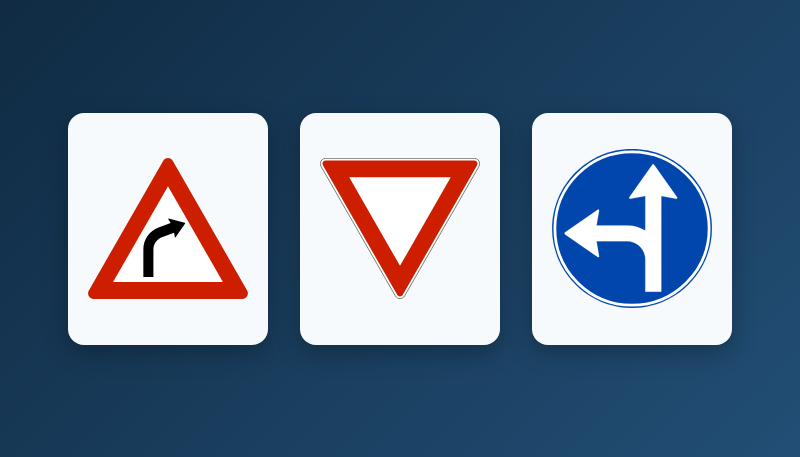
Road signs and road markings are an extensive topic: see the traffic sign catalogue. For the exam structure — the 45/38 format, booking, and vocabulary — see the guide «How to Pass the Theory Test».
Sources
Plain-language summary is our unofficial study aid. Only the Norwegian statute on Lovdata carries legal force.