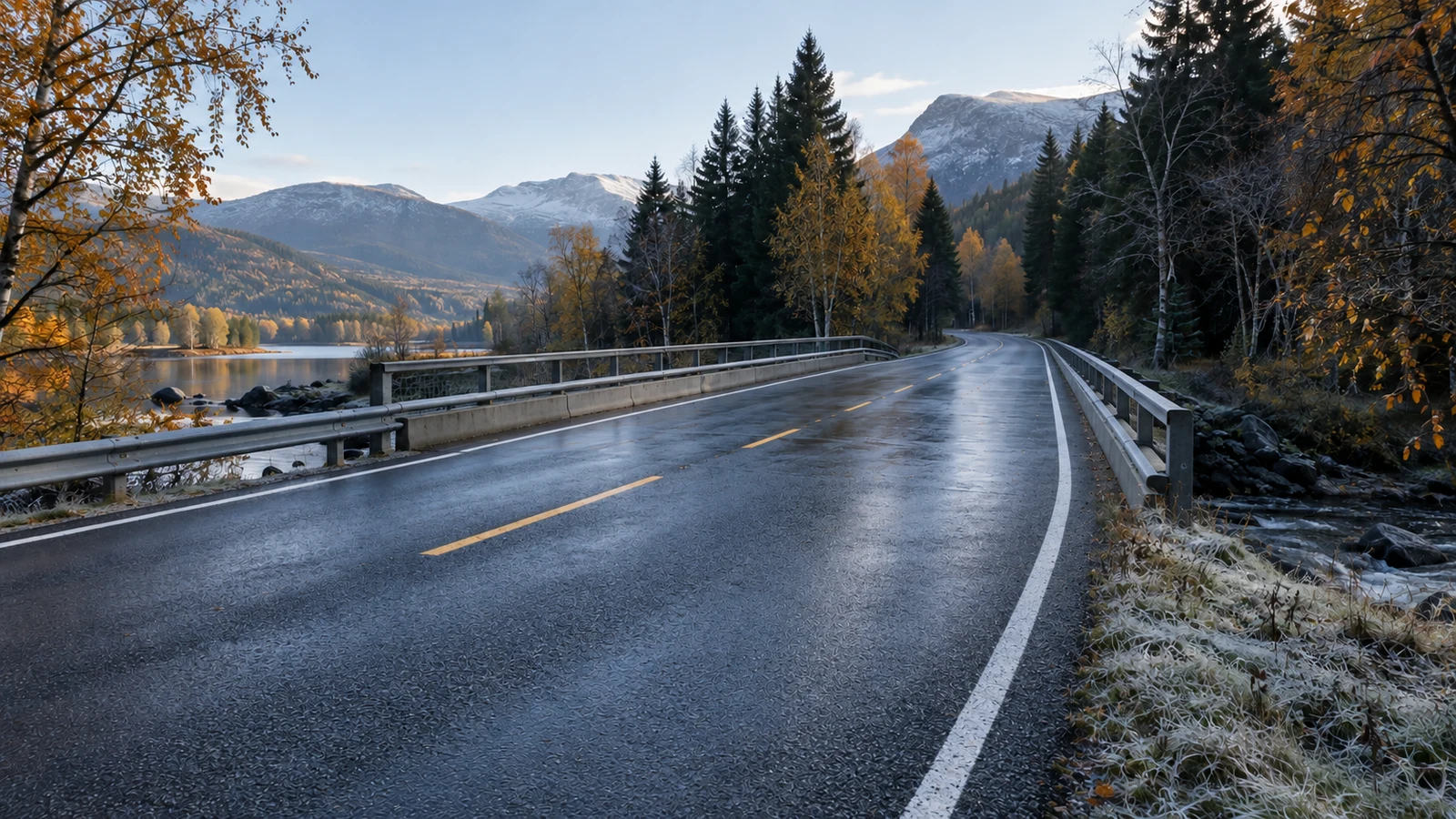
Do not rely on one visual clue
Shade, bridges, low ground, moisture and temperatures near freezing are reasons to consider reduced grip. They do not prove that ice is present, but they raise the cost of a mistake. The car's temperature display describes air near its sensor, not the whole road surface. A shiny patch may be water. If you cannot confidently judge grip from the look of the surface, give yourself more space and time in advance.
The speed limit is only one condition
Trafikkreglene § 13 requires you to be able to stop within the visible stretch of road and before a foreseeable obstruction. Vegtrafikkloven § 6 requires you to adjust your speed to the location, the condition of the road, visibility and traffic. A sign sets an upper limit, not a recommended speed for every situation. Reduce speed smoothly before a bend or bridge, leave more following distance and avoid unnecessary abrupt actions. Do not experiment with braking to test grip among other vehicles.
A familiar route can change locally
The car felt stable on dry asphalt before the bridge. That tells you about the stretch already passed, not the next one. There is a bend beyond the bridge and an oncoming vehicle. Plan early: reduce speed, stay in your lane and preserve a useful gap. If the car ahead is not sliding, that does not mean you will be able to stop in time.
Prepare for the whole journey
Compare the forecast with the actual route, including elevation, shade and time of day. Check the tyres and lights, and clear the windows. If a road like this is too much for you or the car, put the trip off or choose another route. Theory helps you recognise risk; handling a vehicle on slippery surfaces should be learned with an instructor in suitable conditions.
Check yourself
The straight stretch is dry, but there is a shaded bridge ahead after a frost. Can you assume the grip stays the same?
Explanation: No. Conditions may change locally. Assume it is slippery there and slow down before you reach the bridge.