General rule: who to give way to at gangfelt (§ 9 nr. 2)
The key statutory wording is far more precise than everyday "give way to pedestrians", so its conditions matter:
«Ved gangfelt hvor trafikken ikke reguleres av politi eller ved trafikklyssignal, har kjørende vikeplikt for gående som befinner seg i gangfeltet eller er på veg ut i det.»
At a gangfelt where traffic is not controlled by the police or by traffic lights, drivers have vikeplikt for pedestrians who are in the gangfelt or about to step out into it. (unofficial translation)
Three details. First: the rule applies at an uncontrolled crossing — where traffic is actively controlled by signals or an authorised officer, follow those directions. The mere presence of an inactive signal or an officer not directing traffic does not remove the uncontrolled-crossing rule. Second: you must give way not only to someone already in the crossing, but also to anyone on their way into it — a pedestrian at the curb with clear intention to cross. Third: the duty is termed vikeplikt — the exact same legal obligation as at road junctions, with all priority consequences.
Even before reaching a zebra crossing, the duty to yield arises when crossing pedestrian infrastructure itself:
«Kjørende som krysser gangveg eller fortau, har vikeplikt for gående. Det samme gjelder kjøring på gågate eller gatetun.»
Drivers crossing a footpath or a fortau have vikeplikt for pedestrians. The same applies to driving on a gågate or a gatetun. (unofficial translation)
This applies when driving out of a courtyard or car park across a sidewalk: pedestrians on a fortau always have priority, without any sign needed.
Sign 516 and marking 1024: which triggers the rules
Official definitions from skiltforskriften — separately for the sign and the zebra marking:
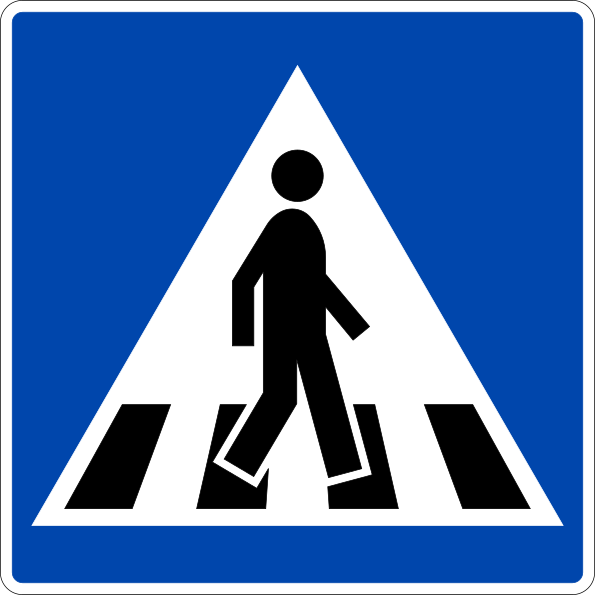
«Skiltet angir kryssingssted for gående hvor trafikkreglenes bestemmelser om gangfelt gjelder.»
The sign indicates a crossing place for pedestrians where the traffic rules' provisions on gangfelt apply. (unofficial translation)
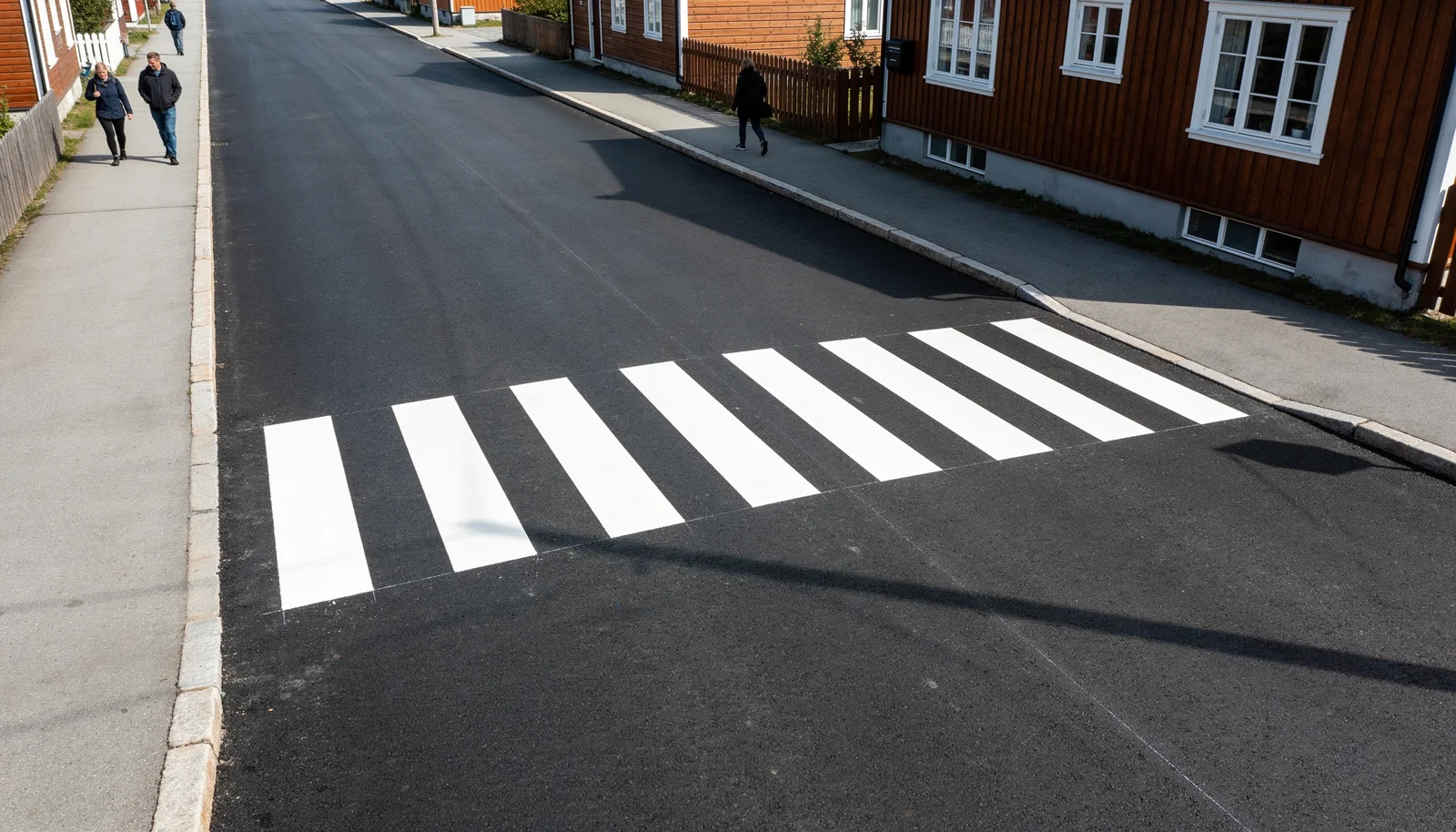
«Oppmerkingen angir at trafikkreglenes bestemmelser om gangfelt gjelder selv om skilt 516 «Gangfelt» ikke er oppsatt.»
The marking indicates that the traffic rules' provisions on gangfelt apply even if sign 516 «Gangfelt» is not erected. (unofficial translation)
Exam takeaway: rules governing a gangfelt are triggered by either element. Zebra stripes without a sign constitute a fully valid pedestrian crossing; a sign without visible stripes (e.g. covered by snow) does as well. Cards for these and adjacent items:
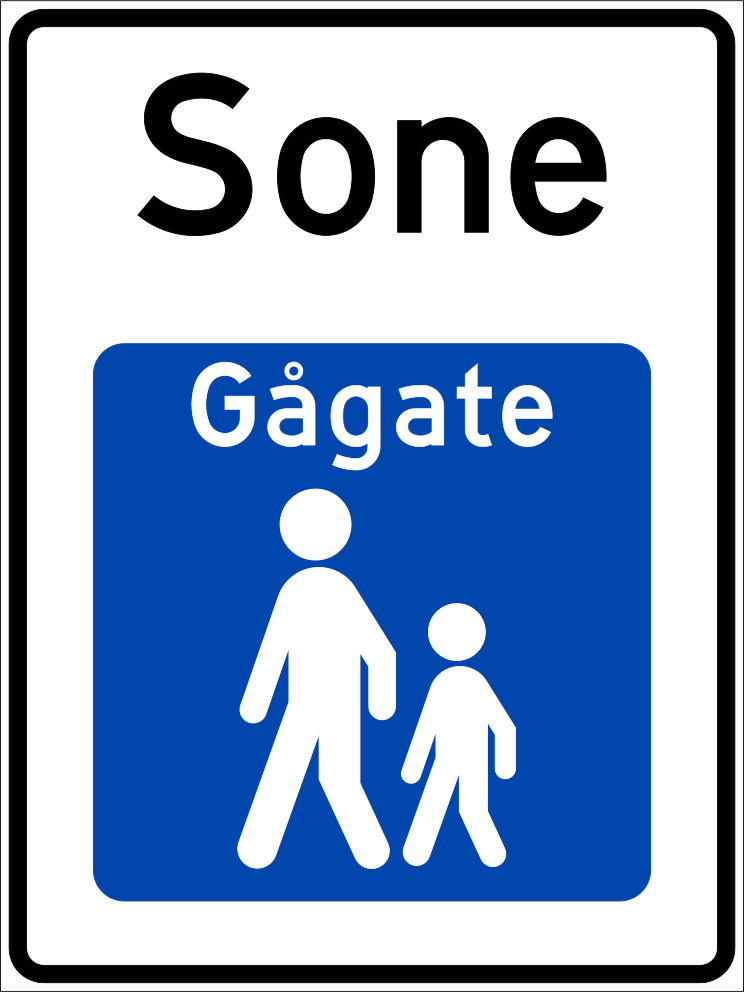

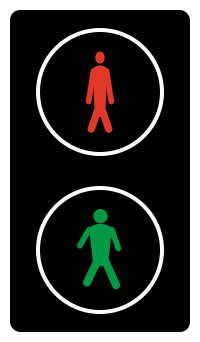
More details on category pages: informative signs, road markings, light signals.
Overtaking and stopping near crossings: two strict prohibitions
Two additional rules apply around gangfelt. § 12 bans overtaking in the most dangerous configuration — when another vehicle obstructs the view of the crossing:
«Kjørende som nærmer seg gangfelt, må ikke kjøre forbi kjøretøy eller sporvogn som hindrer noen del av sikten til gangfeltet.»
A driver approaching a gangfelt must not overtake a vehicle or sporvogn that obstructs any part of the view of the crossing. (unofficial translation)
And § 17 forbids stopping on the crossing and closer than 5 metres before it — so a stationary vehicle does not conceal pedestrians from following drivers (full breakdown in the Stopping and Parking guide):
«på gangfelt eller sykkelkryssing eller nærmere enn 5 meter foran slike steder»
on a gangfelt or a cycle crossing, or closer than 5 metres before such places (unofficial translation)
§ 9 itself adds a mirror requirement — never get stuck on a zebra crossing even in traffic jams:
«Kjørende skal unngå stans på gangfelt.»
Drivers shall avoid stopping on a gangfelt. (unofficial translation)
Children and visually impaired pedestrians: § 13 demands more
Special caution toward vulnerable pedestrians is not just general advice, but a specific statutory rule on speed:
«Kjørende plikter i særlig grad å holde tilstrekkelig liten fart og om nødvendig stanse straks ved passering av … barn som oppholder seg på eller ved vegen … person som nytter hvit stokk eller førerhund for blinde»
A driver is under a particular duty to keep the speed sufficiently low and, if necessary, to stop immediately when passing … children who are on or beside the road … a person using a white cane or a guide dog for the blind (unofficial translation)
Note the phrase “if necessary, to stop immediately”: near children on or by the road and a person with a white cane, the law requires readiness for an immediate full stop, not merely easing off the throttle.
Practice scenarios
Practice scenarios: “at an uncontrolled crossing, a pedestrian at its edge clearly intends to step into it — must you yield?” (yes — the duty covers pedestrians already in the crossing or on their way into it); “does a zebra crossing apply without sign 516?” (yes — marking 1024 enacts the rules on its own); “can you pass a bus stopped before a crossing?” (no, if it obstructs any part of the view — § 12 nr. 6); “how many metres before a zebra is stopping banned?” (5 metres — and specifically before it). Related topics: right of way at junctions and overtaking. Try practice questions in the simulator: first question free without registration.
Sources
- Trafikkreglene § 9 Særlige plikter overfor gående (Lovdata)
- Trafikkreglene § 12 nr. 6, § 13 nr. 2, § 17 nr. 1 (Lovdata)
- Skiltforskriften — Sign 516, Marking 1024 (Lovdata)
Verbatim statutory quotes are sourced from the official Norwegian text on Lovdata; translations and analysis are our own unofficial study guides. Only the Norwegian text has legal effect.