General rule: overtaking on the left. Four exceptions on the right
§ 12 starts with the primary principle: «Forbikjøring skal skje til venstre» — overtaking shall be done on the left. The regulation then lists four situations where passing on the right is lawful: the vehicle in front is turning left (or clearly preparing to); passing a sporvogn (tram); traffic is so dense that vehicles occupy all lanes and travel at the speed of the line ahead; and driving in a lane designated for specific road users past vehicles in another lane. For the first situation, the rule states:
«Når forankjørende svinger til venstre eller tydelig forbereder slik sving, skal forbikjøring skje til høyre.»
When the vehicle in front is turning left or clearly preparing such a turn, overtaking shall be done on the right. (unofficial translation)
This means: if you overtake a vehicle turning or clearly preparing to turn left, pass it on the right, only when lawful and safe. The rule specifies the side of the manoeuvre; it does not require you to overtake.
Four checks before overtaking (nr. 2)
Before initiating an overtake, § 12 nr. 2 requires making sure of four things: the road ahead is clear for a sufficient distance; the driver in front has not signaled an intention to overtake; no one behind has already started to overtake you; and it is apparent that after overtaking you can merge back into traffic without obstruction. The fourth point is tied to the following distance that other drivers must maintain: § 5 requires maintaining sufficient distance between vehicles so that an overtaking vehicle can safely pull in:
«Avstanden skal være slik at forbikjørende uten fare kan kjøre inn mellom kjøretøyene.»
The distance shall be such that an overtaking vehicle can pull in between the vehicles without danger. (unofficial translation)
Where overtaking is prohibited (nr. 5–6)
The three main statutory prohibitions in § 12 are junctions, obstructed visibility, and pedestrian crossings:
«Forbikjøring er forbudt like foran eller i vegkryss»
Overtaking is prohibited immediately before or in a junction. (unofficial translation)
The junction prohibition has specific statutory exceptions: multiple lanes in your direction of travel, passing a left-turning vehicle on the right, junctions controlled by traffic lights or a police officer, and when the intersecting road is subject to vikeplikt (give-way duty) by sign. Next is visibility:
«Forbikjøring er forbudt der sikten er hindret ved bakketopp, kurve eller på annen måte.»
Overtaking is prohibited where visibility is obstructed by a crest, a bend or in another way. (unofficial translation)
The visibility prohibition has an exception for overtaking in a lane where oncoming traffic is not permitted. The final part of nr. 5 also says that its provisions do not apply when overtaking two-wheeled vehicles positioned to the right in the lane; all other safety and crossing duties still apply. And a dedicated clause covers crossings — it does not ban passing near a zebra crossing altogether, but rather the exact dangerous scenario where another vehicle blocks the view:
«Kjørende som nærmer seg gangfelt, må ikke kjøre forbi kjøretøy eller sporvogn som hindrer noen del av sikten til gangfeltet.»
A driver approaching a gangfelt must not overtake a vehicle or sporvogn that obstructs any part of the view of the crossing. (unofficial translation)
Obligations of the overtaken driver (nr. 4)
Overtaking is a two-party maneuver. The regulation explicitly prohibits “defending your position”:
«Når noen vil kjøre forbi til venstre, skal forankjørende holde så langt til høyre som mulig, og ikke øke farten.»
When someone intends to overtake on the left, the vehicle in front shall keep as far to the right as possible and shall not increase speed. (unofficial translation)
For slow-moving or wide vehicles where the road has restricted visibility or oncoming traffic, the requirement is even stricter:
«Når kjøretøyet beveger seg sakte eller tar stor plass, og vegen er uoversiktlig eller har motgående trafikk, skal føreren om nødvendig vike til høyre og sette ned farten eller stanse.»
When the vehicle is moving slowly or takes up much space, and the road has poor visibility or oncoming traffic, the driver shall where necessary move to the right and reduce speed or stop. (unofficial translation)
Signs: 334, 335, and 336
In addition to § 12 statutory rules, signs from skiltforskriften prohibit overtaking where general rules might otherwise permit it:
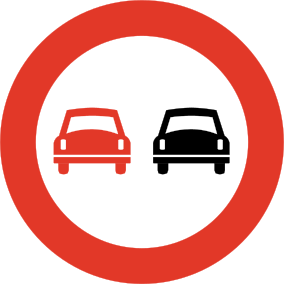
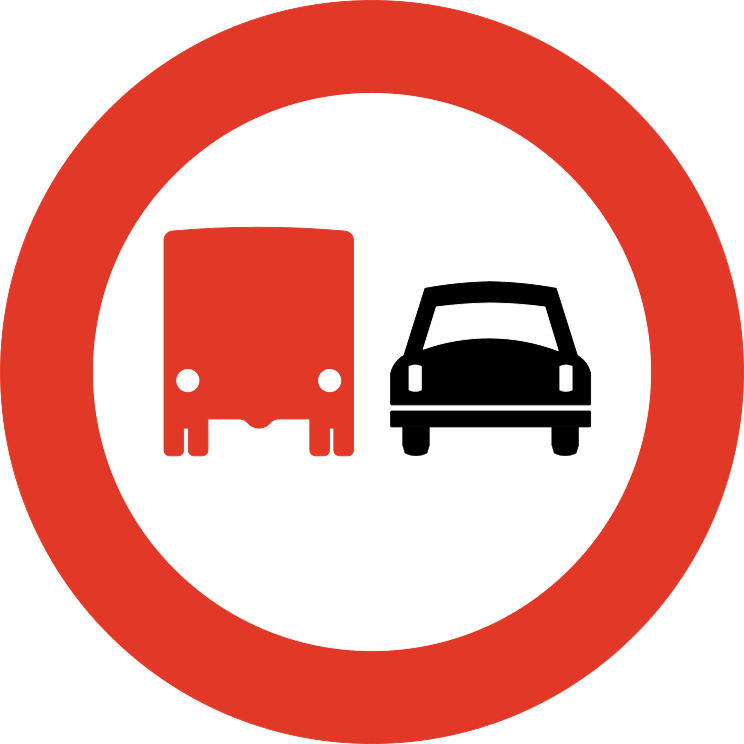
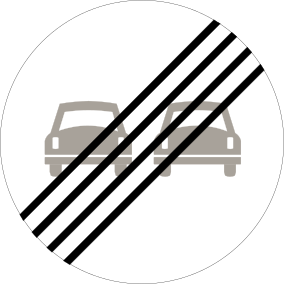
The scope of each sign is detailed in its description; for the entire regulatory class, see the prohibitory signs catalogue.
Practice scenarios
Practice scenarios: “the vehicle in front is signaling left — which side do you pass on?” (on the right — nr. 1 a); “may you overtake a straight-ahead car on its left at an uncontrolled equal-priority junction with one lane in your direction?” (no — the junction prohibition applies and none of the listed exceptions fits that situation); “dense traffic moving slowly across two lanes — is passing on the right allowed?” (yes, that is queuing in traffic — nr. 1 c); “who is at fault if the overtaken vehicle speeds up?” (the regulation prohibits speeding up — nr. 4). Related topics: right of way at junctions and pedestrians and gangfelt. Try practice questions in the simulator: first question free without registration.
Sources
- Trafikkreglene § 12 Forbikjøring (Lovdata)
- Trafikkreglene § 5 — Following distance to the vehicle in front (Lovdata)
- Skiltforskriften — Signs 334, 335, 336 (Lovdata)
Verbatim statutory quotes are sourced from the official Norwegian text on Lovdata; translations and analysis are our own unofficial study guides. Only the Norwegian text has legal effect.