Line Colour: Lane Separators and Road Edges
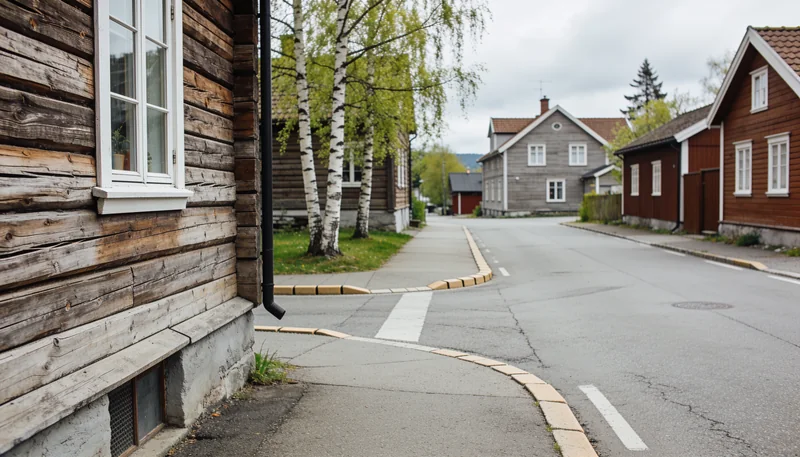
An important distinction for longitudinal lane separators is that a longitudinal yellow line separates opposing traffic streams, while a white line separates lanes moving in the same direction or marks the road edge. White edge lines alone do not establish one-way traffic: a two-way road may have no centreline. Determine permitted directions from signs and road layout.
The statute embeds this distinction directly into the definitions. For example, a warning line (varsellinje) has meanings that depend on its colour:
«Gul varsellinje angir at sikten fremover er for kort til vanlig forbikjøring. Hvit varsellinje angir fare ved å skifte kjørefelt.»
A yellow warning line indicates that the visibility ahead is too short for normal overtaking. A white warning line indicates danger when changing kjørefelt. (unofficial translation)
A yellow warning line indicates that visibility ahead is too short for normal overtaking. A white warning line communicates danger when changing lanes within traffic travelling in the same direction.
Solid vs Broken: What Is Permitted and Prohibited
The second key is line pattern. A standard broken lane line (kjørefeltlinje) may be crossed whenever the manoeuvre is permitted and safe. A solid line (sperrelinje) constitutes a strict prohibition, and for yellow solid lines the statutory phrasing is even more restrictive:
«Det må ikke kjøres på eller over sperrelinje, eller til venstre for gul sperrelinje.»
It is prohibited to drive on or over a solid line, or to the left of a yellow solid line. (unofficial translation)
Notice that for a yellow solid line the law does not merely say "do not cross", but explicitly states that you must not drive to the left of it. This rule prevents using the space to the left of a yellow solid line. For combined lines, read the specific return-to-right exception below.
Combined and Double Lines
When a solid line and a broken line run parallel side by side, the rule of the closest line governs:
«Ved kombinerte linjer skal kjørende rette seg etter den linjen som ligger nærmest. Den som har kjørt over i felt for motgående kjørende, kan likevel kjøre tilbake til høyre vegside.»
With combined lines, drivers must follow the line closest to them. A driver who has crossed into a lane for oncoming traffic may nevertheless drive back to the right-hand side of the road. (unofficial translation)
In practice: the line nearest your vehicle dictates your legal options. A broken line on your side does not remove other restrictions on overtaking. A solid line on your side normally prohibits crossing, but a driver already in the oncoming lane may nevertheless return to the right-hand side of the road. A double yellow warning line is a specialised case under the same rule:
«Dobbel, gul varsellinje angir skille mellom kjørefelt hvor kjøreretningen kan varieres.»
A double yellow warning line indicates the division between kjørefelt where the direction of travel may vary. (unofficial translation)
Double yellow warning lines mark reversible lanes (tidal flow lanes), where the active travel direction is controlled by lane signals overhead.
Road Edges and Barred Areas
The white line along the outer rim of the carriageway is the edge line (kantlinje):
«Linjen angir kjørebanens ytterkant.»
The line indicates the outer edge of the carriageway. (unofficial translation)
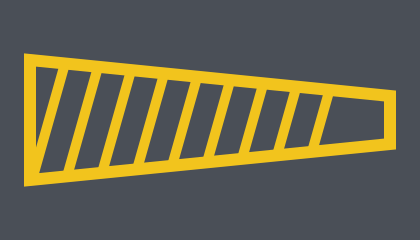
Outside the edge line lies the shoulder (skulder), which by definition is not part of the ordinary carriageway. Chevron-hatched road markings bounded by solid lines are barred areas (sperreområde):
«Det må ikke kjøres på sperreområde begrenset av heltrukken linje.»
It is prohibited to drive on a barred area bounded by a continuous line. (unofficial translation)
Longitudinal Markings — Study Catalogue
Selected longitudinal marking types from skiltforskriften Chapter 11 — with official codes, titles, and explanations:







Transverse markings (stop lines, give-way lines, pedestrian crossings) and pavement symbols can be viewed in our road markings catalogue.
Practice Topics for Theory Study
Road markings belong to the official syllabus area Skilt og oppmerking alongside road signs. Useful practice topics include the meaning of lane separators, combined lines and their return-to-right exception, and warning lines. A yellow warning line indicates visibility too short for normal overtaking; a white warning line indicates danger when changing lane. In winter, when snow obscures road markings, traffic signs and general rules govern. Practise questions in the simulator: first question free without sign-up.
Sources
Verbatim statutory quotes are from the official Norwegian text on Lovdata; translations and commentary are unofficial study aids. Only the Norwegian text is legally binding.