General Limits: 50 in Built-up Areas, 80 Outside
Where no other applicable speed limit is set by an official sign, the general statutory speed limits (generell fartsgrense) apply:
«Dersom ikke annen fartsgrense er fastsatt ved offentlig trafikkskilt, må det i tettbygd strøk ikke kjøres fortere enn 50 km/t, og utenfor tettbygd strøk ikke fortere enn 80 km/t.»
Unless another speed limit is laid down by an official traffic sign, driving faster than 50 km/h is not permitted in a tettbygd strøk, and faster than 80 km/h outside a tettbygd strøk. (unofficial translation)
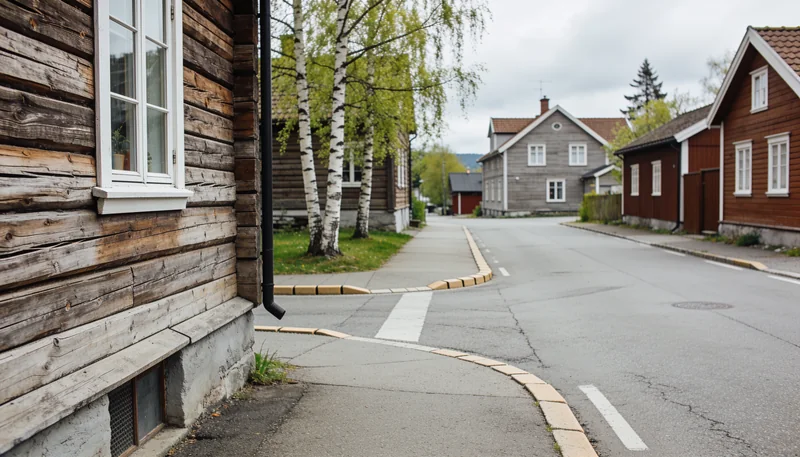
Tettbygd strøk refers to a built-up area or town. Under skiltforskriften § 26 nr. 2, Statens vegvesen may decide whether an area is legally classified as tettbygd strøk and set its boundaries, after the police and municipality have had an opportunity to comment. Where the area contains only municipal roads, the municipality makes that decision after consulting Statens vegvesen and the police. Visible building density alone does not replace that legal classification.
Signs 362–368: Special Limits and Revocation
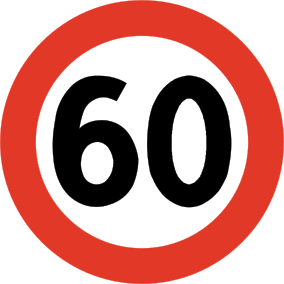
Sign Fartsgrense (362) institutes a special speed limit (særskilt fartsgrense) that supersedes the general limit. Zone signs (366/368) apply across an entire perimeter rather than a single road. The critical insight for exam scenarios is the "End of limit" signs (364/368): they do not mean "drive as fast as you wish", the general statutory limit applies after them unless another applicable posted limit governs the road — 50 km/h in a built-up area or 80 km/h outside:

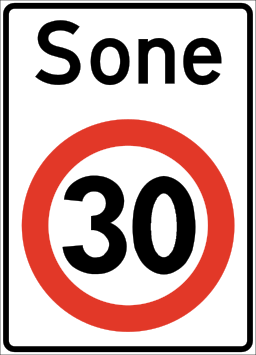
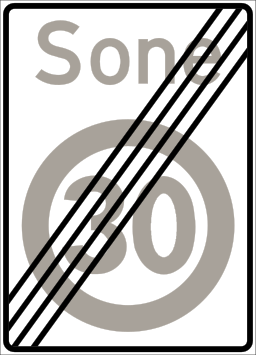
For more on where restrictions start and end, explore the full category in our prohibitory signs guide.
The Overriding Rule: Adjusting Speed to Conditions
A posted speed limit represents an absolute ceiling, not an instruction or target. The first paragraph of § 6 requires drivers to adjust speed to road and visibility conditions — including the requirement to maintain full control of the vehicle:
«Fører av kjøretøy skal avpasse farten etter sted, føre-, sikt- og trafikkforholdene slik at det ikke kan oppstå fare eller voldes ulempe for andre, og slik at annen trafikk blir minst mulig hindret eller forstyrret. Føreren skal alltid ha fullt herredømme over kjøretøyet.»
The driver of a vehicle shall adjust the speed to the place and to the road-surface, visibility and traffic conditions so that no danger can arise and no inconvenience is caused to others, and so that other traffic is hindered or disturbed as little as possible. The driver shall always have full control of the vehicle. (unofficial translation)
Trafikkreglene § 13 reinforces this with the sight-distance rule — you must always be capable of stopping within your visible field of view:
«Kjørende må kunne stanse på den vegstrekning som den kjørende har oversikt over, og foran enhver påregnelig hindring.»
A driver must be able to stop within the stretch of road they can see, and before any foreseeable obstacle. (unofficial translation)
This answers virtually every question of the form "Are you allowed to drive at 80 km/h if...": on ice, in heavy fog, blizzard conditions, or dark unlit roads — no, if the conditions prevent stopping safely within your visible distance. A posted speed limit never justifies hazardous driving.
Special Cases in § 13: Children, Buses, Pedestrian Areas
Section 13 also enumerates situations mandating a "sufficiently low speed" and readiness to stop immediately: children on or near the road, school patrols, people with white canes or guide dogs, and buses or trams stopping at transit stops. For pedestrian priority areas, the limit is defined without numbers:
«På gågate eller gatetun må det ikke kjøres fortere enn i gangfart.»
On a gågate or a gatetun one must not drive faster than walking pace. (unofficial translation)
Gangfart means walking pace, with speed also adapted to pedestrians and the actual conditions. The signs for gatetun (residential yard street) and gågate (pedestrian street) belong to the informational class and activate this strict rule.
Practice scenarios
Three practice scenarios: "What speed limit applies after sign 364?" (the general limit — 50 or 80 km/h depending on location); "What is the maximum speed in a built-up area with no signs?" (50 km/h); and "May you drive at the speed limit during adverse weather?" (only if that speed remains safe for the actual conditions; otherwise reduce it under § 6 and § 13). Speed rules belong to the official syllabus area Fart og plassering — try practice questions in the simulator: first question free without sign-up.
Sources
- Vegtrafikkloven § 6 Fartsregler (Lovdata)
- Trafikkreglene § 13 (Lovdata)
- Skiltforskriften — Signs 362–368 (Lovdata)
Verbatim statutory quotes are from the official Norwegian text on Lovdata; translations and commentary are unofficial study aids. Only the Norwegian text is legally binding.