Balancing and alignment are different
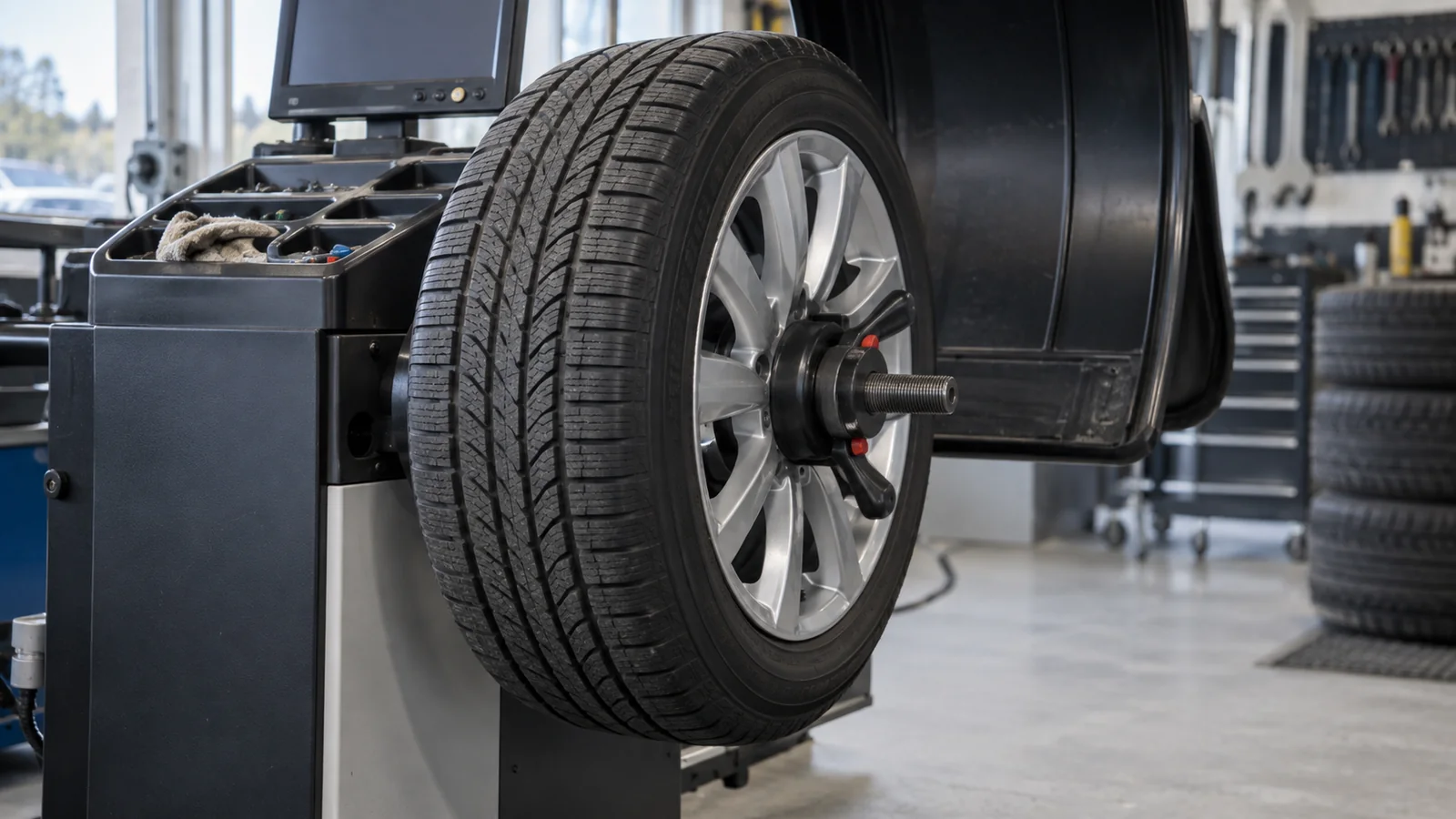
Balancing corrects the mass distribution of the rotating wheel and tyre assembly.
Alignment checks the wheels’ orientation relative to the vehicle and each other. Balance weights do not repair suspension geometry, and adjusting alignment does not cure every vibration. Do not treat either service as a universal solution to steering problems.
A symptom is not a diagnosis
Vibration, an unusual steering-wheel position, pulling and uneven wear warrant inspection.
Possible causes involve tyres, rims, fastenings, pressure, brakes, steering or suspension. Road camber and crosswinds can also affect behaviour. A particular speed, such as 80 km/h, does not prove imbalance or rule out a more serious fault.
Keep control of the steering wheel
Do not let go to test whether the car drifts, and do not accelerate to provoke vibration.
If severe shaking, knocking, sudden pulling or reduced control develops, slow smoothly and stop somewhere safe. Do not continue a normal journey with doubts about wheel attachment or tyre integrity; seek assistance. Never inspect the car while standing in a live traffic lane.
Checks while safely parked
- Look at accessible tyre and rim surfaces for damage, bulges, impact marks and unusual wear.
- Check cold tyre pressures against the manufacturer’s instructions for the load.
- The maximum printed on the sidewall is not the car’s routine pressure setting.
- Never get under a vehicle supported only by a jack.
- A quick visual inspection cannot clear hidden damage.
Help the workshop investigate
- Explain when the symptom began: after a wheel change, pothole, kerb impact or for no obvious reason.
- Describe any connection you already noticed with braking, acceleration or steady travel; do not conduct a special road experiment.
- Ask for the cause and component condition to be checked before adjustment.
- Keep before-and-after alignment readings when that work is performed.
An inspection is not a complete diagnosis
Statens vegvesen warns that EU-kontroll is not a full vehicle condition report.
A recent pass does not cancel a new fault. After repair, ask what was found and corrected, and assess the result during ordinary safe use. If the symptom remains, return for diagnosis instead of repeatedly changing tyres on guesswork.