The scope of this checklist
This covers portable emergency-stop equipment for an ordinary passenger car, not every vehicle requirement.
Brakes, lights, tyres, seat belts, documents and suitable child restraints need separate checks. Special transport and other vehicle types may have additional requirements.
Warning triangle
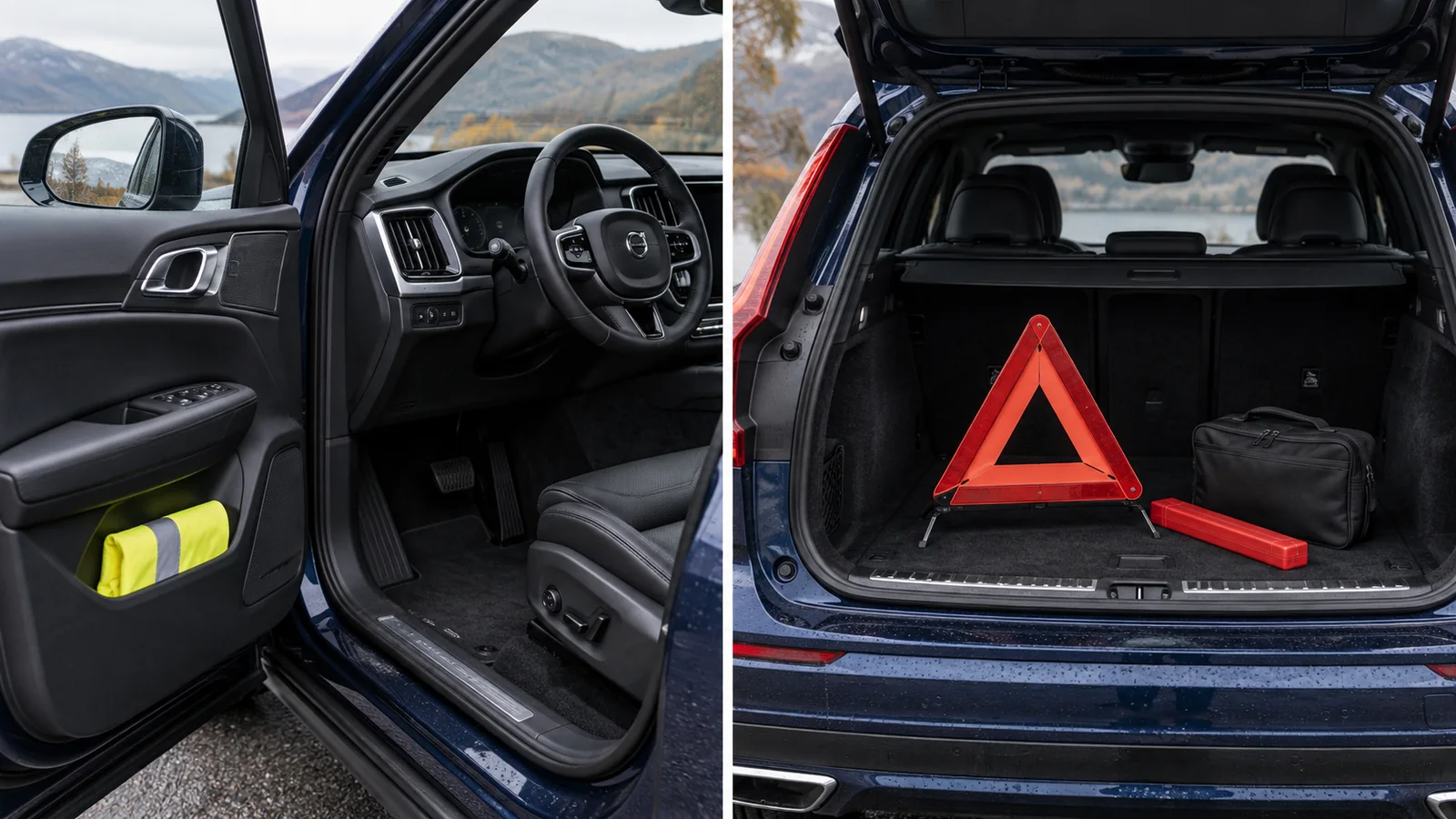
- Carry at least one compliant warning triangle.
- Locate it before travelling and practise assembling it in a safe parking area.
- Do not bury it under luggage or leave it loose in the cabin.
- Check that its supports and reflective elements are intact.
Where to place it
Warn other drivers when the vehicle creates a danger or obstruction and cannot immediately be moved.
Section 1-6 calls for sufficient distance, if possible at least 150 m, so the warning is seen in time. It does not give a universal “50–100 m in town, 150–250 m outside” formula. Consider bends, crests and visibility without putting yourself at risk to measure metres.
Keep the vest within reach
- Carry at least one approved reflective vest that fits the driver and is readily accessible.
- SVV advises keeping it within arm’s reach, such as in the door or glovebox.
- Put it on before getting out at a roadside stop.
- Do not store it over the seat back: this can interfere with a side airbag.
- Extra vests for passengers are sensible preparation.
Useful additions are not new legal duties
A first-aid kit, torch, phone charger, warm clothing and scraper can be useful for the route and season.
This is practical advice, not a claim that every item is compulsory in every car. Choose and secure an extinguisher according to its instructions; carrying one does not mean taking risks in a fire.
Borrowed or hired cars
- Find the triangle and vest before departure and check access and condition.
- Ask how breakdown assistance works and save the contact details.
- Secure additional equipment against movement under braking.
- In an injury collision, safety and calling 113 take precedence over gathering belongings or taking photographs.